NASA Just Found That Proxima Centauri’s Planets Have Magnetic Fields — And It Changes Everything
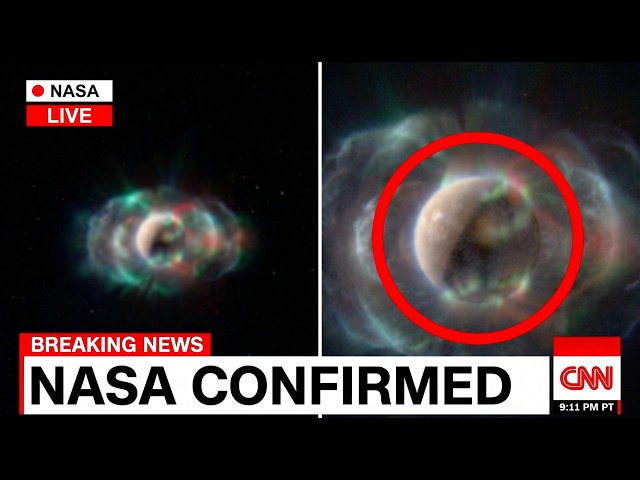
A mysterious glowing planet surrounded by swirling green and purple energy has sparked renewed excitement about one of the most important questions in modern astronomy: Could the planets orbiting our nearest neighboring star possess magnetic fields powerful enough to protect alien life? A dramatic image circulating online shows a distant world surrounded by what appears to be an enormous magnetic shield, accompanied by the announcement “NASA CONFIRMED.” While the image suggests that scientists have made a groundbreaking discovery, the actual science is more complicated. Astronomers are investigating whether planets around Proxima Centauri could maintain protective magnetic fields, but direct confirmation of such fields remains elusive.
Located approximately 4.24 light-years from Earth, Proxima Centauri is the closest known star to our Sun. Despite its relatively short astronomical distance, it remains an extraordinary destination, requiring thousands of years to reach using conventional spacecraft technology.
Proxima Centauri is a red dwarf, considerably smaller and cooler than the Sun. It is also an active star capable of producing powerful flares and bursts of high-energy radiation.
These characteristics make its planetary system particularly fascinating.
The best-known planet, Proxima Centauri b, was discovered in 2016 and has a minimum mass comparable to Earth’s. It orbits its star approximately every 11.2 Earth days.
Because Proxima Centauri emits much less energy than the Sun, this close orbit places Proxima b within the star’s potentially habitable zone.
Under suitable atmospheric conditions, temperatures could theoretically allow liquid water to exist on its surface.
However, being located within a habitable zone does not automatically make a planet habitable.
One of the greatest challenges facing Proxima b is the intense activity of its host star.
Red dwarfs can release powerful stellar flares, sending energetic particles and radiation into surrounding space.
Over millions or billions of years, such activity could affect planetary atmospheres and potentially influence whether surface environments remain suitable for life.
This is where planetary magnetic fields become extremely important.
Earth possesses a global magnetic field generated by the movement of electrically conducting material within its liquid outer core.
This magnetic field creates a vast protective region known as the magnetosphere.
The magnetosphere deflects many charged particles carried by the solar wind, helping shield Earth’s atmosphere and near-Earth environment from some forms of space weather.
Without this protection, interactions between stellar particles and the atmosphere could be significantly different.
Scientists therefore want to determine whether rocky planets around Proxima Centauri possess similar magnetic defenses.
If Proxima b has an active metallic core capable of generating a substantial magnetic field, it might maintain a magnetosphere that influences how its atmosphere interacts with the star’s energetic particles.
However, a magnetic field alone would not guarantee habitability or completely protect a planet from intense radiation.
Its effectiveness would depend on field strength, atmospheric composition, stellar activity, and many other environmental factors.
Researchers have investigated possible magnetic interactions between Proxima Centauri and its planets.
One promising approach involves searching for radio emissions produced when charged particles interact with planetary magnetic environments.
Similar processes occur within our solar system, particularly around magnetized planets such as Jupiter.
Under certain conditions, interactions between a planet and its host star could produce detectable radio signals.
Some observations of Proxima Centauri have revealed radio activity that researchers have examined as possible evidence of star-planet magnetic interactions.
However, interpreting such signals is difficult because red dwarf stars naturally produce radio emissions through their own magnetic activity.
Consequently, scientists have not conclusively measured or confirmed global magnetic fields around Proxima Centauri’s planets.
The possibility remains scientifically interesting, but it should not be presented as an established NASA discovery.
Another important question concerns the planet’s internal structure.
Planetary magnetic fields are generally associated with electrically conducting fluids moving within planetary interiors.
On Earth, this process is known as the geodynamo.
Whether Proxima b possesses a similar mechanism depends on properties astronomers have not yet determined, including its internal composition, thermal evolution, and rotational dynamics.
Because Proxima b orbits extremely close to its star, tidal interactions may also influence its rotation.
The planet could be tidally locked or occupy another rotational state, depending on its orbital history and physical characteristics.
Such conditions could affect atmospheric circulation, surface temperatures, and potentially aspects of its internal evolution.
The supplied thumbnail portrays a planet surrounded by a colorful, luminous halo resembling a magnetic field.
Although visually striking, this should not be interpreted as a direct telescope photograph of Proxima b’s magnetosphere.
Magnetic fields are invisible to ordinary cameras, and astronomers generally infer their presence through physical effects such as charged-particle behavior, radio emission, and interactions with surrounding plasma.
The image is best understood as an artistic visualization rather than verified evidence of a newly discovered magnetic shield.
Scientists are also interested in other planetary candidates associated with Proxima Centauri, including the more distant candidate Proxima c and the small inner planet Proxima d.
These worlds offer opportunities to investigate how planets form and evolve around low-mass stars.
Future observations using advanced telescopes and radio observatories could help researchers place stronger constraints on their atmospheres and magnetic environments.
Such measurements would have implications extending far beyond the Proxima Centauri system.
Red dwarfs are among the most common stars in the Milky Way, meaning enormous numbers of potentially rocky planets may orbit stars with similar characteristics.
Understanding whether these planets can maintain atmospheres and magnetic protection is therefore essential to evaluating the galaxy’s potential for habitability.
Ultimately, the discovery of a confirmed magnetic field around Proxima b would be a major scientific achievement, but that discovery has not yet been established.
What makes the investigation extraordinary is the possibility that a rocky planet around our nearest stellar neighbor could possess some of the protective mechanisms found on Earth.
If future observations confirm a substantial magnetosphere, astronomers would gain an important new clue about the planet’s internal activity and its ability to withstand stellar space weather.
But the larger mystery would remain: could such a world maintain liquid water, a stable atmosphere, and conditions suitable for life?
What do you think? Could Proxima Centauri b possess an Earth-like magnetic shield strong enough to protect its atmosphere, or would the powerful radiation from its red dwarf star make survival extremely difficult? And if scientists eventually discover a magnetic field and an atmosphere around this nearby world, could it become humanity’s most promising destination in the search for extraterrestrial life? Share your thoughts in the comments!