NASA Just Saw Saturn After 50 Years — And Something Is Wrong
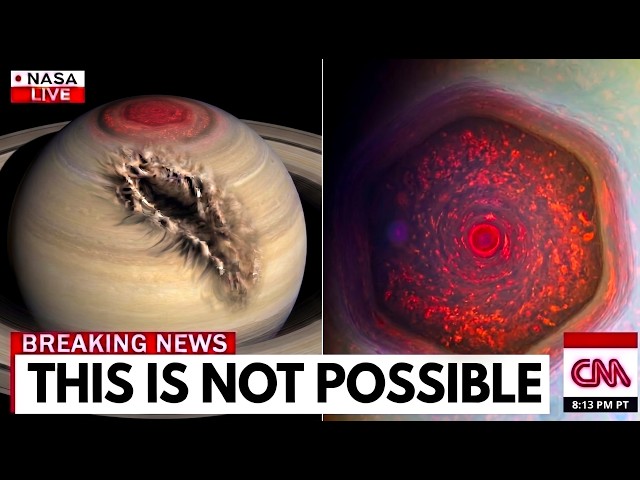
A mysterious formation swirling above Saturn has reignited questions about one of the most extraordinary planets in our solar system. A dramatic image circulating online shows the ringed giant with an enormous dark disturbance stretching across its atmosphere, while a second image reveals a glowing red hexagonal structure surrounding what appears to be a mysterious central opening. Accompanied by the alarming headline “THIS IS NOT POSSIBLE!”, the scene suggests that NASA has discovered something deeply unusual on Saturn. But has something gone wrong with the planet, or are scientists witnessing one of the strangest atmospheric phenomena ever discovered in our solar system?
Saturn has fascinated astronomers for centuries, but one of its greatest mysteries lies not within its spectacular rings, but high above its north pole.
There, an enormous six-sided atmospheric structure known as Saturn’s hexagon has persisted for decades.
The feature was first observed by NASA’s Voyager spacecraft during flybys in the early 1980s. Later, the Cassini spacecraft provided remarkably detailed observations of the structure during its mission around Saturn.
Unlike ordinary storms on Earth, Saturn’s hexagon is a vast atmospheric pattern measuring approximately 30,000 kilometers across.
It is large enough to accommodate multiple Earth-sized planets within its boundaries.
At the center lies a powerful polar cyclone, surrounded by fast-moving atmospheric winds.
Scientists believe the hexagonal shape is associated with a persistent jet stream and complex wave dynamics in Saturn’s atmosphere.
Computer simulations and laboratory experiments have demonstrated that rotating fluids can sometimes produce polygonal patterns under particular conditions.
However, researchers are still investigating precisely why Saturn’s hexagon has remained so stable for such an extraordinary length of time.
One of its most remarkable characteristics is its changing appearance.
Cassini observations revealed that the region surrounding the hexagon changed color over several years, shifting from bluish tones toward a more golden appearance.
Scientists have suggested that seasonal variations in sunlight and atmospheric chemistry may contribute to these changes.
Saturn takes approximately 29.5 Earth years to complete one orbit around the Sun, meaning each season lasts more than seven Earth years.
As sunlight gradually changes across the planet’s polar regions, atmospheric circulation and chemical processes can evolve.
These changes provide scientists with valuable clues about the behavior of Saturn’s enormous atmosphere.
Another fascinating mystery involves the planet’s powerful storms.
Saturn occasionally experiences enormous atmospheric disturbances known as Great White Spots.
These storms can expand across vast regions of the planet, producing dramatic changes in cloud patterns and atmospheric circulation.
In 2010, Cassini observed a particularly powerful storm that eventually stretched around much of Saturn’s northern hemisphere.
Such events demonstrate that Saturn’s atmosphere is far more dynamic than its relatively calm appearance might suggest.
The planet’s interior also presents extraordinary scientific challenges.
Unlike Earth, Saturn has no solid surface that spacecraft could land upon.
Its atmosphere consists primarily of hydrogen and helium, with pressure and temperature increasing dramatically toward deeper layers.
Scientists believe that hydrogen may behave in unusual ways under the immense pressures found inside the planet.
Studying these conditions helps researchers understand the formation and evolution of gas giants throughout the universe.
But what about the disturbing images suggesting that Saturn contains an enormous hole or a glowing red portal?
There is no verified evidence that NASA has discovered a physical opening, artificial structure, or mysterious gateway inside Saturn’s atmosphere.
The hexagon is an atmospheric phenomenon, not a solid geometric object.
Its central region contains a powerful polar vortex rather than an entrance into the planet.
The dramatic red coloration in the thumbnail should also be treated cautiously. Astronomical images often use enhanced or artificial colors to reveal atmospheric structures that are difficult to distinguish in ordinary visible light.
The supplied image appears heavily stylized and should not be interpreted as an authenticated recent NASA photograph.
The headline’s suggestion that NASA has observed Saturn for the first time in 50 years is also misleading.
Saturn has been studied continuously through ground-based telescopes and numerous spacecraft observations.
NASA’s Pioneer 11 spacecraft flew past Saturn in 1979, followed by Voyager 1 in 1980 and Voyager 2 in 1981.
Cassini then spent more than 13 years orbiting the planet, collecting extraordinary information about its atmosphere, rings, and moons before its mission ended in 2017.
More recently, the James Webb Space Telescope and other observatories have continued investigating Saturn and its surrounding environment.
These observations allow scientists to examine seasonal atmospheric changes and compare modern measurements with historical spacecraft data.
Although Saturn’s appearance can change dramatically over time, there is no established evidence that the planet has suddenly developed an impossible new structure.
Instead, its unusual atmospheric behavior offers researchers an opportunity to study fluid dynamics on a scale impossible to reproduce naturally on Earth.
The hexagon remains particularly valuable because it demonstrates how powerful winds and planetary rotation can create remarkably organized patterns within turbulent gases.
Understanding these processes may also help scientists interpret atmospheric structures on distant gas giant exoplanets.
Ultimately, Saturn is not breaking the laws of physics, but its atmosphere continues to reveal phenomena that challenge scientists to refine their explanations.
Its persistent hexagon, enormous storms, and complex seasonal changes make it one of the most scientifically fascinating worlds in our solar system.
And as new observations become available, astronomers may discover additional details about the forces maintaining its extraordinary polar structure.
Perhaps the greatest mystery is not why Saturn appears so strange, but how nature can produce something so geometrically precise within an atmosphere of constantly moving gas.
What do you think? Is Saturn’s enormous hexagon simply an extraordinary atmospheric phenomenon, or could future observations reveal something completely unexpected beneath its swirling clouds? And why do you think this mysterious six-sided structure has survived for decades? Share your thoughts in the comments!