What James Webb Discovered Inside These Red Dots Changes Everything
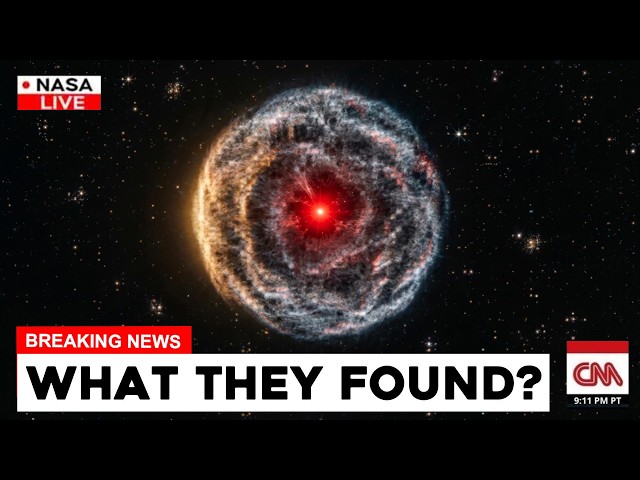
A mysterious population of tiny red objects scattered across the distant universe is challenging astronomers’ understanding of how the earliest galaxies and supermassive black holes formed. Since the James Webb Space Telescope began observing the cosmos, scientists have encountered an unexpected class of objects known as Little Red Dots, compact and unusually bright sources that appear in images of the early universe. A dramatic illustration circulating online shows a gigantic circular structure surrounding a brilliant red center, accompanied by the question “WHAT THEY FOUND?” While the image is not an authenticated photograph of a Little Red Dot, the scientific mystery behind these objects is real—and it could transform our understanding of the universe’s first billion years.
When astronomers initially examined Webb’s deep-field observations, they noticed something surprising. Numerous distant objects appeared as tiny reddish points, often too compact for their internal structures to be resolved clearly. Their colors, brightness, and spectral properties suggested that something unusual was happening inside them.
Some appeared to contain enormous amounts of luminous material despite existing when the universe was remarkably young.
This created a major puzzle.
According to conventional models, galaxies develop as gas accumulates within dark matter halos, gradually forming stars and sometimes feeding central black holes.
But certain Little Red Dots seemed unexpectedly bright for their apparent size and age.
Researchers began investigating whether these objects represented extremely dense galaxies, rapidly growing black holes, or a previously underappreciated phase of cosmic evolution.
One leading explanation involves actively feeding supermassive black holes.
When gas falls toward a black hole, it can form a rapidly rotating accretion disk. Friction and other physical processes heat the material, producing enormous amounts of radiation.
If this activity occurs inside a dense environment containing gas and dust, much of the emitted light can be absorbed and redistributed toward longer wavelengths.
This could help explain why some compact objects appear unusually red in Webb observations.
Spectroscopic measurements have strengthened the case that at least some Little Red Dots contain active black holes.
Researchers have detected broad emission lines in certain objects, suggesting gas moving at extraordinary velocities near massive gravitational sources.
Such signatures can indicate the presence of actively accreting black holes.
However, not every Little Red Dot has been conclusively identified as a black hole-powered system.
Some may contain substantial stellar populations, while others could involve combinations of star formation, dust, and black hole activity.
The mystery becomes even more fascinating when scientists consider the age of these objects.
Many Little Red Dots are observed at high redshifts, meaning their light began traveling toward Earth billions of years ago.
Some existed within the universe’s first billion years.
If they contain already-massive black holes, astronomers must explain how those objects accumulated so much mass so quickly.
Black holes can grow by consuming surrounding material and merging with other black holes, but their growth depends on the availability of gas and the physical conditions of their environments.
One possibility is that some early black holes formed from unusually massive seeds.
Rather than originating exclusively from the remnants of ordinary stars, certain black holes might have emerged through the direct collapse of enormous primordial gas clouds.
These heavier initial seeds could potentially grow into supermassive black holes more rapidly.
Another possibility is that early black holes experienced periods of exceptionally efficient accretion.
Webb’s discoveries are helping scientists test these competing explanations.
The telescope’s Near-Infrared Spectrograph can separate light into its component wavelengths, allowing researchers to examine emission lines associated with hydrogen and other elements.
These measurements provide clues about the movement of gas, the presence of dust, and the physical conditions surrounding compact cosmic sources.
By combining spectroscopy with detailed imaging, astronomers can investigate whether a Little Red Dot is dominated by stars, black hole activity, or both.
The supplied thumbnail, however, presents a more dramatic interpretation.
Its enormous spherical formation and brilliant red center resemble a science-fiction depiction of an energetic cosmic object.
Actual Little Red Dots generally appear as compact sources in astronomical observations, not as detailed circular structures with visible surfaces.
There is no verified evidence that Webb has discovered an artificial object, a cosmic portal, or an impossible structure inside these red dots.
Their significance lies in their unusual astrophysical properties rather than any confirmed supernatural explanation.
Another important question concerns why Little Red Dots appear relatively common in some observations of the early universe but less prominent at later cosmic times.
This pattern could indicate that they represent a temporary stage in the development of galaxies and their central black holes.
Perhaps many early galaxies passed through a compact, dust-obscured phase before evolving into more familiar structures.
If so, Little Red Dots might provide a crucial missing link between the universe’s earliest black hole seeds and the enormous supermassive black holes observed in mature galaxies.
Scientists are also investigating how these objects relate to the growth of their host galaxies.
Black holes can influence surrounding gas through radiation, energetic outflows, and other feedback processes.
These interactions may regulate star formation and shape the evolution of entire galaxies.
Understanding Little Red Dots could therefore reveal how black holes and galaxies grew together during the earliest chapters of cosmic history.
Ultimately, James Webb has not overturned the laws of physics, but it has uncovered a population of mysterious objects that existing models must explain.
The discovery demonstrates why observing the universe with more powerful instruments can reveal unexpected complexity.
What once appeared to be ordinary faint galaxies may contain rapidly growing black holes, extraordinarily dense stellar systems, or combinations of processes scientists are only beginning to understand.
As Webb continues collecting observations, researchers hope to determine how these compact red sources formed, what powers their radiation, and why they were so prominent in the young universe.
The answers could reshape our understanding of the origins of supermassive black holes and the earliest generations of galaxies.
What do you think? Are these mysterious Little Red Dots hiding rapidly growing black holes, ancient galaxies packed with stars, or an entirely unexpected cosmic phenomenon? Could James Webb be revealing a missing chapter in the history of the universe? Share your thoughts in the comments!