NASA Revealed a SHOCKING Question — Are We the First Civilization in the Universe?
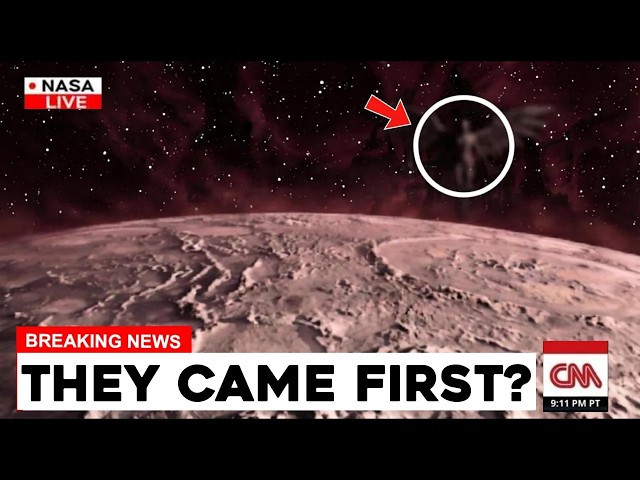
A mysterious image showing a shadowy, humanoid-shaped figure hovering above a barren planetary landscape has reignited one of the most profound questions in modern science: Are human beings the first intelligent civilization in the universe, or did another civilization emerge billions of years before Earth even existed? The dramatic scene, accompanied by the headline “THEY CAME FIRST?”, suggests that NASA may have uncovered evidence of an ancient extraterrestrial presence. Although the image does not provide verified proof of alien life, the question behind it is scientifically fascinating. With an estimated 13.8 billion years of cosmic history and countless planets scattered across the universe, astronomers are increasingly interested in understanding whether humanity arrived early, late, or somewhere in the middle of the universe’s potential history of intelligent life.
The universe is approximately 13.8 billion years old, while Earth formed about 4.54 billion years ago. This means billions of years passed before our planet even existed. During that enormous interval, earlier generations of stars formed, evolved, and produced the heavier chemical elements necessary for rocky planets and complex chemistry.
Some planetary systems are significantly older than our solar system. This raises an extraordinary possibility: if suitable environments developed around ancient stars, life could theoretically have emerged long before the first organisms appeared on Earth.
And if intelligent life evolved elsewhere, some civilizations might have had millions or even billions of years to develop technology.
However, scientists have not confirmed the existence of any extraterrestrial civilization, ancient or modern.
This uncertainty lies at the heart of the famous Fermi paradox.
If the universe contains so many stars and potentially habitable planets, why have we not discovered convincing evidence of advanced extraterrestrial intelligence?
Several explanations have been proposed.
Perhaps intelligent life is extraordinarily rare. Maybe simple organisms are relatively common, but the transition to technological civilization requires an unlikely sequence of evolutionary events.
Another possibility is that civilizations emerge frequently but rarely survive long enough to spread beyond their home planets.
Some researchers have also suggested that technological societies might communicate in ways humanity does not yet recognize.
NASA’s astronomical missions are helping scientists investigate parts of this mystery.
The James Webb Space Telescope can examine the atmospheres of selected exoplanets, searching for chemical signatures that reveal their environmental conditions.
Meanwhile, NASA’s Kepler and TESS missions have helped establish that planets are widespread throughout the galaxy.
These discoveries have fundamentally changed humanity’s understanding of planetary systems.
Only a few decades ago, astronomers had confirmed very few planets beyond our solar system. Today, thousands of exoplanets have been identified, including rocky worlds and planets orbiting within their stars’ potentially habitable zones.
But a planet’s location within a habitable zone does not guarantee the presence of liquid water, biological activity, or intelligent life.
Scientists must also consider atmospheric composition, stellar radiation, geological activity, and long-term environmental stability.
The search becomes even more complicated when investigating civilizations that might have disappeared millions of years ago.
Could an advanced society leave behind detectable traces long after its extinction?
Researchers studying hypothetical technosignatures have considered possibilities such as artificial radio emissions, unusual atmospheric pollutants, large-scale energy use, or structures that alter the light from distant stars.
These ideas provide potential directions for scientific investigation, but none has produced confirmed evidence of extraterrestrial technology.
The mysterious figure highlighted in the viral image also raises questions about how extraordinary claims spread online.
The scene appears to depict a humanlike silhouette above a cratered or rocky world, surrounded by a reddish cosmic background.
However, there is no authenticated NASA observation associated with this image demonstrating that an alien being was photographed above another planet.
Its cinematic composition suggests an illustration or digitally manipulated scene rather than verified spacecraft imagery.
Still, the underlying question remains compelling.
If humanity is not the first civilization, the universe could have hosted technological societies before the Sun formed.
Some might have disappeared because of environmental changes, catastrophic events, or other processes we cannot yet predict.
Others, if they exist, might inhabit regions so distant that communication would require thousands or millions of years.
The enormous scale of the universe creates a fundamental challenge: even advanced civilizations could remain completely unaware of one another.
Light itself requires more than four years to travel from the nearest star system to Earth.
Across the Milky Way, communication delays could stretch across tens of thousands of years.
And beyond our galaxy, the distances become almost unimaginable.
These limitations mean that the absence of confirmed contact does not establish that humanity is alone.
At the same time, the possibility of ancient civilizations must not be mistaken for evidence that they actually existed.
For now, Earth remains the only world where life has been conclusively identified.
Scientists continue searching for microbial life within our solar system, potentially habitable environments on distant planets, and technological signals that might indicate intelligent activity.
Each discovery brings researchers closer to understanding whether life is a rare accident or a widespread cosmic phenomenon.
Ultimately, the most extraordinary possibility may not be that aliens visited Earth in the distant past, but that the universe could have contained entire histories of life long before humanity appeared.
If scientists eventually discover evidence of an ancient extraterrestrial civilization, it would transform our understanding of biology, technology, and humanity’s place in cosmic history.
Until then, the question remains unanswered.
Are we the universe’s first technological civilization, or are we simply the latest chapter in a cosmic story that began billions of years ago? If another civilization existed before humanity, what evidence might it have left behind? Share your thoughts in the comments!


