James Webb REVEALED What Lies at the Edge of the Universe
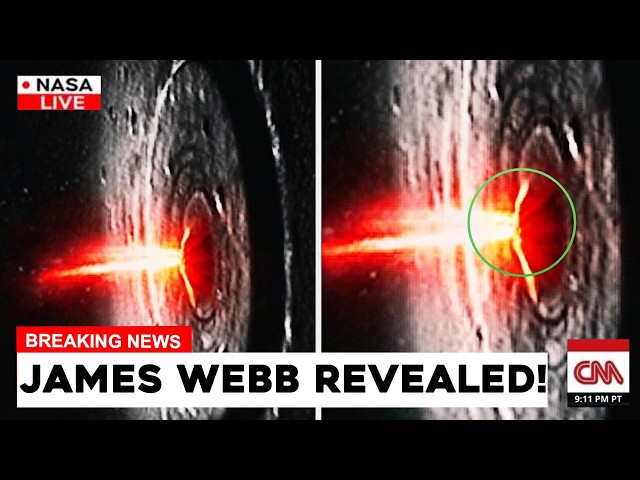
A mysterious glowing structure at the apparent boundary of the cosmos has reignited one of astronomy’s most extraordinary questions: what actually exists at the edge of the universe? A dramatic image circulating online shows a brilliant red beam striking a dark, circular formation surrounded by strange vertical patterns. The scene appears to suggest that NASA’s James Webb Space Telescope has discovered an enormous cosmic barrier, perhaps even a gateway leading beyond the known universe. Accompanied by the sensational announcement “JAMES WEBB REVEALED!”, the image raises an astonishing possibility. Has humanity finally seen the boundary of existence itself, or is Webb revealing something even more remarkable about the universe’s earliest moments?
Since beginning scientific operations in 2022, the James Webb Space Telescope has transformed astronomers’ ability to investigate the distant universe. Its powerful infrared instruments allow scientists to observe galaxies whose light began traveling toward Earth billions of years ago, providing an extraordinary glimpse into cosmic history.
But the concept of an edge of the universe is far more complicated than it first appears.
According to modern cosmology, the universe began expanding from an extremely hot, dense state approximately 13.8 billion years ago. Since then, space itself has continued expanding, carrying distant galaxies farther apart on enormous cosmic scales.
Because light travels at a finite speed, astronomers cannot observe every region of the universe.
Instead, humanity is surrounded by an observable universe, a region containing objects whose light has had sufficient time to reach us.
The observable universe extends approximately 46 billion light-years in every direction, measured in present-day distance.
This distance is much greater than 13.8 billion light-years because space expanded while the light was traveling.
Beyond this observational horizon, additional galaxies and cosmic structures may exist, but their light has not yet reached Earth.
The observable universe therefore has a horizon, not a confirmed physical wall or boundary.
James Webb is helping scientists investigate the earliest galaxies visible within this enormous cosmic region.
One of its remarkable discoveries is JADES-GS-z14-0, a distant galaxy observed as it existed approximately 290 million years after the Big Bang.
Its brightness and developed stellar population surprised researchers, encouraging new investigations into how rapidly galaxies formed during the universe’s earliest periods.
Webb has also revealed galaxies whose unusual structures and intense star formation challenge some previous expectations about early cosmic evolution.
These observations do not mean that the Big Bang theory has collapsed.
Instead, they suggest that astronomers may need to refine their understanding of how efficiently stars formed and how quickly matter accumulated into galaxies.
Another fascinating aspect of Webb’s observations involves cosmic redshift.
As the universe expands, light traveling through space becomes stretched toward longer wavelengths.
Light originally emitted as ultraviolet or visible radiation can eventually reach Earth in the infrared portion of the electromagnetic spectrum.
Webb was specifically designed to detect this ancient, redshifted light.
By analyzing its spectrum, scientists can estimate the distances of galaxies and investigate their chemical composition, star formation, and physical conditions.
The farther astronomers look, the further back in time they observe.
But even Webb cannot directly photograph the instant of the Big Bang.
During the universe’s earliest stages, matter existed in an extremely hot, dense plasma that prevented light from traveling freely.
Approximately 380,000 years after the Big Bang, the universe cooled enough for neutral atoms to form, allowing radiation to propagate across space.
That ancient radiation survives today as the cosmic microwave background.
Specialized observatories, including the Planck satellite, have studied this radiation to reconstruct conditions in the early universe.
Webb, by contrast, investigates objects that formed later, including some of the earliest generations of galaxies.
The mysterious image accompanying the headline presents a very different interpretation.
Its brilliant red beam and dark circular formation resemble a science-fiction depiction of a cosmic portal or a massive object emitting powerful radiation.
However, there is no verified evidence that Webb has photographed a physical edge of the universe, an enormous cosmic gateway, or a barrier separating our universe from another reality.
The supplied image appears illustrative or digitally manipulated rather than an authenticated astronomical observation.
Actual Webb observations often combine infrared measurements into scientifically processed color images, allowing astronomers to visualize structures invisible to human eyes.
Such images can reveal extraordinary phenomena, but they must be interpreted using observational data rather than dramatic appearances alone.
The possibility of regions beyond the observable universe remains an important subject in theoretical cosmology.
Some models suggest that the universe could extend enormously beyond the region we can observe, potentially without any spatial boundary.
Others explore whether space might possess a finite but unbounded geometry, somewhat analogous to how the surface of a sphere has a finite area without an edge.
Scientists are also investigating cosmic inflation, a proposed period of extremely rapid expansion during the universe’s earliest moments.
Inflation could help explain why the observable universe appears remarkably uniform on large scales.
Yet many questions remain unresolved, including the precise nature of inflation and the universe’s overall global geometry.
Ultimately, James Webb has not revealed a literal edge of existence.
What it has revealed is something scientifically profound: galaxies were already forming and evolving during an extraordinarily early chapter of cosmic history.
Each distant observation brings astronomers closer to understanding how the first stars illuminated the darkness and how the structures surrounding us today began to emerge.
And perhaps the greatest mystery is that the farther we look into the universe, the more clearly we recognize how much remains beyond our observational reach.
If future telescopes uncover galaxies from even earlier periods, scientists may discover new clues about the transition from the cosmic dark ages to the first generation of stars.
But whether the universe possesses a true physical boundary remains an open question.
What do you think? If humanity could somehow travel beyond the observable universe, would we discover endless galaxies, a completely different cosmic environment, or something our current understanding of physics cannot describe? Could the greatest secrets of existence be hidden forever beyond the cosmic horizon? Share your thoughts in the comments!