Interstellar Object 3I/ATLAS Enters the Solar System, Inspiring New Debate Over Cosmic Mysteries
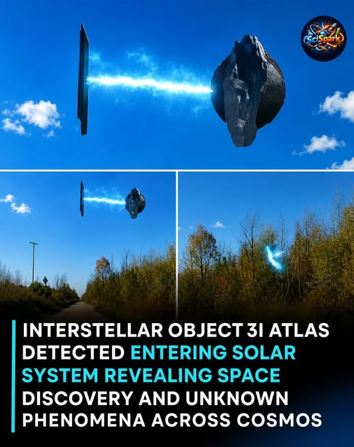
July 2026 — A dramatic image circulating online has reignited public fascination with one of astronomy’s newest discoveries: 3I/ATLAS, an interstellar object traveling through our Solar System. While the viral artwork depicts what appears to be a mysterious object emitting a bright beam of energy toward a dark rectangular structure, scientists emphasize that the illustration is an artistic interpretation rather than an actual photograph of the celestial visitor. Nevertheless, the discovery of 3I/ATLAS has sparked worldwide discussions about the nature of interstellar visitors and whether objects arriving from beyond our Solar System could reveal new insights into the universe.

Astronomers first identified 3I/ATLAS using advanced sky survey telescopes designed to detect potentially hazardous asteroids and comets. Initial orbital calculations indicate that the object follows a hyperbolic trajectory, meaning it is not gravitationally bound to the Sun and originated from outside the Solar System. This makes 3I/ATLAS only the third confirmed interstellar object ever observed passing through our cosmic neighborhood, following the discoveries of ‘Oumuamua in 2017 and Comet Borisov in 2019.
Unlike ordinary asteroids that orbit the Sun, interstellar objects are thought to have been ejected from distant planetary systems during the formation of stars and planets billions of years ago. After traveling through interstellar space for millions—or even billions—of years, a tiny fraction eventually passes through the Solar System, offering scientists a rare opportunity to study material that formed around another star.
The viral image accompanying the discovery has generated significant online speculation. Some social media users have suggested that 3I/ATLAS could be more than a natural celestial body, proposing theories that it might represent an artificial spacecraft or advanced extraterrestrial technology. These claims largely echo discussions that surrounded ‘Oumuamua, whose unusual elongated shape and unexpected acceleration led to widespread public debate despite subsequent studies favoring natural explanations.
Astronomers, however, urge caution when interpreting extraordinary claims. Current observations of 3I/ATLAS indicate that the object behaves consistently with known natural interstellar bodies. Preliminary analyses suggest that it may be an icy comet or rocky object originating from another stellar system. Researchers continue collecting spectroscopic data to determine its composition, rotation, size, and any evidence of cometary activity as it approaches the inner Solar System.
The illustration’s depiction of energy beams and geometric structures should not be interpreted as observational evidence. Scientists note that telescopes currently detect interstellar objects only as distant points of light, making detailed visual images impossible with existing technology. Instead, astronomers rely on measurements of brightness, orbital motion, reflected sunlight, and spectral signatures to infer the physical characteristics of these ancient cosmic travelers.
Interest in interstellar objects has grown significantly over the past decade because they provide a unique opportunity to study material formed around distant stars without launching missions beyond the Solar System. By analyzing their chemical composition, scientists hope to gain valuable insights into how planetary systems evolve throughout the Milky Way. Every newly discovered interstellar visitor serves as a natural messenger carrying information from another corner of the galaxy.
Several research teams worldwide have already begun coordinating telescope observations to monitor 3I/ATLAS throughout its journey. Large observatories in North America, Europe, South America, and Asia are expected to contribute data, allowing astronomers to refine orbital calculations and better understand the object’s physical properties. Some scientists have even proposed future space missions capable of intercepting interstellar visitors should sufficient warning become available before their arrival.
Despite the excitement surrounding the discovery, researchers emphasize that there is currently no scientific evidence indicating that 3I/ATLAS is an artificial object or related to extraterrestrial intelligence. While the possibility of advanced civilizations elsewhere in the universe remains an active field of scientific inquiry, extraordinary hypotheses require equally extraordinary evidence. At present, all available observations are consistent with a naturally occurring interstellar body.
The discovery nevertheless highlights humanity’s growing ability to detect rare visitors from beyond our Solar System. Advances in automated sky surveys, artificial intelligence, and next-generation telescopes are dramatically increasing astronomers’ chances of identifying additional interstellar objects in the coming years. Each new detection expands our understanding of planetary formation and the diversity of objects traveling through interstellar space.
Whether 3I/ATLAS ultimately proves to be a rocky asteroid, an icy comet, or an entirely new category of interstellar object, its arrival represents a remarkable scientific opportunity rather than evidence of alien technology. As astronomers continue to gather data, the object is expected to provide valuable clues about distant star systems that humanity may never directly visit.
For now, 3I/ATLAS remains one of the most exciting astronomical discoveries of recent years—a genuine visitor from another stellar neighborhood whose journey across the galaxy reminds us just how vast, dynamic, and mysterious the universe truly is.