Big Bang Is Over! James Webb Telescope Detects A First Star That Should Not Exist
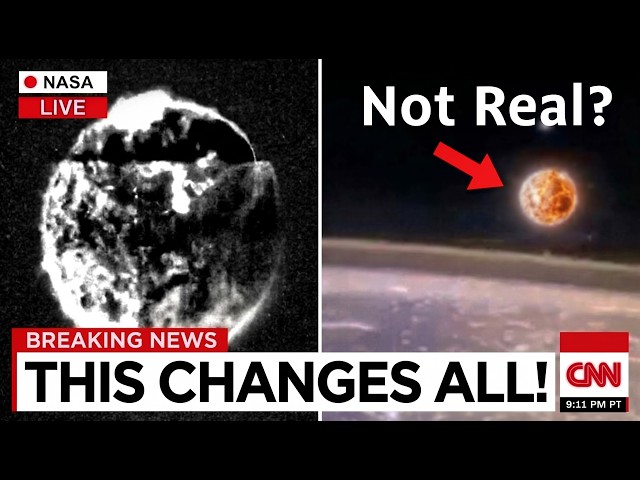
A mysterious glowing object from the earliest chapter of cosmic history is raising extraordinary questions about how the universe formed its very first stars. A dramatic image circulating online shows a strange, fragmented celestial body alongside a brilliant orange object suspended above a distant planetary horizon. Accompanied by the alarming message “THIS CHANGES ALL!”, the image suggests that NASA’s James Webb Space Telescope may have discovered a star so ancient that its existence challenges the Big Bang theory itself. But has Webb really detected a star that should not exist, or are astronomers uncovering surprising evidence about how quickly the first generation of stars appeared after the universe began?
According to the prevailing cosmological model, the universe began expanding from an extremely hot, dense state approximately 13.8 billion years ago. During its earliest stages, temperatures were far too high for ordinary stars and galaxies to exist.
As the universe expanded and cooled, protons and electrons eventually combined to form neutral atoms, primarily hydrogen and helium. This transition occurred approximately 380,000 years after the Big Bang, allowing light to travel more freely through space.
What followed was an era commonly called the cosmic dark ages.
There were no stars illuminating the universe as we know them today. Instead, enormous clouds of primordial gas gradually responded to gravity, accumulating within concentrations of dark matter.
Eventually, some regions became sufficiently dense for gravitational collapse to produce the first stars.
Astronomers call this hypothetical first stellar generation Population III.
Unlike modern stars, which contain varying amounts of heavier chemical elements, Population III stars would have formed almost entirely from hydrogen and helium, with only trace amounts of primordial lithium.
Many theoretical models suggest that some of these stars could have been exceptionally massive, extremely hot, and relatively short-lived.
Their intense ultraviolet radiation would have transformed the surrounding gas, while their eventual deaths could have enriched the universe with heavier elements produced through nuclear fusion and stellar explosions.
These early stars helped establish the conditions necessary for later generations of stars, planets, and ultimately life.
However, scientists have not yet obtained an unambiguous, universally accepted direct detection of an individual Population III star.
That is precisely why the James Webb Space Telescope is so important.
Webb was designed to observe infrared light from extremely distant objects, including galaxies that existed during the universe’s earliest periods.
Because the expansion of space stretches light toward longer wavelengths, radiation originally emitted in visible or ultraviolet wavelengths can reach Earth as infrared light after traveling across billions of years.
Webb’s instruments allow astronomers to investigate this ancient radiation with extraordinary sensitivity.
One of its remarkable discoveries is JADES-GS-z14-0, a galaxy observed at a redshift of approximately 14.3.
Its light originated when the universe was only about 290 million years old.
The galaxy’s brightness and physical properties have challenged some earlier expectations about how rapidly stars and galaxies developed.
Rather than discovering a universe that evolved slowly and predictably, astronomers are finding evidence that significant star formation occurred remarkably early.
This has encouraged researchers to reconsider how efficiently primordial gas collapsed, how quickly galaxies accumulated matter, and how the first generations of stars influenced their surroundings.
Another fascinating possibility involves gravitational lensing.
When light from a distant object passes through the gravitational field of a massive galaxy cluster, its path can bend and become magnified.
This natural cosmic magnification can sometimes allow astronomers to detect extremely distant stars that would otherwise remain invisible.
Webb has contributed to research on gravitationally lensed stars, including the exceptionally distant star nicknamed Earendel, originally identified in Hubble observations.
Earendel’s light comes from a much later era than the expected formation period of the first Population III stars, but its study demonstrates how gravitational lensing can extend the reach of astronomical observations.
Scientists hope similar techniques may eventually help reveal even earlier stellar populations.
But what would happen if astronomers discovered a star that appeared to exist before the universe should have been capable of forming stars?
Such a finding would require extraordinary scrutiny.
Researchers would first examine the object’s distance, spectrum, chemical composition, and surrounding environment.
They would investigate whether its apparent age resulted from uncertainties in stellar models, gravitational lensing, or incorrect assumptions about its physical properties.
An unexpected observation would not immediately invalidate the Big Bang.
Instead, it could reveal that the first stars formed earlier or through different mechanisms than current models predict.
The sensational thumbnail accompanying the headline presents another important issue.
The glowing orange sphere resembles a nearby star or energetic celestial object, while the dark fragmented structure appears unusually detailed.
However, the supplied image is not authenticated evidence that Webb has photographed a primordial star violating the established timeline of cosmic history.
At the enormous distances involved, even powerful telescopes generally cannot resolve the surfaces of ordinary individual stars in the early universe.
The detailed appearance shown in the thumbnail is therefore more consistent with an artistic illustration or digitally manipulated image than a direct astronomical photograph.
The claim that the “Big Bang is over” also misrepresents how scientific theories are evaluated.
The Big Bang model is supported by several independent observations, including the expansion of the universe, the cosmic microwave background, and the measured abundance of primordial light elements.
Discovering unexpectedly early stars would require scientists to reconsider details of cosmic structure formation, but it would not automatically erase this extensive evidence.
In fact, the search for Population III stars is one of the most exciting ways to test predictions about the early universe.
Their discovery could reveal how the first heavy elements formed, how early galaxies developed, and how the universe transitioned from darkness into an era filled with starlight.
Ultimately, James Webb has not confirmed the discovery of a star that disproves the Big Bang or demonstrates that the universe is older than currently estimated.
What it has revealed is a surprisingly active early cosmos, where galaxies and stars may have developed more rapidly than some previous models anticipated.
And that possibility is scientifically extraordinary.
If Webb eventually identifies convincing evidence of the first generation of stars, astronomers could gain an unprecedented glimpse into the moment when the universe began transforming primordial gas into the luminous structures we observe today.
The greatest revelation may not be that the Big Bang was wrong, but that the universe’s first stars were even more remarkable than scientists imagined.
What do you think? If James Webb discovered a star that appeared far older than current cosmological models allow, would it mean the universe began earlier than scientists believe, or that the first stars formed much faster than expected? Could the earliest generation of stars still be hiding secrets capable of transforming our understanding of cosmic history? Share your thoughts in the comments!