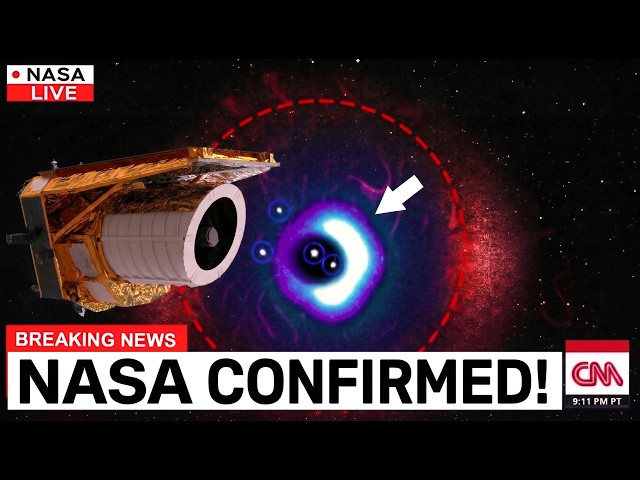
James Webb Is Over! Euclid Just Found A Galaxy Made Entirely Of Dark Matter
A mysterious cosmic structure has sparked extraordinary speculation about one of the greatest unsolved mysteries in modern astronomy: dark matter. A dramatic image circulating online shows the European Space Agency’s Euclid space telescope observing a strange, glowing formation surrounded by deep purple and blue radiation. At its center, several dark circular regions appear embedded within a brilliant ring of light, creating the impression of an object unlike any ordinary galaxy. Accompanied by the sensational announcement “NASA CONFIRMED!”, the image raises an astonishing question: Has Euclid discovered a galaxy made entirely of invisible dark matter, potentially challenging everything scientists believe about the universe?
The Euclid space telescope, launched by the European Space Agency in July 2023, was designed to investigate two of the most mysterious components of the cosmos: dark matter and dark energy. Together, these components are estimated to account for approximately 95 percent of the universe’s total mass-energy content.
Unlike ordinary matter, which forms stars, planets, gas clouds, and living organisms, dark matter does not appear to emit, absorb, or reflect light in any measurable way. Its existence is inferred primarily through gravitational effects on visible matter and light.
Astronomers have observed that galaxies rotate in ways that cannot be fully explained by the gravitational influence of their visible stars and gas alone. Galaxy clusters also contain more gravitational mass than their luminous material can account for.
These observations provide compelling evidence that an additional, largely invisible component of matter exists throughout the universe.
Euclid aims to investigate this mystery by observing billions of galaxies across a vast region of the sky.
Its instruments measure galaxy shapes, distances, and the subtle distortions caused by gravitational lensing.
This phenomenon occurs when the gravity of massive objects bends light traveling from more distant sources.
By examining these distortions, scientists can reconstruct the distribution of matter, including dark matter that cannot be observed directly.
One of Euclid’s most fascinating discoveries involves a spectacular Einstein ring surrounding the galaxy NGC 6505.
An Einstein ring forms when light from a distant galaxy is gravitationally bent around a massive foreground object, producing a nearly circular pattern.
The phenomenon provides valuable information about the gravitational mass of the foreground galaxy, including its invisible dark matter.
Such observations demonstrate how astronomers can investigate hidden cosmic structures without seeing dark matter itself.
But what about the possibility of a galaxy composed almost entirely of dark matter?
This idea is not entirely new.
Astronomers have identified unusual galaxies containing relatively few visible stars compared with the amount of mass inferred from their gravitational behavior.
These objects are sometimes described as dark-matter-dominated galaxies.
One notable example is Dragonfly 44, an ultra-diffuse galaxy that attracted considerable attention because early observations suggested an exceptionally large dark matter content.
Subsequent research revised some of those estimates, illustrating how difficult it can be to determine the mass and composition of faint galaxies.
Another intriguing example is the galaxy NGC 1052-DF2, which became famous for an apparently opposite reason: observations suggested it might contain surprisingly little dark matter.
Both cases demonstrate that galaxies can possess unexpectedly different relationships between their visible stars and invisible gravitational mass.
However, a galaxy containing mostly dark matter is not the same as a galaxy made entirely of dark matter.
Ordinary galaxies are generally identified through the light emitted by their stars or gas.
A hypothetical galaxy containing no luminous material would be extremely difficult to detect directly.
Scientists would instead need to search for its gravitational influence on nearby objects or background light.
If Euclid discovered a massive concentration of dark matter with no detectable stars, astronomers would investigate whether it represented a dark matter halo, a faint galaxy, or another gravitational structure.
Such a discovery could provide important evidence about how dark matter behaves and how galaxies form.
Current cosmological models predict that dark matter accumulates into enormous halos, providing gravitational environments in which ordinary matter can collect and eventually form stars.
But not every dark matter halo necessarily produces a bright galaxy.
Some smaller halos may contain very little luminous material, making them challenging to detect.
Euclid’s enormous survey could help astronomers investigate these hidden populations and test predictions about the universe’s underlying structure.
The dramatic image accompanying the headline, however, requires careful interpretation.
The glowing blue ring and dark circular features do not establish that Euclid has photographed a galaxy composed entirely of dark matter.
Because dark matter is invisible to conventional telescopes, it cannot be directly photographed as a glowing purple or blue structure.
Astronomical visualizations often use artificial colors to represent gravitational effects, radiation measurements, or theoretical models.
The thumbnail therefore appears illustrative rather than authenticated evidence of the claimed discovery.
The suggestion that “James Webb is over” is also misleading.
Although Euclid and the James Webb Space Telescope both investigate the distant universe, their scientific missions are different.
Webb specializes in highly detailed infrared observations of selected astronomical targets, including early galaxies, stellar nurseries, and exoplanet atmospheres.
Euclid, by contrast, is designed to survey enormous areas of the sky and study the large-scale distribution of galaxies and dark matter.
Rather than replacing Webb, Euclid complements it.
Together, their observations can help astronomers understand both individual cosmic structures and the enormous gravitational network connecting them.
Ultimately, there is no established confirmation from the supplied image that Euclid has discovered a galaxy consisting entirely of dark matter.
What Euclid is genuinely revealing is an increasingly detailed picture of the invisible gravitational framework shaping the universe.
Its observations could help scientists determine how dark matter is distributed, how galaxies evolve, and whether current cosmological models accurately describe the cosmos.
And if astronomers eventually identify a truly starless, dark-matter-dominated galactic structure, it could become one of the most important discoveries in the history of astrophysics.
The greatest mystery may not be what Euclid can see, but what its measurements reveal about the enormous invisible universe surrounding us.
What do you think? Could galaxies exist almost entirely without stars, hidden from ordinary telescopes by their invisible dark matter? And if Euclid discovers a massive gravitational structure with no detectable light, would it confirm our current understanding of dark matter or reveal something completely unexpected? Share your thoughts in the comments!