Scientists Urge Caution After Claims of “Alien Contact Protocol” Following Alleged UFO File Release
A wave of online speculation has erupted after viral social media posts claimed that leading scientists had issued an official “Alien Contact Protocol” instructing governments and the public not to respond to potential extraterrestrial signals following the alleged declassification of top-secret UFO documents. While the dramatic claims have spread rapidly across video platforms and discussion forums, experts emphasize that no government has confirmed the existence of such extraordinary evidence.

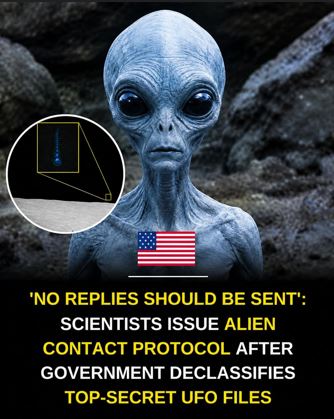
The viral image, which has been shared millions of times across social media, features a classic “Grey alien” alongside the bold headline: “No Replies Should Be Sent: Scientists Issue Alien Contact Protocol After Government Declassifies Top-Secret UFO Files.” The post has reignited worldwide fascination with unidentified aerial phenomena (UAPs), extraterrestrial intelligence, and humanity’s preparedness for a possible first contact.
According to the narrative circulating online, recently released government records allegedly describe unidentified craft exhibiting flight characteristics beyond known aerospace technology. Supporters of the claim argue that these documents represent the strongest indication yet that Earth may not be alone in the universe. They further suggest that an international panel of researchers quietly developed emergency communication guidelines to prepare for the possibility of receiving a confirmed extraterrestrial transmission.
However, independent analysts note that the widely shared posts do not cite official government documents or peer-reviewed scientific reports supporting these specific assertions.
The idea of an “Alien Contact Protocol” is not entirely fictional. For decades, scientists involved in the Search for Extraterrestrial Intelligence (SETI) have discussed hypothetical procedures that could be followed if a genuine signal from another civilization were detected. These proposals generally recommend careful verification of any discovery, international scientific cooperation, and transparent communication with the global community before any response is considered.
One of the most debated questions among astronomers has always been whether humanity should actively answer an extraterrestrial message.
Some researchers argue that responding could represent humanity’s greatest scientific achievement and open the door to unprecedented knowledge. Others warn that broadcasting Earth’s location to an unknown civilization could involve unpredictable risks. This debate has existed within the scientific community for decades and remains unresolved.
The viral posts appear to blend these genuine scientific discussions with unverified claims regarding newly released classified material.
Interest in UFOs has grown significantly in recent years following multiple congressional hearings, military pilot testimonies, and the establishment of government offices dedicated to investigating unidentified aerial phenomena. Although officials have acknowledged that some incidents remain unexplained, no government agency has publicly concluded that these objects represent extraterrestrial spacecraft.
Despite this, public fascination continues to grow.
Online communities point to numerous military videos showing unusual objects performing unexpected maneuvers, arguing that conventional explanations fail to account for every recorded event. Skeptics, meanwhile, emphasize that unexplained observations should not automatically be interpreted as evidence of alien visitors.
The latest viral image has fueled renewed discussions about what humanity would actually do if an intelligent extraterrestrial civilization attempted contact.
Experts in astronomy, linguistics, artificial intelligence, cybersecurity, and international law have all contributed ideas regarding how such an event might be managed. Proposed frameworks typically involve multiple stages of verification, independent scientific review, and global consultation before any response is transmitted.
Many scientists stress that even detecting an authentic extraterrestrial signal would require extraordinary levels of evidence. Natural cosmic phenomena, satellite interference, equipment malfunctions, and human-made radio transmissions would all need to be ruled out before announcing such a discovery.
Meanwhile, social media has become increasingly influential in shaping public perceptions of UFO-related stories. Images, AI-generated artwork, edited videos, and speculative headlines often spread much faster than verified information, making it difficult for audiences to distinguish between confirmed developments and fictional scenarios created for entertainment.
Several researchers have encouraged the public to approach sensational UFO claims with healthy skepticism while remaining open to future scientific discoveries.
“The universe is unimaginably vast,” one astronomer commented during a recent public lecture. “The possibility that intelligent life exists elsewhere cannot be dismissed. But extraordinary claims require extraordinary evidence.”
The search for extraterrestrial intelligence remains one of science’s most ambitious endeavors. Powerful radio telescopes continue scanning distant star systems for unusual signals, while next-generation space telescopes search exoplanets for atmospheric signatures that could indicate biological activity.
Although no confirmed evidence of intelligent extraterrestrial life has yet been announced, advances in astronomy continue expanding humanity’s understanding of the cosmos at an unprecedented pace.
As for the alleged “Alien Contact Protocol” referenced in the viral image, no official announcement has verified the existence of newly issued global instructions prohibiting communication with extraterrestrials. Instead, experts say the image appears to combine genuine discussions about hypothetical first-contact procedures with speculative interpretations of ongoing UFO debates.
Whether future discoveries eventually transform these conversations from speculation into reality remains one of the greatest unanswered questions in modern science. Until then, scientists continue encouraging critical thinking, careful examination of evidence, and international collaboration as humanity explores one of the universe’s most profound mysteries: Are we truly alone?