Cosmology Is Over! James Webb Telescope Detects A Zig-Zag Of Light That Should Not Exist
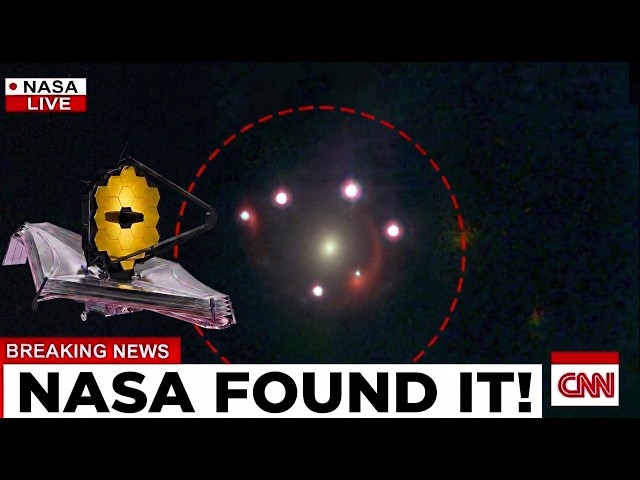
A mysterious pattern of glowing lights in deep space has sparked extraordinary speculation about whether NASA’s James Webb Space Telescope has discovered something that challenges our understanding of the universe. A dramatic image circulating online shows several bright points arranged around a faint central glow, creating what appears to be an unusual zig-zag formation. The accompanying headline claims that cosmology itself could be in trouble. But has James Webb really discovered light behaving in a way that violates the laws of physics, or are astronomers witnessing an extraordinary phenomenon that Einstein predicted more than a century ago? The answer may involve one of the universe’s most fascinating optical effects: gravitational lensing.
According to Einstein’s theory of general relativity, massive objects distort the fabric of spacetime. When light from a distant galaxy passes near an enormous concentration of matter, such as a galaxy cluster, its path can bend. This phenomenon, known as gravitational lensing, can produce multiple images of the same distant object, sometimes arranged in arcs, rings, or seemingly impossible patterns.
To someone unfamiliar with the phenomenon, these formations can appear artificial or even suggest that light is traveling in contradictory directions. In reality, the light is following different paths through curved spacetime before reaching our telescopes.
The James Webb Space Telescope has provided astronomers with an unprecedented opportunity to investigate these cosmic distortions. Its powerful infrared instruments can detect extremely faint galaxies whose light has traveled for billions of years. When gravitational lensing magnifies these distant objects, Webb can observe details that would otherwise remain beyond its reach.
One particularly remarkable example is the gravitationally lensed supernova nicknamed SN H0pe. Discovered in Webb observations of the galaxy cluster PLCK G165.7+67.0, the explosion appeared in three separate images because its light followed different routes through the gravitational field of the intervening cluster.
Although the images originated from the same cosmic explosion, they did not necessarily arrive at Earth simultaneously. Each light path traveled a different effective distance through curved spacetime, creating measurable time delays.
Scientists can use these delays to investigate the expansion rate of the universe, making gravitationally lensed supernovae valuable tools for cosmological research.
Another extraordinary example is the Einstein Cross, a configuration in which gravitational lensing produces multiple images of a background object around a foreground mass.
Such arrangements can resemble mysterious formations of lights surrounding a central point. Depending on the distribution of matter, gravitational lenses may produce four images, five images, or even more complicated configurations.
However, the unusual arrangement of bright objects in the supplied thumbnail cannot be identified as a specific Webb discovery without its original observation data. The image may be an edited illustration, a processed astronomical photograph, or a composite created for dramatic effect.
The existence of a zig-zag pattern alone does not establish that light has violated any known physical law.
Nevertheless, genuine Webb observations are raising important questions about cosmology.
The telescope has discovered unexpectedly bright galaxies from the universe’s earliest periods, including objects that existed only a few hundred million years after the Big Bang. Some appear to have formed stars more efficiently than researchers initially predicted.
These discoveries have encouraged scientists to reconsider assumptions about early galaxy formation, the growth of supermassive black holes, and the conditions that shaped the young universe.
Other research has focused on the Hubble tension, a persistent disagreement between certain measurements of the universe’s present expansion rate and values inferred from observations of the early cosmos.
Webb’s observations of Cepheid variable stars have provided additional tests of the cosmic distance ladder, helping astronomers investigate whether measurement errors could explain the discrepancy.
The debate remains unresolved, and scientists continue examining possible explanations.
Could the answer involve unknown properties of dark energy? Could the behavior of gravity require modification on enormous cosmic scales? Or might improved observations eventually reveal a more conventional explanation?
These possibilities remain subjects of active scientific investigation rather than confirmed discoveries.
The dramatic claim that “cosmology is over” therefore goes far beyond what the evidence supports. Modern cosmology is not a single theory that collapses whenever an unexpected object appears. It is a scientific framework continually tested against observations, with models refined when new evidence reveals limitations.
In fact, unusual gravitational lenses often strengthen confidence in general relativity because their patterns can be predicted using the distribution of matter between the source and observer.
The truly mysterious component is sometimes the invisible matter responsible for much of the gravitational distortion.
Dark matter does not emit or absorb light in the way ordinary matter does, but its gravitational influence can affect how distant galaxies appear. By studying distorted images, astronomers can map the distribution of mass in galaxy clusters, including material that telescopes cannot directly see.
Ultimately, James Webb has not confirmed that light is breaking the laws of physics or that cosmology has been overturned. But its observations are revealing a universe filled with optical phenomena, ancient galaxies, and gravitational structures that are more intricate than scientists once imagined.
The greatest discovery may not be that Einstein was wrong, but that his predictions allow astronomers to investigate regions of the universe that would otherwise remain invisible.
And as Webb continues exploring the cosmos, the strange patterns it reveals may provide essential clues about dark matter, cosmic expansion, and the earliest galaxies.
What do you think? If James Webb discovered a pattern of light that existing theories genuinely could not explain, would it point toward a new law of physics, an unknown form of matter, or a hidden structure in spacetime? Could the universe still be concealing something far stranger than scientists currently imagine? Share your thoughts in the comments!