What Artemis II Astronauts Will Actually Experience Going to The Moon
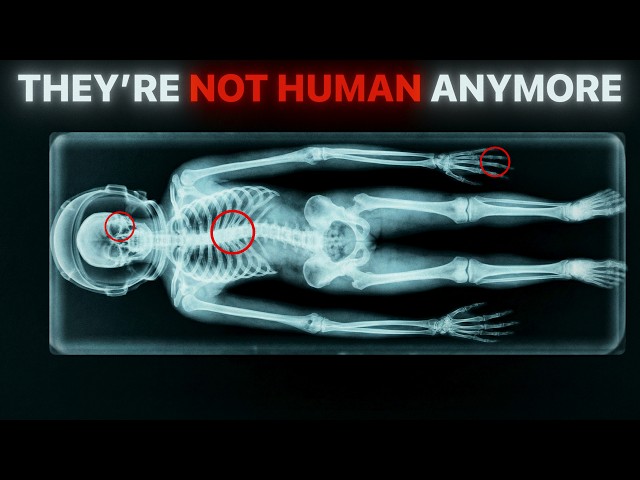
Imagine leaving Earth behind and watching the planet grow smaller as your spacecraft travels toward the Moon. For the four astronauts assigned to NASA’s Artemis II mission, this extraordinary journey will be much more than a historic adventure. It will expose their bodies and minds to conditions that humans were never naturally designed to endure. From invisible radiation penetrating deep space to the strange biological effects of weightlessness, every stage of the mission presents challenges that scientists have spent decades trying to understand. A disturbing image circulating online shows a human skeleton with mysterious markings around its skull, chest, and wrist, accompanied by the alarming statement “THEY’RE NOT HUMAN ANYMORE.” But could traveling to the Moon actually transform the human body in frightening ways? The scientific reality is fascinating, although there is no evidence that astronauts undergo alien-like transformations or lose their humanity during spaceflight.
Artemis II is designed to send four astronauts—Reid Wiseman, Victor Glover, Christina Koch, and Canadian Space Agency astronaut Jeremy Hansen—around the Moon aboard NASA’s Orion spacecraft. The journey will take them far beyond the region where astronauts aboard the International Space Station normally operate. Although the mission is expected to last approximately ten days, the crew will encounter several environmental conditions that make deep-space exploration particularly demanding.
Perhaps the most serious invisible threat comes from cosmic radiation. Earth’s magnetic field provides substantial protection against many charged particles traveling through space. As Orion journeys toward the Moon, the astronauts will move beyond much of this natural shielding, entering an environment influenced by galactic cosmic rays and energetic particles originating from the Sun.
These particles can pass through spacecraft materials and interact with biological tissues, potentially damaging cells and DNA. A short journey around the Moon does not necessarily result in severe radiation illness, but the possibility of a powerful solar particle event remains a significant safety concern.
NASA has therefore equipped Orion with radiation-monitoring capabilities and developed emergency procedures that allow the astronauts to arrange available supplies and spacecraft materials to provide additional shielding when necessary. Understanding and controlling radiation exposure will become even more important during future missions lasting months or years.
Yet radiation is only one part of the challenge. Almost immediately after entering space, the astronauts’ bodies will begin responding to the absence of normal gravitational forces.
On Earth, muscles continuously work against gravity, while bones experience regular mechanical loading. In microgravity, those demands decrease dramatically. During lengthy missions, this can contribute to muscle weakness and reduced bone mineral density. Because Artemis II is relatively short, such changes are expected to be considerably less pronounced than those experienced during extended stays aboard a space station.
Other adaptations can occur much sooner. Body fluids that normally accumulate in the lower extremities begin shifting toward the upper body and head. This redistribution may produce facial swelling, nasal congestion, and changes in cardiovascular regulation.
The astronauts’ sense of balance will also face an unfamiliar challenge. Human orientation depends partly on signals from the inner ear, which normally helps the brain distinguish between upward and downward movement. In weightlessness, these signals become less reliable.
As a result, some astronauts experience space motion sickness, including nausea, headaches, and temporary coordination difficulties. Their nervous systems gradually adjust to the new environment, allowing movement and daily activities to become more comfortable.
But the physical effects of spaceflight are only part of the experience.
Inside Orion, the crew will live and work in a confined environment while traveling hundreds of thousands of kilometers from Earth. They will need to monitor spacecraft systems, conduct scientific observations, follow mission procedures, and remain prepared for unexpected emergencies.
Meanwhile, the psychological experience of seeing Earth from such an extraordinary distance could be profound. The familiar world containing their families, homes, and communities will become a distant object against the darkness of space.
Communication with Earth will remain possible during much of the journey, although the growing distance introduces noticeable signal delays. These delays are relatively small compared with those anticipated for future Mars missions, but the separation reinforces how remote the crew will be from immediate assistance.
The unsettling X-ray illustration associated with the headline suggests something much more disturbing. Red markings emphasize specific areas of the skeleton, seemingly implying that exposure to deep space produces mysterious changes in human anatomy.
However, the image is not authenticated medical evidence from Artemis II. There is no scientific basis for claiming that lunar travel creates alien-like bones, transforms human anatomy into an unknown biological form, or causes astronauts to cease being human.
Instead, researchers investigate spaceflight-related changes using medical examinations, radiation measurements, physiological monitoring, and scientific evidence accumulated through earlier missions.
Decades of experience from Apollo, the Space Shuttle, and the International Space Station have helped NASA understand many of these effects. Artemis II will provide an opportunity to extend that knowledge into the modern era of human lunar exploration.
The journey’s final stage will introduce another extraordinary physical challenge: returning safely through Earth’s atmosphere.
After completing its flight around the Moon, Orion must approach Earth at approximately 40,000 kilometers per hour. As the spacecraft enters the atmosphere, its heat shield must withstand intense external heating while protecting the astronauts inside.
The crew will also experience substantial deceleration forces as the capsule slows. Following their period in weightlessness, they must readjust to Earth’s gravitational environment, which can temporarily affect cardiovascular responses, coordination, and balance.
These conditions make atmospheric reentry one of the most demanding phases of the mission.
Ultimately, Artemis II is not a story about astronauts becoming something inhuman. It is about the remarkable ability of the human body to adapt to an environment far removed from the conditions under which our species evolved.
Radiation, microgravity, isolation, and atmospheric reentry all present genuine challenges. Understanding their combined effects will help NASA prepare for longer lunar expeditions and, eventually, journeys much farther into the solar system.
The real achievement will be demonstrating that humans can travel beyond Earth’s familiar surroundings, perform demanding tasks in deep space, and return safely with new knowledge about both the universe and ourselves.
What do you think? If you were selected for a journey around the Moon, which experience would frighten you most: invisible cosmic radiation, losing your sense of gravity, being isolated hundreds of thousands of kilometers from Earth, or surviving the fiery return through our planet’s atmosphere? Share your thoughts in the comments!