James Webb Discovers a Galaxy That Could Break Physics
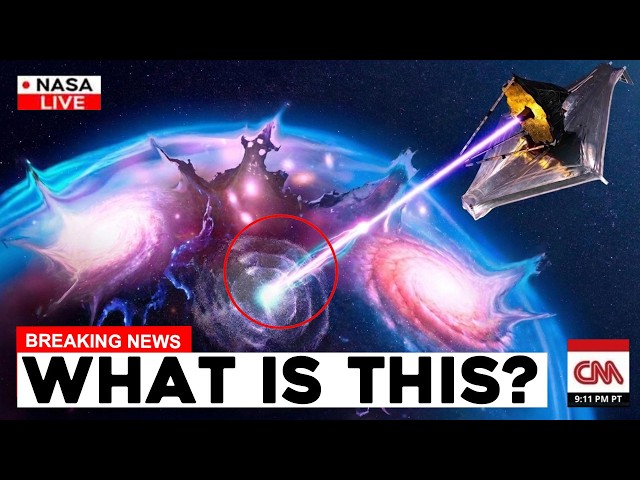
A mysterious discovery from the depths of the universe is challenging astronomers’ understanding of how galaxies formed shortly after the Big Bang. NASA’s James Webb Space Telescope has revealed extraordinarily distant galaxies whose brightness, apparent mass, and surprisingly mature structures have raised difficult questions about the earliest chapters of cosmic history. A dramatic image circulating online depicts Webb directing a powerful beam toward an enormous, glowing formation surrounded by colorful galactic structures, accompanied by the alarming question, “WHAT IS THIS?” The illustration suggests that scientists have encountered something so extraordinary it could overturn the fundamental laws of physics. But has James Webb actually discovered a galaxy that should not exist, or are astronomers witnessing evidence that their theories of early galaxy formation need significant refinement?
Since beginning scientific observations in 2022, the James Webb Space Telescope has transformed humanity’s view of the early universe. Its powerful infrared instruments allow researchers to detect light emitted by galaxies billions of years ago, including objects that existed when the universe was only a small fraction of its present age.
Because the expansion of space stretches ancient light toward longer wavelengths, Webb’s infrared sensitivity makes it particularly effective at studying these distant cosmic structures.
One of the telescope’s most surprising achievements has been identifying galaxies that appear remarkably bright and developed at extremely high redshifts. Some were already forming stars at impressive rates only a few hundred million years after the Big Bang.
According to conventional models, galaxies grow through the accumulation of gas, the formation of stars, and mergers with smaller structures. These processes take time, leading scientists to expect that the earliest galaxies would generally be smaller and less chemically evolved than those observed billions of years later.
Yet Webb has revealed objects that initially appeared far more massive than researchers anticipated.
Among the most discussed discoveries are compact, unusually red galaxies sometimes called “little red dots.” These mysterious objects have distinctive appearances in Webb’s infrared observations and may contain rapidly growing supermassive black holes, dense stellar populations, or combinations of both.
Their existence raises important questions about how quickly galaxies and black holes developed in the early universe.
Another striking example is JADES-GS-z14-0, a galaxy observed at a redshift of approximately 14.3. Its light began traveling toward us when the universe was roughly 290 million years old.
The galaxy’s unexpected brightness suggests that substantial star formation was already occurring at an astonishingly early stage of cosmic history.
Scientists are investigating how galaxies could accumulate sufficient material and produce luminous stars so quickly.
But discovering galaxies that challenge theoretical expectations does not mean the laws of physics have been broken.
Instead, these observations may indicate that some existing models underestimate the efficiency of star formation, the speed of early galaxy growth, or the influence of black holes on surrounding material.
Another possibility is that certain galaxies initially appeared more massive than they actually were because researchers had not fully accounted for the contribution of active galactic nuclei.
When gas falls toward a supermassive black hole, it can release tremendous amounts of energy. This radiation may make a galaxy appear brighter than its stellar population alone would suggest.
Distinguishing between starlight and black-hole activity is therefore essential for determining the true properties of these distant objects.
Webb’s spectroscopic instruments play a critical role in this investigation.
By separating incoming light into different wavelengths, astronomers can identify chemical signatures, measure redshifts, and investigate the physical conditions within distant galaxies.
Spectroscopy also helps determine whether an object’s apparent distance is genuine, reducing the risk of mistaking a nearer, dust-reddened galaxy for one from the earliest universe.
These measurements have already demonstrated that the young cosmos was more complex than many astronomers expected.
The discovery of unexpectedly early chemical enrichment is particularly intriguing. Elements heavier than hydrogen and helium are produced through stellar processes, meaning their presence indicates that earlier generations of stars had already formed and evolved.
Finding evidence of these elements in extremely distant galaxies provides clues about how rapidly the first stellar populations developed.
The sensational thumbnail accompanying the headline, however, should not be mistaken for an authentic Webb observation.
Its enormous, monster-like cosmic structure and concentrated purple beam are artistic elements rather than a scientifically verified image of a galaxy interacting with the telescope. Webb collects incoming infrared radiation; it does not fire energy beams into distant galaxies.
The real observations are less theatrical but considerably more scientifically significant.
Astronomers are now using Webb’s findings to test competing explanations for early cosmic evolution, including more efficient gas cooling, intense bursts of star formation, and unexpectedly rapid black-hole growth.
Researchers are also examining whether these galaxies require adjustments to assumptions about dark matter and the formation of the earliest cosmic structures.
Dark matter remains an important component of the prevailing cosmological model because its gravitational influence helps explain how galaxies and large-scale structures develop.
Although some Webb observations have stimulated debate about galaxy formation within that framework, they have not established that dark matter is nonexistent or that modern cosmology has collapsed.
Ultimately, James Webb has not confirmed a galaxy that violates the fundamental laws of physics, but it has discovered distant objects that are forcing scientists to reconsider how quickly the early universe became populated with stars, galaxies, and black holes.
And that may be even more exciting than the sensational headline suggests.
Every unexpected observation provides another opportunity to improve our understanding of the cosmos, revealing that the universe’s earliest history may have been far more active and complicated than previously imagined.
What do you think? If James Webb continues discovering galaxies that appear too massive, too bright, or too mature for their age, will scientists eventually need to rewrite their theories of the early universe? Or could these mysterious objects be hiding an entirely new cosmic phenomenon that astronomers have not yet recognized? Share your thoughts in the comments!