James Webb Detected Something Moving INSIDE 3I/ATLAS — Scientists Are Terrified

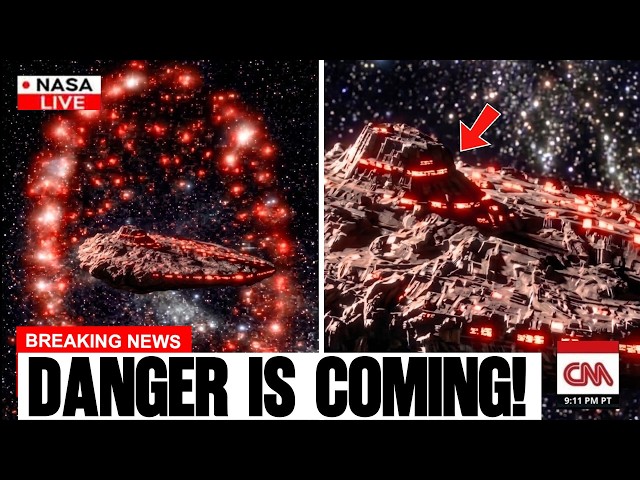
A mysterious interstellar visitor traveling through our solar system has become the center of an extraordinary debate, with sensational claims suggesting that NASA’s James Webb Space Telescope may have detected something moving inside the object. Known as 3I/ATLAS, this remarkable celestial body originated beyond our solar system, making it one of the rarest astronomical discoveries in modern history. A dramatic image circulating online depicts an enormous, spacecraft-like structure surrounded by glowing red lights, with intricate mechanical details seemingly embedded beneath its surface. The headline suggests that scientists have uncovered evidence of something artificial hidden inside the mysterious visitor. But has the James Webb Space Telescope really discovered movement within an interstellar object, or are these claims exaggerating an already fascinating scientific mystery? There is no verified evidence that Webb has detected machinery, extraterrestrial beings, or independently moving structures inside 3I/ATLAS.
The discovery of 3I/ATLAS represents an important milestone in astronomy. First identified in July 2025 by the ATLAS survey system, the object was recognized as an interstellar visitor because of its highly hyperbolic trajectory. Unlike ordinary comets that remain gravitationally bound to the Sun, 3I/ATLAS is traveling along a path indicating that it arrived from interstellar space and will eventually depart the solar system.
Its designation carries special significance. The number three identifies it as the third confirmed interstellar object discovered passing through our solar system, following 1I/’Oumuamua in 2017 and 2I/Borisov in 2019.
Each of these visitors provides scientists with a rare opportunity to examine material that formed around another star.
What makes 3I/ATLAS particularly intriguing is its cometary activity. Astronomical observations have revealed material surrounding the object, consistent with a coma produced as volatile substances are heated by sunlight. As frozen compounds transform into gas, they can carry dust away from the nucleus, producing structures that change over time.
These changes can create the impression that something unusual is moving around or within the object.
However, movement in a comet’s surrounding gas and dust does not establish that machinery or living organisms exist inside its nucleus.
Comets are dynamic environments. Jets of gas can emerge from localized regions, dust particles can move in complicated patterns, and sunlight can influence the appearance of surrounding material. Rotation of the nucleus may also cause changes in brightness and the orientation of visible structures.
From a distance, these natural processes can produce surprisingly dramatic observations.
The James Webb Space Telescope is especially valuable for studying such objects because its infrared instruments can investigate the chemical composition of gases and dust. By analyzing how different molecules absorb and emit infrared radiation, astronomers can identify substances that provide clues about an object’s origin and evolution.
Studies of 3I/ATLAS have drawn attention to its volatile composition, including evidence of carbon dioxide and other comet-associated materials. Such measurements can help researchers compare interstellar comets with those that formed in our own solar system.
The possibility that another planetary system produced an object with different chemical characteristics is scientifically exciting. It could reveal how temperatures, radiation, and chemical environments vary across the Milky Way.
Nevertheless, determining a comet’s composition is fundamentally different from imaging its interior.
Even Webb’s powerful instruments cannot simply look through the solid nucleus of a distant comet and observe hidden objects moving beneath its surface. Its measurements primarily concern radiation from the object and its surrounding environment.
The dramatic thumbnail accompanying the viral headline goes far beyond what astronomical observations have established. It portrays 3I/ATLAS as a massive mechanical vessel covered in illuminated structures, with glowing formations suggesting engines, compartments, or artificial technology.
However, the image is not an authenticated James Webb photograph of 3I/ATLAS. Its spacecraft-like appearance should be understood as a fictional or digitally constructed visualization rather than evidence of an extraterrestrial vehicle.
Another important consideration is the enormous distance separating astronomers from the object. Even large telescopes generally cannot resolve fine structural details on the surface of a relatively small comet nucleus at such distances. Claims about individual mechanical components or internal movement would therefore require extraordinary supporting evidence.
Scientists would need reproducible observations, reliable instrument data, and independent confirmation before concluding that any unusual feature represented technology rather than natural cometary activity.
The broader significance of 3I/ATLAS lies in what it can teach humanity about distant planetary systems. Its journey across interstellar space may have lasted an immense period of time before it entered our solar system. The materials it carries could preserve chemical clues from the environment in which it originally formed.
By examining its gases, dust, trajectory, and changing activity, researchers can investigate whether planet-forming systems elsewhere in the galaxy produce comets similar to those surrounding our Sun.
Ultimately, 3I/ATLAS is a genuine interstellar visitor with extraordinary scientific value, but there is no confirmed discovery of an alien spacecraft, hidden machinery, or mysterious beings moving inside it.
The real mystery is already remarkable: a small object born around another star has traveled through the galaxy and briefly entered humanity’s astronomical reach.
And as telescopes continue studying interstellar visitors, each discovery brings scientists closer to understanding the materials and processes that shape planetary systems throughout the universe.
What do you think? If future observations revealed unexpected changes in the movement or structure of 3I/ATLAS, would you believe they were caused by natural cometary activity, unusual physical properties, or something that could challenge our understanding of objects arriving from interstellar space? Share your thoughts in the comments!