A Mysterious Object Just Appeared — Is 3I/ATLAS in Danger?

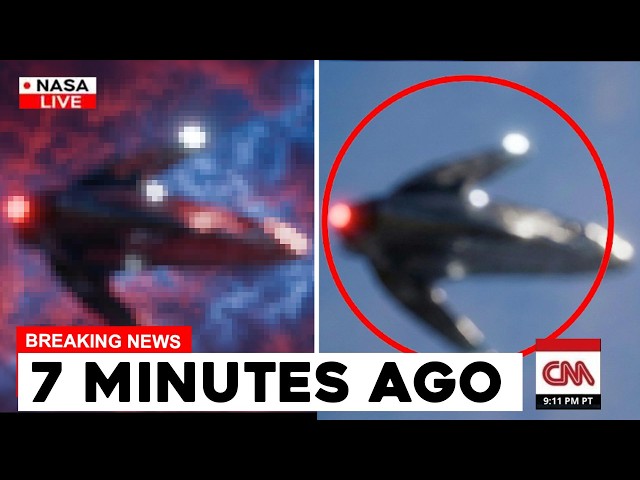
A mysterious object appearing near an interstellar visitor has sparked extraordinary speculation about what might be happening beyond Earth’s orbit. The object at the center of the mystery is 3I/ATLAS, a rare comet that entered our solar system after traveling through the vast darkness between the stars. A dramatic image circulating online appears to show a strange, spacecraft-like formation moving through a colorful cosmic environment, with several bright lights surrounding its dark, angular structure. Accompanied by the alarming message “7 MINUTES AGO,” the footage suggests that an unidentified object may have suddenly approached 3I/ATLAS, raising questions about whether the interstellar comet is encountering something unexpected. But has astronomers’ most intriguing cosmic visitor actually come under threat from another mysterious object, or is the viral footage presenting a fictional interpretation of an ordinary astronomical phenomenon?
Discovered in July 2025 by the ATLAS sky-survey system, 3I/ATLAS quickly attracted international attention because of its extraordinary trajectory. Unlike most comets observed from Earth, which orbit the Sun along gravitationally bound paths, 3I/ATLAS follows a hyperbolic trajectory indicating that it originated outside our solar system.
It is only the third confirmed interstellar object detected passing through our planetary neighborhood, following 1I/’Oumuamua in 2017 and 2I/Borisov in 2019.
These rare visitors provide astronomers with an opportunity to examine material formed in distant planetary systems.
Scientists have identified cometary activity surrounding 3I/ATLAS, including a cloud of gas and dust released as sunlight warms volatile materials. This surrounding cloud, known as a coma, can change in brightness and appearance as the comet approaches and moves away from the Sun.
Such activity can sometimes create unexpected visual features in astronomical images.
Bright spots, elongated structures, and apparently separate objects may result from dust concentrations, background stars, image-processing artifacts, or changes in the comet’s surrounding material.
However, there is no verified evidence that a mysterious spacecraft has appeared beside 3I/ATLAS or that the comet is being pursued by an extraterrestrial object.
The sensational thumbnail shows what resembles a futuristic spacecraft with extended mechanical structures and glowing lights. Although the image is visually striking, it does not provide the information required to establish a genuine astronomical discovery.
Authentic scientific observations generally include details such as the telescope used, observation time, sky coordinates, exposure duration, and original imaging data.
Without such evidence, it is impossible to determine whether a strange formation represents a real celestial object, a digital creation, or a visual effect introduced during editing.
Another important consideration involves the enormous distances separating interstellar objects from Earth.
Even powerful astronomical instruments cannot routinely resolve small surface features on a distant comet. Detecting a separate object near 3I/ATLAS would require careful measurements across multiple observations to establish its position, movement, and relationship to the comet.
A single blurry image would not be sufficient.
Astronomers would need to determine whether the apparent companion moved consistently with 3I/ATLAS, followed an independent trajectory, or simply appeared nearby because of perspective.
This distinction is particularly important because objects that seem close together in a photograph may actually be separated by millions or even billions of kilometers.
The James Webb Space Telescope and other observatories can contribute valuable information about the chemical and physical properties of interstellar visitors. Infrared spectroscopy, for example, allows scientists to investigate molecules released from cometary material and compare their composition with substances found in comets originating within our solar system.
These measurements can reveal clues about the temperatures and environments in which distant planetary systems formed.
But studying chemical composition is very different from confirming the presence of an artificial object.
The suggestion that 3I/ATLAS might be “in danger” also requires clarification.
Comets can experience genuine physical hazards while traveling through planetary systems. Solar heating may cause intense outgassing, while gravitational interactions can alter their trajectories. Some comets fragment when thermal stresses or rotational forces exceed their structural strength.
A collision with another object is physically possible, but space is extraordinarily vast, making such encounters uncommon.
There is currently no established evidence that 3I/ATLAS faces an imminent collision with an unidentified object.
Its natural cometary activity is a far more plausible explanation for changes in its observed appearance than an encounter with alien technology.
The viral claim also highlights a recurring problem in online astronomy coverage: dramatic timestamps can make older or unverified images appear to represent discoveries made only minutes earlier.
A caption reading “7 MINUTES AGO” does not establish when an observation occurred, whether the image originated from a scientific observatory, or whether the event has been independently confirmed.
Researchers rely on documented measurements rather than sensational graphics when evaluating unusual discoveries.
Ultimately, 3I/ATLAS remains an extraordinary interstellar comet, but there is no confirmed scientific observation showing a mysterious spacecraft approaching it, threatening it, or interacting with its nucleus.
The real scientific opportunity lies in studying a visitor that may have traveled through interstellar space for an immense period before entering our solar system.
Its composition, activity, and trajectory could provide valuable clues about the formation of planets and comets around distant stars.
And while the possibility of discovering extraterrestrial technology remains a fascinating subject for scientific investigation, extraordinary conclusions require extraordinary evidence.
For now, the greatest mystery surrounding 3I/ATLAS is not whether something is chasing it, but what this ancient traveler can reveal about the distant region of the galaxy where it originated.
What do you think? If astronomers genuinely detected a second object moving alongside 3I/ATLAS, would you suspect a natural fragment, an unrelated celestial body, or something that could challenge our understanding of interstellar visitors? And what evidence would convince you that the object was truly artificial? Share your thoughts in the comments!