NASA Reveals a Mysterious Green Star — And Could It Change What We Know About Space?
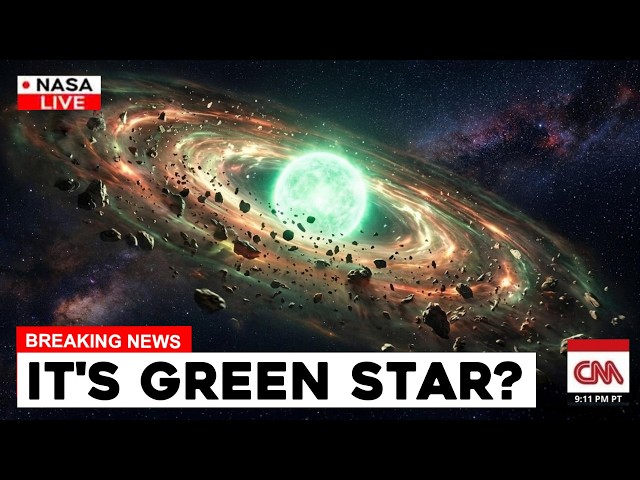
A mysterious green star surrounded by swirling rings of cosmic debris has captured the imagination of space enthusiasts, raising fascinating questions about the extraordinary objects hidden throughout our universe. The dramatic image appears to show a brilliant emerald-colored celestial body at the center of an enormous rotating disk, with countless rocky fragments scattered across the surrounding region. Accompanied by sensational claims of a groundbreaking NASA discovery, the image has fueled speculation about unusual stellar phenomena, unknown forms of energy, and the possibility that astronomers may have encountered something that challenges established scientific theories. But could a genuinely green star exist, and what would such a discovery reveal about the physics of our universe?
The image presents a spectacular cosmic environment dominated by an intensely glowing green sphere. Surrounding it are enormous spiraling bands of illuminated material, resembling an accretion disk or a young planetary system undergoing formation. Hundreds of rocky objects appear suspended throughout the scene, suggesting a chaotic environment filled with collisions, gravitational interactions, and rapidly moving debris.
Although visually extraordinary, there is no verified evidence that this thumbnail represents a newly discovered green star photographed by NASA. Its appearance is consistent with a dramatic astronomical illustration rather than an authenticated telescope observation.
Nevertheless, the question of whether green stars can exist is scientifically fascinating.
Stars produce light through nuclear fusion, primarily converting hydrogen into helium within their cores. The enormous energy generated by this process travels outward before escaping into space as electromagnetic radiation.
The color of a star depends largely on its surface temperature and the distribution of wavelengths it emits.
Cooler stars generally appear reddish or orange, while hotter stars can appear white or blue. Our Sun, with a surface temperature of approximately 5,500 degrees Celsius, emits strongly in the visible spectrum and appears essentially white when viewed from space.
Interestingly, the Sun’s spectrum reaches its maximum intensity near green wavelengths when measured per unit wavelength. Yet the Sun does not appear green.
This happens because stars emit light across a broad range of visible wavelengths rather than producing only one color. When these wavelengths combine, the human eye generally perceives the result as white, yellowish, bluish, or reddish.
As a result, ordinary stars do not appear distinctly green to human observers, even when their radiation peaks near the green portion of the visible spectrum.
However, astronomy does contain genuinely green-looking objects.
Certain planetary nebulae, for example, can display striking green or turquoise colors because energized oxygen atoms emit light at specific wavelengths.
One famous example is the planetary nebula NGC 6826, sometimes called the Blinking Planetary Nebula. Its glowing gas demonstrates how atomic emissions can produce vivid colors that differ from the broad-spectrum light emitted by ordinary stars.
Comets can also develop greenish comas when sunlight excites particular molecules, including diatomic carbon, in the gas surrounding their nuclei.
These natural processes show that green light in space is not mysterious by itself.
The enormous disk surrounding the object in the image introduces another intriguing possibility.
Young stars are frequently surrounded by protoplanetary disks composed of gas, dust, and rocky material. Within these disks, microscopic particles can gradually combine into larger objects, eventually contributing to the formation of planets.
NASA’s James Webb Space Telescope has provided detailed observations of such environments, helping scientists investigate how planetary systems emerge from clouds of material surrounding young stars.
Other cosmic objects, including black holes and neutron stars, can also be surrounded by disks of matter.
In these extreme environments, gravitational forces accelerate material to tremendous speeds, producing intense radiation and sometimes powerful jets of energetic particles.
Astronomers study these systems using different wavelengths of light, including infrared, visible, ultraviolet, X-ray, and radio emissions.
Importantly, the colors displayed in astronomical images do not always represent what human eyes would see directly.
Scientists frequently assign visible colors to infrared or X-ray measurements to reveal structures, temperatures, and chemical differences that would otherwise remain invisible.
A green region in a processed telescope image might therefore represent a particular wavelength, material, or physical property rather than a genuinely green object.
The mystery becomes even more fascinating when considering how much of the universe remains unexplored.
Scientists continue discovering unusual stars, rapidly rotating neutron stars, exotic stellar remnants, and distant planetary systems that challenge existing models of cosmic evolution.
Some stars exhibit unexpected chemical compositions, dramatic brightness variations, or powerful magnetic activity that researchers are still working to understand.
These discoveries demonstrate that astronomy remains a rapidly evolving science.
However, no confirmed observation has established the existence of a conventional star that shines as a pure emerald-green sphere like the one depicted in the thumbnail.
Ultimately, the image should be understood as an imaginative representation of an extraordinary cosmic environment rather than proof of a newly discovered stellar object.
Yet the scientific questions it raises are genuine.
Could astronomers discover entirely new classes of celestial objects? Might unusual chemical environments produce unexpected colors or radiation signatures? And how many remarkable phenomena remain hidden beyond the reach of our current instruments?
As powerful observatories continue exploring the cosmos, scientists are uncovering increasingly complex structures that deepen our understanding of stars, planets, and galaxies.
The next major astronomical breakthrough may not involve a mysterious green star, but it could reveal something equally surprising about the universe.
What do you think? Could an unusual green glow in space reveal a previously unknown astronomical phenomenon, or would it most likely result from glowing gases and the way telescope images are processed? If scientists discovered a celestial object displaying colors never before observed, would you suspect an exotic natural process or something even more extraordinary? Share your thoughts in the comments!