NASA Last Saw Neptune Up 37 Years Ago — Webb Just Showed What Changed

Nearly four decades after NASA’s Voyager 2 spacecraft made its historic journey past Neptune in 1989, the James Webb Space Telescope is revealing extraordinary new details about one of the most mysterious planets in our solar system. Located approximately 4.5 billion kilometers from the Sun, Neptune remains a world of violent storms, powerful winds, freezing temperatures, and atmospheric mysteries that scientists are only beginning to understand. New infrared observations have provided astronomers with a remarkable perspective on the distant ice giant, raising an intriguing question: How much has Neptune changed since humanity first observed it up close?
In August 1989, Voyager 2 became the first and only spacecraft to visit Neptune. Its historic flyby revealed a deep-blue planet with an atmosphere dominated by hydrogen, helium, and methane. Among its most remarkable discoveries was the Great Dark Spot, an enormous atmospheric storm comparable in size to Earth.
Voyager 2 also detected extraordinarily powerful winds, some reaching speeds exceeding 2,000 kilometers per hour. These observations revealed that Neptune possesses one of the most dynamic atmospheres in the solar system, despite receiving only a tiny fraction of the sunlight that reaches Earth.
However, when astronomers observed Neptune again using the Hubble Space Telescope, the original Great Dark Spot had disappeared.
This unexpected development demonstrated that Neptune’s atmosphere is constantly changing, with enormous storms forming, evolving, and eventually vanishing.
Now, the James Webb Space Telescope is providing another major breakthrough.
Using its powerful infrared instruments, Webb can examine Neptune in wavelengths that reveal atmospheric structures difficult to detect in ordinary visible-light images.
One of Webb’s most spectacular achievements has been capturing exceptionally clear views of Neptune’s faint rings.
Although Voyager 2 discovered important details about the planet’s ring system, Webb’s infrared observations have provided a striking new perspective on these delicate structures.
The telescope has also revealed bright atmospheric clouds, many associated with methane-ice formations high above Neptune’s deeper atmosphere.
Because methane absorbs certain infrared wavelengths, Neptune appears much darker in some Webb images than in the familiar blue photographs captured by Voyager 2.
This difference does not mean that Neptune has suddenly changed color. Instead, it demonstrates how different wavelengths of light reveal different physical characteristics.
Another extraordinary discovery involves Neptune’s auroras.
In 2025, scientists reported that Webb observations had provided the first clear images of auroral emissions on Neptune, revealing atmospheric activity associated with charged particles interacting with the planet’s magnetic environment.
Unlike Earth’s auroras, which generally occur near the magnetic poles, Neptune’s unusual magnetic-field geometry produces auroral activity in unexpected regions.
These observations are helping researchers investigate the relationship between the planet’s magnetic field, upper atmosphere, and energetic particles.
Webb’s measurements have also provided valuable information about temperatures in Neptune’s upper atmosphere, offering clues about changes that may have occurred since Voyager 2’s historic encounter.
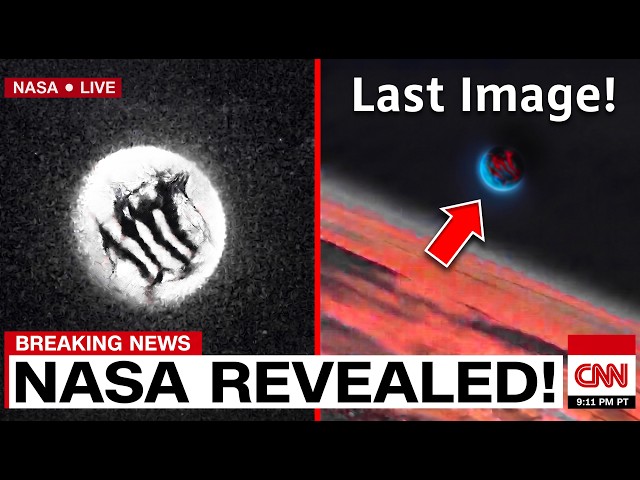
But the dramatic thumbnail accompanying this story presents a more mysterious interpretation.
The image appears to show an unusual dark formation surrounded by a bright circular glow, alongside a small blue planetary object positioned above a reddish surface.
The visual composition suggests that scientists may have discovered a strange structure or unexplained object near Neptune.
However, there is no verified evidence that this thumbnail represents an authentic Webb photograph of an alien structure, mysterious spacecraft, or previously unknown object near Neptune.
The image should be treated as illustrative or unverified rather than an authenticated scientific observation.
Nevertheless, the genuine discoveries surrounding Neptune are remarkable.
Scientists are particularly interested in understanding why the planet’s atmosphere remains so energetic despite its enormous distance from the Sun.
Neptune radiates more energy than it receives from sunlight, suggesting that internal heat plays an important role in driving atmospheric activity.
Researchers are also investigating the planet’s changing cloud patterns and the relationship between solar activity and atmospheric chemistry.
Long-term observations have revealed that Neptune’s clouds can vary significantly over time, demonstrating the complexity of its weather systems.
Another important mystery involves Neptune’s interior.
Although classified as an ice giant, Neptune is not believed to contain a simple frozen surface beneath its atmosphere. Instead, scientists expect increasingly dense layers of fluid materials under extreme pressures and temperatures.
Deep inside the planet, water, ammonia, and methane may behave in ways dramatically different from their familiar forms on Earth.
Understanding these conditions could help explain Neptune’s unusual magnetic field and provide insights into the many Neptune-sized exoplanets discovered around distant stars.
Despite Webb’s extraordinary capabilities, astronomers still face significant limitations.
The telescope cannot directly photograph Neptune’s deep interior or reveal every detail of its atmospheric circulation.
Future spacecraft missions would be needed to investigate the planet’s environment at close range and answer questions that remote observations cannot resolve.
Ultimately, the James Webb Space Telescope has not revealed that something impossible or extraterrestrial is hiding on Neptune. Instead, it has provided powerful new evidence that the distant ice giant is a complex, changing world filled with remarkable physical phenomena.
Thirty-seven years after Voyager 2’s historic flyby, Neptune continues to surprise astronomers.
Its mysterious storms, unusual auroras, faint rings, and extreme atmospheric conditions demonstrate how much remains unexplored within our own solar system.
And as Webb continues studying distant worlds, scientists may discover that some of the universe’s greatest mysteries are waiting much closer to home than we ever imagined.
What do you think? Could Neptune still be hiding extraordinary discoveries beneath its turbulent atmosphere? Should NASA send another spacecraft to investigate the planet up close, or should scientists focus on exploring potentially habitable worlds such as Europa and Enceladus? Share your thoughts in the comments!


