Real UFO 2026: Insane Raw UFO Sightings Caught on Camera!

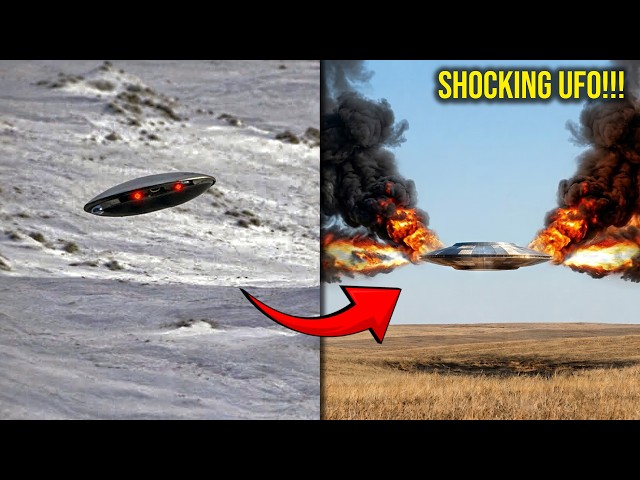
A mysterious series of alleged UFO sightings circulating online in 2026 has reignited worldwide speculation about unidentified objects operating in Earth’s atmosphere. Dramatic images appear to show a dark metallic flying saucer hovering above a remote, snow-covered landscape before a similar disc-shaped craft is seen surrounded by enormous streams of fire and thick black smoke over an open grassland. The extraordinary scenes have captured the attention of UFO enthusiasts, raising questions about secret experimental aircraft, advanced propulsion technology, and the possibility of extraterrestrial visitors. But could these images represent genuine evidence of an unknown spacecraft, or are increasingly sophisticated digital effects creating the illusion of an extraordinary encounter?
The first image presents a dark, oval-shaped object suspended above a frozen landscape. Several bright red lights illuminate its underside, while its smooth metallic exterior reflects the surrounding environment. The craft appears to be flying at a relatively low altitude, without visible wings, propellers, or conventional jet engines.
Its unusual shape resembles the classic flying saucers described in UFO reports for generations, although its flattened design also recalls experimental aircraft concepts developed by aerospace engineers.
The second image presents an even more dramatic scenario. A silver disc-shaped object appears to hover above an expansive field of dry grass, with powerful orange flames extending outward from both sides. Thick columns of black smoke rise into the sky, creating the impression that the craft is experiencing a catastrophic malfunction or releasing enormous amounts of energy.
The combination of these scenes suggests a possible sequence in which an unidentified object was first observed flying normally before encountering an unexpected technical failure.
However, there is no independently verified evidence that these images document a genuine extraterrestrial spacecraft or unexplained aerial accident in 2026. The supplied thumbnail provides no authenticated location, original video, or independently confirmed eyewitness testimony. Its dramatic visual composition may involve digital manipulation or artificial intelligence.
Nevertheless, unidentified anomalous phenomena, commonly known as UAP, remain a legitimate subject of scientific and governmental investigation.
For decades, military pilots, radar operators, and civilian witnesses have reported unusual objects displaying unfamiliar shapes, unexpected movements, and unexplained lighting patterns.
Some incidents have involved multiple observational systems, making them particularly interesting to researchers attempting to determine what witnesses actually encountered.
NASA has encouraged scientific approaches to investigating UAP, emphasizing reliable measurements, transparent analysis, and independently verifiable evidence.
The United States Department of Defense established the All-domain Anomaly Resolution Office, known as AARO, to investigate unusual phenomena and assess potential aviation safety and national security concerns.
One of the greatest challenges involves determining whether an unidentified object genuinely demonstrates extraordinary technological capabilities.
Camera perspective, atmospheric conditions, reflections, and digital processing can create misleading impressions of an object’s size, distance, and movement.
A small object close to a camera may appear enormous, while conventional aircraft or drones can look unfamiliar when recorded from unusual angles.
The bright red lights beneath the first object raise an intriguing question: could an advanced aircraft use a propulsion system unlike anything currently available?
Scientists have developed several forms of advanced propulsion, including ion engines, electric propulsion systems, and experimental plasma technologies.
However, the presence of unusual lights in an image does not establish that an object possesses extraterrestrial technology.
The enormous flames surrounding the second craft introduce another important question: what would investigators expect if an unidentified aircraft genuinely suffered a catastrophic malfunction?
A real incident could produce radar records, emergency communications, independent eyewitness reports, environmental damage, and recoverable debris.
Researchers would examine any recovered materials to determine their chemical composition, structural characteristics, and manufacturing properties.
Even the discovery of unusual materials would not automatically establish an extraterrestrial origin.
The rapid development of artificial intelligence has made UFO investigations increasingly complicated.
Modern image-generation systems can produce remarkably realistic flying saucers, explosions, smoke clouds, unusual lighting effects, and fictional aerial encounters.
These images can spread rapidly across social media, especially when accompanied by sensational headlines suggesting that governments are concealing evidence of extraterrestrial contact.
Without original recordings, reliable metadata, multiple camera angles, and independent corroboration, dramatic visual material cannot establish that an extraordinary event occurred.
Yet the possibility of extraterrestrial life remains one of the most fascinating questions in modern astronomy.
Scientists have discovered thousands of planets orbiting distant stars, including rocky worlds that may possess environments suitable for liquid water.
NASA’s James Webb Space Telescope is helping researchers investigate the atmospheres of selected exoplanets, searching for chemical signatures that reveal information about their environments.
Meanwhile, planetary missions continue exploring potentially habitable locations within our solar system, including Mars, Europa, and Enceladus.
These investigations demonstrate that the scientific search for extraterrestrial life is real, even though no confirmed alien civilization has been discovered.
Ultimately, the images do not prove that extraterrestrial spacecraft are operating above Earth or experiencing mysterious explosions in our atmosphere.
What they demonstrate is humanity’s enduring fascination with the possibility that intelligent life exists elsewhere in the universe.
As artificial intelligence and digital technology continue advancing, distinguishing authentic observations from fictional creations will become increasingly important.
The greatest breakthrough in humanity’s search for extraterrestrial intelligence may eventually come from an unexpected astronomical signal, a remarkable planetary discovery, or independently verifiable physical evidence.
Until then, curiosity must be balanced with careful scientific investigation.
And if humanity ever discovers undeniable evidence of another intelligent civilization, the consequences could fundamentally transform our understanding of life, technology, and our place in the cosmos.
What do you think? Could mysterious disc-shaped objects represent technology beyond human understanding, or are increasingly realistic AI-generated videos creating the illusion of extraterrestrial encounters? If you witnessed a flying saucer surrounded by enormous flames above an open field, would you believe it was an alien spacecraft or a secret experimental aircraft? Share your thoughts in the comments!