NASA Just RELEASED A New Discovery — What 3I/ATLAS Really Is
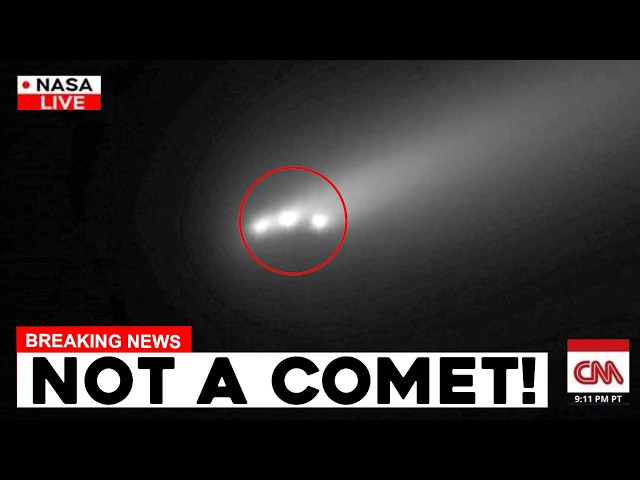
A mysterious object traveling through our solar system has captured worldwide attention, triggering extraordinary speculation about its origins and true identity. Known as 3I/ATLAS, this interstellar visitor has become the subject of viral images showing unusual glowing formations surrounded by enormous clouds of material. One dramatic image appears to reveal three bright lights arranged inside a mysterious cosmic object, accompanied by the alarming announcement “NOT A COMET!” But has NASA discovered something that challenges our understanding of interstellar objects, or are scientists witnessing an extraordinary natural visitor from beyond our solar system?
The story began in July 2025, when astronomers using the ATLAS survey system detected an unusual object moving through space. Subsequent observations revealed that its trajectory was strongly hyperbolic, indicating that it was not gravitationally bound to the Sun.
This meant the object had entered our solar system from interstellar space.
Astronomers designated it 3I/ATLAS, identifying it as the third confirmed interstellar object discovered passing through our planetary neighborhood.
The first, 1I/’Oumuamua, was discovered in 2017, followed by the interstellar comet 2I/Borisov in 2019.
Unlike ordinary comets originating from the distant reservoirs of our own solar system, interstellar objects formed elsewhere before being ejected into the space between stars.
Their discovery offers scientists an extraordinary opportunity to investigate material originating from another planetary system.
What makes 3I/ATLAS especially fascinating is its combination of unusual motion and comet-like activity.
Observations have revealed a surrounding cloud of gas and dust, known as a coma, associated with material released from its icy nucleus.
As a comet approaches the Sun, solar heating can cause volatile substances within its interior to turn into gas, carrying dust particles into surrounding space.
These processes create the glowing structures astronomers observe around active comets.
However, the appearance of a coma can sometimes make determining the nucleus’s actual size and shape extremely difficult.
The bright surrounding material may obscure the much smaller solid object at its center.
This is particularly important when interpreting dramatic images showing strange lights or apparently geometric structures.
A bright formation inside a comet’s coma does not automatically indicate an artificial object or extraterrestrial technology.
Astronomical images can contain effects caused by exposure settings, image processing, telescope resolution, and the interaction of sunlight with dust particles.
Some photographs may also be enhanced or digitally altered before circulating online.
The supplied thumbnail, showing three bright points within a diffuse cloud, cannot by itself establish the existence of multiple spacecraft, engines, or artificial structures.
Scientists require original observational data and independent confirmation before drawing such conclusions.
One of the most important questions surrounding 3I/ATLAS concerns its chemical composition.
Because the object originated outside our solar system, its materials may preserve information about the environment in which it formed.
By examining sunlight reflected from dust and radiation associated with gas molecules, astronomers can investigate the object’s physical and chemical properties.
Observations from powerful telescopes, including space-based observatories, can help researchers identify volatile compounds and study how the comet responds to solar heating.
Such measurements are valuable because different planetary systems may develop under different temperatures, chemical conditions, and stellar environments.
An interstellar comet therefore provides a rare sample of the broader galaxy’s planetary-building materials.
Another intriguing feature is the object’s remarkable velocity.
Interstellar visitors travel along trajectories shaped by their previous journeys through the galaxy and their gravitational encounters with stars and planetary systems.
Their speeds and orbital paths help astronomers reconstruct aspects of their movement through interstellar space.
However, an unusual velocity does not necessarily indicate artificial propulsion.
Natural gravitational interactions can eject comets and asteroids from their original planetary systems, sending them into interstellar space for millions or even billions of years.
Over time, some of these objects may pass through neighboring star systems, including our own.
Scientists are particularly interested in whether 3I/ATLAS differs significantly from comets that formed around the Sun.
Variations in chemical composition, dust production, and activity could reveal differences between planetary systems.
The object may also help researchers understand how frequently stars exchange small bodies through gravitational ejection.
These discoveries could improve models of planetary formation throughout the Milky Way.
But what about the sensational suggestion that NASA has confirmed 3I/ATLAS is not a comet?
There is no established scientific confirmation that 3I/ATLAS is an alien spacecraft or that its observed behavior requires an artificial explanation.
Its observed coma and activity support its classification as an interstellar comet.
Although scientists continue studying its properties, unresolved details should not be confused with evidence of extraterrestrial engineering.
The distinction between an unidentified feature in an image and an unidentified spacecraft is essential.
A phenomenon may initially appear mysterious simply because the available measurements are incomplete.
Further observations often reveal ordinary physical explanations.
That does not make the discovery less exciting.
In fact, the natural origin of 3I/ATLAS makes it scientifically extraordinary.
Humanity has never traveled to another star system, yet interstellar objects allow astronomers to examine material that formed around distant stars.
They are cosmic messengers carrying clues from environments beyond our planetary neighborhood.
As astronomers analyze observations of 3I/ATLAS, they may uncover important information about the chemistry, evolution, and diversity of planetary systems across the galaxy.
The greatest revelation may not involve alien technology, but the realization that our solar system is constantly connected to a much larger cosmic environment.
Objects born around distant stars can eventually cross the enormous distances between stellar systems and briefly become visible from Earth.
What do you think? Is 3I/ATLAS simply an ancient interstellar comet carrying secrets from another planetary system, or could future observations reveal unexpected physical properties that scientists have never encountered before? And if another mysterious object enters our solar system, what evidence would convince you that it deserves a closer investigation? Share your thoughts in the comments!