Real UFO Sightings 2026: We Are Closer Than Ever | Real UFO Footage Caught on Camera!

A new wave of mysterious UFO videos is capturing worldwide attention in 2026, reigniting one of humanity’s most fascinating questions: Are we truly alone in the universe, or are we getting closer to discovering something extraordinary? Dramatic footage circulating across social media appears to show a massive disc-shaped object hovering silently in a clear blue sky, followed by disturbing scenes of a crashed metallic craft surrounded by flames, thick black smoke, and military personnel. The images have sparked intense speculation about unidentified flying objects, secret government investigations, and the possibility of extraterrestrial technology. But while the footage looks astonishing, an important question remains: are these images evidence of an actual encounter, or do they demonstrate how difficult it has become to distinguish authentic sightings from digitally created material?
The subject of unidentified flying objects, now officially referred to in many government investigations as Unidentified Anomalous Phenomena, or UAP, has attracted growing scientific and public interest. For decades, witnesses have reported strange lights, unusual aerial movements, and objects that appear to behave differently from conventional aircraft. Some sightings have involved military pilots, radar operators, and trained observers, making certain cases particularly interesting to investigators. However, the term unidentified does not automatically mean extraterrestrial. It simply indicates that the available information is insufficient to determine what was observed.
In recent years, the United States government has taken a more structured approach to investigating these reports. The Pentagon established the All-domain Anomaly Resolution Office, known as AARO, to examine unexplained observations and identify possible national security or aviation safety concerns. NASA has also encouraged more rigorous scientific investigation of UAP, emphasizing the importance of reliable measurements, transparent analysis, and high-quality observational data.
One of the greatest challenges involves the interpretation of videos showing unusual objects moving through the sky. Camera angles, atmospheric conditions, optical reflections, digital zoom, and sensor limitations can create misleading impressions of speed, size, and distance. An object that appears to accelerate impossibly fast may actually be moving at an ordinary speed while the camera itself changes position. Similarly, distant aircraft, balloons, drones, and astronomical objects can sometimes appear mysterious when recorded under unusual lighting conditions.
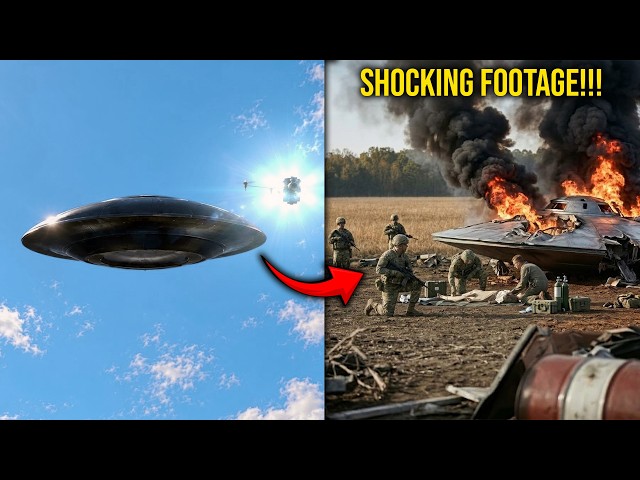
The dramatic thumbnail accompanying this story presents two especially striking scenes. On the left, a dark metallic flying saucer appears suspended above the ground, while a bright object glows in the distance. On the right, a saucer-shaped craft appears to have crashed in an open field, with armed personnel inspecting wreckage as flames rise into the sky.
Although these scenes resemble an extraordinary military recovery operation, there is no verified evidence supplied with the image establishing that such a UFO crash occurred in 2026. The composition has characteristics of cinematic or digitally generated imagery, and the dramatic caption alone cannot authenticate the event.
For investigators, a genuine crash involving unknown technology would require far more than photographs or short video clips. Researchers would need independently verified location information, original recordings, physical debris, documented recovery procedures, and scientific examination of any recovered materials. Without these forms of evidence, claims involving extraterrestrial spacecraft remain speculation.
Nevertheless, some UAP reports continue to attract attention because their available data does not immediately support a clear explanation. Investigators must distinguish between cases that are genuinely unresolved and cases where important information is simply missing. A lack of sufficient data should never be mistaken for proof that an object possesses technology beyond human capabilities.
Another major development is the increasing role of artificial intelligence in online UFO content. Modern image-generation and video-editing tools can produce remarkably realistic spacecraft, explosions, military vehicles, and fictional recovery operations. These technologies make sensational videos easier to create and more difficult for casual viewers to evaluate.
As a result, scientists and independent analysts increasingly emphasize the importance of examining original files, identifying visual inconsistencies, checking environmental details, and comparing footage with reliable external information.
Yet the scientific search for extraterrestrial life is very real.
Astronomers have discovered thousands of planets orbiting stars beyond our solar system, including worlds that may possess conditions suitable for liquid water. Powerful observatories such as the James Webb Space Telescope are helping researchers investigate the atmospheric chemistry of selected exoplanets, searching for clues about their environments.
Meanwhile, planetary missions continue exploring potentially habitable locations within our own solar system, including Mars and the icy moons Europa and Enceladus.
These investigations represent a scientifically grounded search for life beyond Earth, even though no confirmed extraterrestrial civilization has been discovered.
The possibility that intelligent life exists elsewhere in the universe remains an important subject of scientific discussion. With billions of stars in the Milky Way and enormous numbers of planets throughout the observable universe, researchers continue examining whether the conditions that allowed life to emerge on Earth might also occur elsewhere.
However, the existence of potentially habitable planets does not establish that extraterrestrial spacecraft have visited Earth.
As of the evidence presented here, no authenticated footage confirms that an alien spacecraft crashed or was recovered by military personnel in 2026. The viral images are intriguing, but their extraordinary implications remain unverified.
Ultimately, the growing fascination with UFO sightings reveals something important about humanity’s relationship with the unknown. Every mysterious observation encourages questions about our technology, our atmosphere, and our place in the cosmos. Some sightings may eventually receive ordinary explanations, while others could motivate new scientific investigations.
The real breakthrough will come not from the most dramatic thumbnail, but from evidence strong enough to withstand independent scientific examination.
And if humanity ever discovers undeniable proof of extraterrestrial intelligence, it could become one of the most significant events in human history.
What do you think? Are the increasingly realistic UFO videos appearing online bringing us closer to the truth, or making genuine evidence harder to recognize? If scientists announced that an unidentified craft had been recovered, what proof would you need before believing it came from another world? Share your thoughts in the comments!