James Webb CONFIRMS 3I/ATLAS Is Much Bigger Than Anyone Expected
A mysterious visitor from beyond our Solar System has captured the attention of astronomers worldwide, and new observations from NASA’s James Webb Space Telescope are helping scientists investigate its extraordinary properties. Known as 3I/ATLAS, this interstellar comet is only the third confirmed object ever discovered passing through our Solar System from another star system. Its unusual trajectory, chemical composition, and intense activity have sparked questions about its true size, origin, and what might be hidden beneath its surface. But while sensational headlines suggest Webb has confirmed an enormous object containing something artificial, the scientific reality is more complicated—and potentially just as fascinating.
Discovered in July 2025 by the ATLAS survey, 3I/ATLAS immediately stood out because of its hyperbolic orbit, indicating that it was not gravitationally bound to the Sun. Unlike ordinary comets that repeatedly travel around our star, this object arrived from interstellar space and will eventually disappear into the galaxy again. Its extraordinary speed and unusual orbital path make it a rare opportunity to study material formed in a completely different planetary system.
One of the biggest mysteries surrounding 3I/ATLAS is its actual size. When astronomers observe a distant comet, they are not necessarily seeing its solid nucleus directly. Instead, sunlight heats the icy surface, releasing gas and dust that form a glowing cloud known as a coma. This surrounding material can make a relatively small nucleus appear dramatically larger than it really is.
That distinction is especially important when interpreting observations from Webb. The telescope’s infrared instruments can examine the comet’s chemical composition and activity, but a bright, extended coma does not automatically mean the solid object inside is enormous. Determining the nucleus’s true diameter requires careful modeling and complementary observations from other telescopes.
Webb’s observations have revealed another remarkable characteristic: 3I/ATLAS possesses a coma unusually rich in carbon dioxide relative to water. Scientists have also investigated other volatile compounds, offering clues about the temperature and chemical environment in which the comet originally formed.
These findings raise an extraordinary possibility. The object may have spent billions of years traveling through interstellar space, preserving chemical information from a planetary system that could be very different from our own.
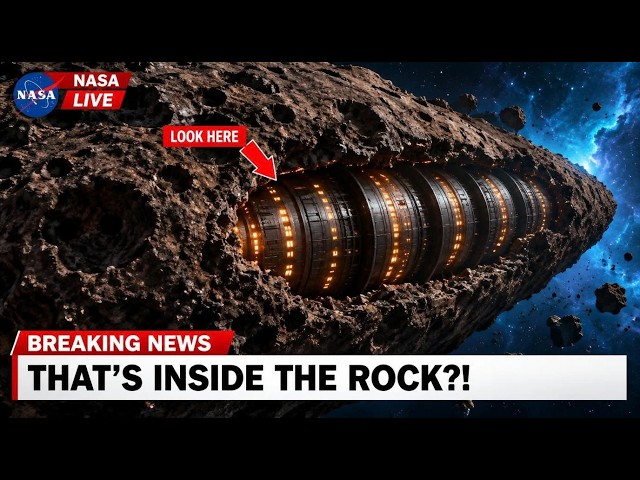
However, the dramatic image accompanying this story shows something that scientists have not discovered: a massive metallic cylinder apparently embedded inside the rocky body. There is no authenticated James Webb observation demonstrating that 3I/ATLAS contains machinery, an artificial spacecraft, or a hidden technological structure. The image should be understood as a fictional or artistic visualization rather than genuine telescope footage.
The actual mystery involves the comet’s composition, physical dimensions, and response to solar heating. By combining infrared spectroscopy, optical observations, and measurements of its changing brightness, researchers can better estimate how much material the comet is releasing and what its nucleus might look like.
Understanding these properties could reveal whether interstellar comets resemble the icy bodies found in our Solar System or whether they preserve evidence of dramatically different planetary formation environments.
The implications extend far beyond a single comet. Every confirmed interstellar visitor provides scientists with a natural sample from another stellar neighborhood, delivered across unimaginable distances without requiring humanity to send a spacecraft to another star.
James Webb has not confirmed a gigantic alien machine hidden inside 3I/ATLAS, nor has it conclusively established that its solid nucleus is larger than every previous estimate. But the comet’s unusual chemistry and interstellar origin are already giving astronomers something extraordinary: a rare opportunity to investigate the building blocks of an alien planetary system—and perhaps discover how different other worlds can truly be.