James Webb Just Detected The Most Distant Object Ever — And It Was Right Next To Us!
The James Webb Space Telescope has once again pushed astronomy toward the edge of the observable universe, detecting extraordinarily distant galaxies whose light began traveling toward us when the cosmos was only a tiny fraction of its present age.
But the dramatic claim that Webb has discovered “the most distant object ever” and somehow found it “right next to us” requires an important explanation. In astronomy, an object can appear surprisingly close to another object in an image while actually being separated from it by billions of light-years along our line of sight.
This cosmic optical coincidence is one of the reasons deep-space observations can be so visually deceptive. Webb’s powerful infrared instruments are designed to detect ancient light that has been stretched to longer wavelengths by the expansion of the universe, allowing astronomers to observe galaxies existing only a few hundred million years after the Big Bang.
Some of Webb’s record-breaking galaxy candidates and spectroscopically confirmed galaxies are so distant that we see them as they existed more than 13 billion years ago.
Their present-day distance is even greater because the universe continued expanding while their light traveled toward Earth. Yet when Webb photographs a tiny region of sky, the resulting image can contain objects at radically different distances.
A nearby star inside our own Milky Way might appear almost beside a primordial galaxy from the early universe, even though the two have absolutely no physical relationship. Astronomers determine the difference using spectroscopy and a phenomenon called redshift.
As the universe expands, wavelengths of light traveling across cosmic distances are stretched toward the red and infrared portions of the electromagnetic spectrum. The greater the cosmological redshift, generally speaking, the further back in cosmic history astronomers are observing.
Webb can separate this ancient light into its component wavelengths, allowing scientists to estimate distance, chemical composition and star-formation activity rather than relying simply on how an object looks in a photograph. Another phenomenon can make the situation even stranger: gravitational lensing.
Massive galaxies and galaxy clusters can bend and magnify light from much more distant objects located behind them, sometimes creating arcs, rings or multiple distorted images. In extreme cases, a galaxy billions of light-years farther away can appear wrapped around a foreground object, creating an illusion that the two structures are physically connected.
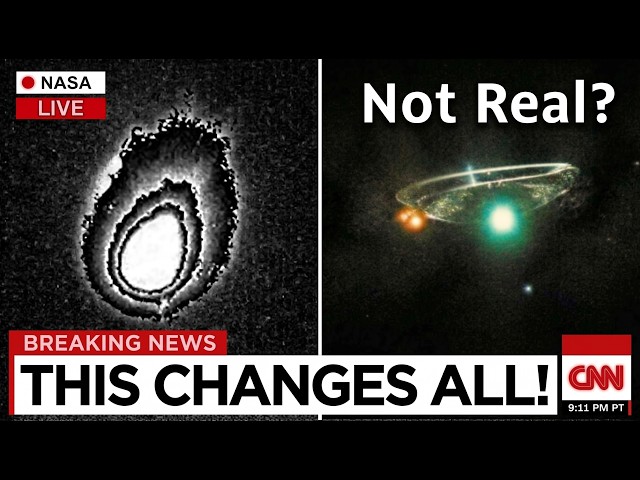
The bizarre glowing rings and spacecraft-like form shown in the accompanying thumbnail should therefore not be interpreted as an authentic close-up Webb photograph of a mysterious artificial object. There is no verified evidence that Webb has discovered a gigantic alien structure or an impossible object sitting near Earth.
The genuine science is arguably more astonishing. Webb is effectively functioning as a cosmic time machine, capturing photons that began their journey billions of years before Earth existed.
By studying these ancient galaxies, astronomers can investigate how the first generations of stars formed, how quickly early galaxies grew and whether current models of cosmic evolution accurately describe the young universe.
Some early Webb discoveries have indeed surprised researchers because certain galaxies appear brighter, more massive or more chemically developed than initially expected, prompting refinements to theories of early galaxy formation rather than proving established cosmology is wrong.
What Webb is revealing is not that the edge of the universe is mysteriously sitting beside us, but something almost as remarkable: objects separated by enormous stretches of space and cosmic history can appear side by side in the same tiny patch of our night sky.