James Webb “Leak” Sparks Online Debate After Image Allegedly Shows 3I/ATLAS Refueling an Alien Craft
A dramatic image circulating across social media has reignited worldwide fascination with extraterrestrial life, advanced space technology, and the mysteries hidden beyond our solar system. The viral post claims that the James Webb Space Telescope (JWST) leaked a “terrifying” image showing the recently discovered interstellar object known as 3I/ATLAS apparently refueling a gigantic alien spacecraft somewhere in deep space.
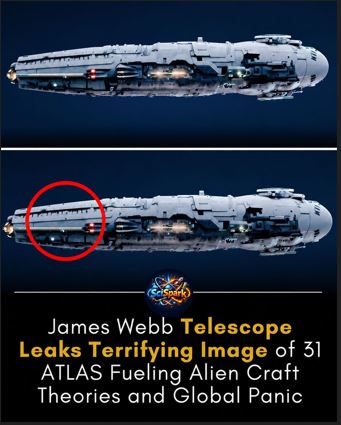
The striking image, which has spread rapidly across platforms including X, Facebook, TikTok, and YouTube, depicts what appears to be an enormous cylindrical vessel positioned near another object identified as 3I/ATLAS. Supporters of the theory argue that unusual lights, geometric structures, and apparent docking features visible in the image suggest the presence of highly advanced extraterrestrial engineering rather than a natural astronomical object.
The viral post has accumulated millions of views within hours, with thousands of users debating whether humanity may have unknowingly witnessed evidence of intelligent life operating within our own cosmic neighborhood.
According to the claims accompanying the image, unnamed sources allegedly connected to the James Webb mission leaked classified observations before they could be reviewed by government agencies. The post further suggests that researchers noticed strange energy signatures surrounding 3I/ATLAS that allegedly could not be explained by known astrophysical processes.
Some UFO enthusiasts believe the object may not be an ordinary comet or interstellar visitor at all. Instead, they speculate that 3I/ATLAS could function as a mobile fuel depot, navigation beacon, or autonomous supply station used by civilizations traveling between star systems. Others have proposed that the object itself could actually be an enormous artificial spacecraft disguised to resemble a naturally occurring celestial body.
Several independent content creators have attempted to enhance the circulating image, claiming they discovered repeating structural patterns, symmetrical panels, illuminated sections, and what appear to be propulsion systems along the surface of the mysterious craft. While these analyses have generated significant excitement online, professional astronomers caution that image enhancement techniques can easily introduce misleading visual artifacts that appear meaningful even when they are not.
Scientists familiar with the James Webb Space Telescope emphasize that the observatory has revolutionized astronomy by capturing incredibly detailed infrared observations of distant galaxies, exoplanets, nebulae, and stellar nurseries. However, no official announcement has been made suggesting that JWST has photographed alien spacecraft or confirmed evidence of extraterrestrial civilizations.
Astronomers also point out that interstellar objects passing through our solar system remain scientifically valuable because they provide rare opportunities to study material originating from other planetary systems. Since the discovery of the first known interstellar visitor, ‘Oumuamua, in 2017, researchers have debated unusual characteristics observed in such objects, leading to numerous hypotheses ranging from natural explanations to speculative artificial origins.
The latest claims involving 3I/ATLAS have inevitably drawn comparisons to previous controversies surrounding ‘Oumuamua. Harvard astrophysicist Avi Loeb famously suggested that some unusual properties of that object deserved consideration as a possible technological artifact, although the majority of the scientific community continues to favor natural explanations.
Social media users remain sharply divided over the latest image. Some argue that the apparent symmetry of the alleged spacecraft is too precise to occur naturally, while others believe the entire image could have been digitally manipulated or generated using modern artificial intelligence tools. Digital imaging experts note that AI-generated content has become increasingly sophisticated, making it more difficult for casual viewers to distinguish authentic astronomical imagery from fabricated composites.
Meanwhile, independent fact-checkers have begun examining the origins of the viral post, attempting to trace when and where the image first appeared online. As of now, no verified source has confirmed that the image originated from NASA, the European Space Agency, the Canadian Space Agency, or the official James Webb science team.
NASA has consistently maintained that any extraordinary scientific discovery made using the James Webb Space Telescope undergoes extensive verification before being released to the public through peer-reviewed research and official press briefings. The agency has repeatedly encouraged the public to rely on verified scientific publications rather than unconfirmed social media claims.
Despite the lack of official confirmation, the story continues to fuel intense public curiosity. Online discussion forums are filled with theories suggesting that governments may possess additional undisclosed information regarding unidentified anomalous phenomena, while others view the viral image simply as another example of how easily compelling visuals can spread across the internet regardless of their authenticity.
Whether the image represents a misunderstood astronomical observation, a digitally altered illustration, or an imaginative piece of science-fiction artwork, it has once again highlighted humanity’s enduring fascination with one of the oldest questions ever asked: Are we alone in the universe?
Editor’s Note: The claims described in this article are based on viral social media posts and online speculation. At the time of writing, there is no verified evidence that the James Webb Space Telescope has photographed an alien spacecraft, that 3I/ATLAS is an artificial object, or that any space agency has confirmed extraterrestrial technology. Readers should distinguish between verified scientific findings and unconfirmed claims circulating online.