What NASA Discovered on Europa Is Truly SHOCKING!

NASA’s continuing investigation of Europa, one of Jupiter’s largest moons, is revealing a world that may possess nearly all the ingredients scientists consider important when searching for potentially habitable environments beyond Earth. Beneath Europa’s fractured, radiation-battered shell of water ice, researchers believe there is a vast global ocean containing roughly twice as much liquid water as all of Earth’s oceans combined.
That possibility alone has made Europa one of the Solar System’s most compelling destinations, but recent observations have added an even more intriguing clue: material associated with carbon has been detected on its surface, potentially connecting the hidden ocean below with chemistry visible from space. Observations from NASA’s James Webb Space Telescope identified carbon dioxide concentrated in a region called Tara Regio, an area of disrupted terrain where relatively young surface material appears to have been brought upward from Europa’s interior. Researchers concluded that the carbon dioxide was probably not simply delivered by meteorites or other external sources.
Instead, it may have originated within Europa’s subsurface ocean, although scientists emphasize that further evidence is required to establish exactly how the material reached the surface. This is important because carbon is one of the fundamental elements needed for life as we know it.
Europa already appears to have water, chemical building blocks and a possible source of energy generated by tidal forces as Jupiter’s enormous gravity repeatedly flexes the moon’s interior.
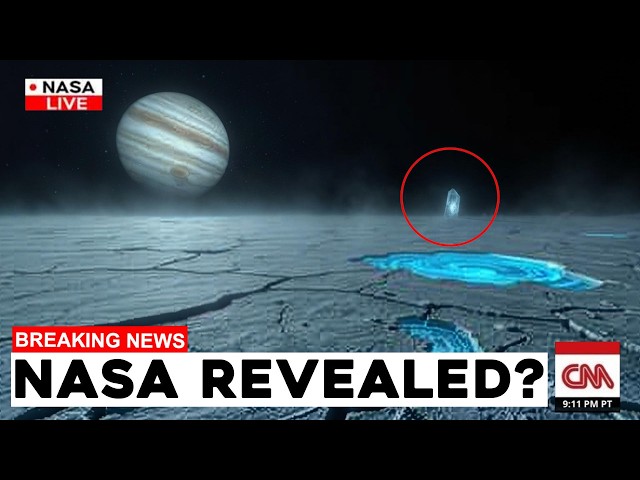
Together, those characteristics make its buried ocean an extraordinary natural laboratory for astrobiology. Yet NASA has not announced the discovery of life on Europa, nor has it found the mysterious crystal-like structure depicted in the accompanying image.
That scene should be understood as an imaginative visualization rather than an authentic photograph from Europa’s surface. No spacecraft has yet landed there. Scientists are also investigating controversial evidence that Europa may occasionally eject water vapor into space.
Earlier Hubble observations found possible signs of enormous plumes rising above the moon, potentially allowing future spacecraft to analyze material from its ocean without drilling through kilometers of ice. However, plume activity remains uncertain, and repeated observations have not always produced the same result. NASA is now taking the investigation much further with the Europa Clipper mission.
Launched in October 2024, the spacecraft is scheduled to reach Jupiter in 2030 and conduct dozens of close flybys of Europa rather than landing on its surface. Its sophisticated instruments will examine the moon’s ice shell, composition, geology and internal structure while searching for evidence about the depth and salinity of its ocean.
Radar observations could help scientists determine how thick the ice is and whether pockets of liquid water exist closer to the surface, while other instruments will analyze particles and gases surrounding the moon. Europa Clipper is not specifically designed to detect living organisms. Its central question is whether Europa contains environments capable of supporting life.
If scientists eventually demonstrate that its ocean contains water, carbon-based chemistry, essential elements and usable energy simultaneously, the implications would be profound. It would show that potentially habitable environments can exist far from the warmth of a Sun-like star, hidden beneath ice and powered partly by gravitational interactions. So while the sensational “NASA REVEALED?” imagery may exaggerate what has actually been discovered, the genuine mystery is powerful enough on its own.
Somewhere beneath Europa’s frozen surface may lie an enormous, dark ocean that has existed for billions of years—and humanity is finally sending a spacecraft capable of investigating whether that alien sea has the conditions necessary for life.