New Lunar Image Reignites Apollo 11 Debate as Historic Landing Equipment Appears Visible on the Moon
A newly circulated lunar image has captured the attention of space enthusiasts around the world, reigniting discussions about the Apollo 11 mission more than five decades after humanity’s first successful Moon landing. The image, which has spread rapidly across social media platforms, claims to show remarkably clear evidence of Apollo-era hardware still resting on the lunar surface, while also fueling fresh speculation surrounding mysterious objects visible near the historic landing site.
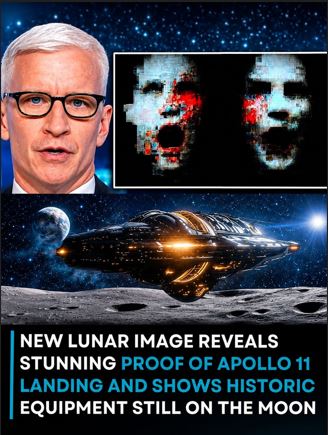
The photograph, accompanied by dramatic headlines proclaiming, “New Lunar Image Reveals Stunning Proof of Apollo 11 Landing and Shows Historic Equipment Still on the Moon,” has generated millions of views within days. While the image celebrates one of humanity’s greatest technological achievements, it has also sparked renewed curiosity after online users pointed to several unexplained features appearing near the photographed region.
Supporters of the viral claim argue that the enhanced lunar imagery provides one of the clearest public views yet of equipment left behind by NASA astronauts during the Apollo program. Some social media users believe the photographs reveal the descent stage of the Apollo 11 Lunar Module, scientific instruments, and even faint trails believed to be footprints preserved in the Moon’s airless environment.
Others, however, have focused on what they describe as unusual geometric shadows and unidentified structures visible beyond the historic landing zone. These interpretations have fueled speculation ranging from unknown geological formations to theories involving extraterrestrial technology. No scientific organization has confirmed such interpretations, and experts caution that image enhancement techniques can sometimes exaggerate natural surface features.
Interest surrounding the Apollo 11 landing has remained remarkably strong since July 20, 1969, when astronauts Neil Armstrong and Buzz Aldrin became the first humans to walk on another world while Michael Collins orbited overhead aboard the Command Module. During their historic mission, the astronauts deployed scientific instruments, collected approximately 21 kilograms of lunar rock samples, and left behind numerous pieces of equipment that remain on the Moon today.
Because the Moon has virtually no atmosphere, no wind, and extremely limited geological activity, many artifacts from the Apollo era are expected to remain largely undisturbed for millions of years. High-resolution orbital photography collected over the past decade has successfully identified several Apollo landing sites, including the descent stages of lunar modules, experiment packages, and the paths astronauts traveled during their surface exploration.
Scientists note that modern lunar orbiters possess imaging capabilities far beyond what was possible during the Apollo era. Advances in digital image processing, artificial intelligence, and surface mapping have enabled researchers to examine the Moon with unprecedented detail, revealing subtle terrain features that were once impossible to observe from orbit.
The latest viral image has also revived long-standing conspiracy theories questioning the authenticity of the Apollo missions. Despite overwhelming historical evidence supporting the Moon landings—including thousands of photographs, telemetry records, independent tracking by multiple countries, lunar rock samples analyzed worldwide, and decades of scientific research—claims suggesting the missions were staged continue to circulate online.
Space historians emphasize that the evidence supporting Apollo 11 is among the most extensively documented achievements in human history. Independent observatories around the world tracked the spacecraft during its journey, while laser reflectors placed on the lunar surface by Apollo astronauts continue to be used by scientists today to measure the Earth-Moon distance with extraordinary precision.
Nevertheless, the internet’s fascination with mysteries beyond the official narrative remains strong. Online discussions surrounding the new lunar photograph have expanded beyond Apollo history, with some users suggesting that unexplained objects visible in enhanced versions of the image could represent unknown spacecraft or artificial structures hidden in plain sight.
Planetary geologists remain skeptical of these interpretations. They explain that unusual lighting angles, compression artifacts, image sharpening, and the Moon’s rugged topography frequently create optical illusions that resemble manufactured objects. Similar misinterpretations have occurred repeatedly throughout the history of lunar photography.
Meanwhile, NASA and international space agencies are preparing to return astronauts to the Moon through a new generation of exploration missions. Programs such as Artemis aim to establish a sustained human presence on the lunar surface while studying regions that have never before been visited. These future missions may provide opportunities to revisit or photograph historic Apollo sites with even greater clarity, offering additional confirmation of the equipment left behind by the pioneering astronauts.
Beyond the technical debate, the renewed public interest demonstrates the enduring legacy of Apollo 11. More than half a century later, the mission continues to inspire new generations of engineers, scientists, and dreamers while reminding humanity of what international ambition and technological innovation can accomplish.
Whether the latest viral image represents merely another impressive view of humanity’s first footsteps beyond Earth or simply fuels another round of internet speculation, one fact remains undisputed: the Apollo 11 mission forever transformed human history. As imaging technology continues to improve and future explorers prepare to revisit the Moon, the artifacts left behind in 1969 remain silent witnesses to one of civilization’s greatest achievements, continuing to inspire both scientific curiosity and endless public fascination with the mysteries that still await among the stars.


