NASA Just Confirmed Voyager 1 Found Something Impossible
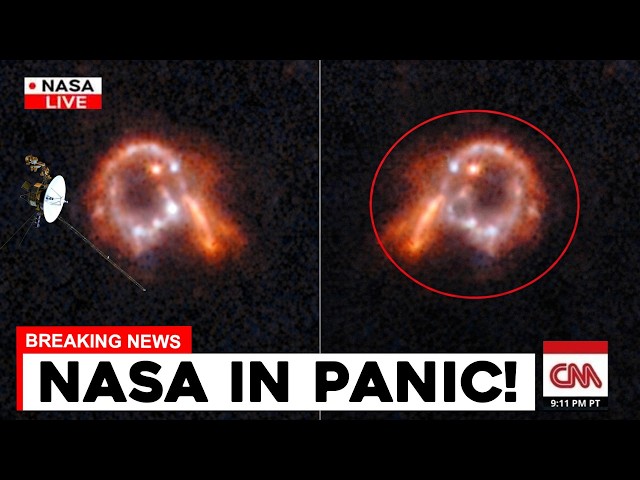
NASA’s legendary Voyager 1 spacecraft has spent nearly half a century traveling farther from Earth than any other human-made object, and the information it continues to return from interstellar space is forcing scientists to reconsider what happens at the distant boundary between our Sun and the galaxy beyond. The dramatic image accompanying this story suggests that Voyager has photographed a mysterious glowing object and that NASA is “in panic,” but no such object has been confirmed.
In fact, Voyager 1 does not have functioning cameras capable of producing new images like the one shown—the spacecraft’s imaging system was switched off decades ago after its famous “Family Portrait” of the Solar System in 1990. What Voyager is still capable of doing is arguably more scientifically valuable: measuring particles, magnetic fields and plasma conditions in a region no operating spacecraft had explored before. Voyager 1 crossed the heliopause—the boundary where the solar wind gives way to the interstellar environment—in August 2012, becoming the first spacecraft to enter interstellar space. Scientists initially expected the environment beyond this boundary to be relatively quiet, but Voyager’s measurements revealed something much more complicated.
The spacecraft detected unexpected changes in cosmic rays, plasma density and magnetic fields, showing that the transition between the Sun’s protective bubble and interstellar space is not a simple, clean border. One particularly fascinating discovery came from Voyager’s Plasma Wave Subsystem, which detected a persistent low-frequency “hum” produced by plasma waves in the interstellar medium. By analyzing these vibrations, researchers can estimate the density of matter surrounding the spacecraft and effectively listen to the otherwise invisible environment between stars.
Voyager 1 has also experienced extraordinary technical challenges. In late 2023, the spacecraft began returning unreadable science and engineering data even though NASA could still communicate with it. Engineers eventually traced the problem to part of its flight data system memory and developed a complex workaround from more than 15 billion miles away. By 2024, useful science data from all four operating instruments had been restored. NASA has continued carefully managing Voyager’s dwindling electrical power, periodically shutting down instruments to extend the mission for as long as possible.
These engineering achievements can sound almost impossible themselves: commands traveling at the speed of light require more than 23 hours to reach Voyager 1, meaning a simple instruction and confirmation can take nearly two days. Yet the aging probe continues transmitting information using technology designed in the 1970s. There is currently no NASA confirmation that Voyager 1 has encountered an alien spacecraft, impossible structure or unidentified glowing object like the one depicted in the thumbnail. The authentic discovery is subtler but perhaps more profound. Voyager is revealing that the frontier of our Solar System is a dynamic region shaped by interactions between solar particles, interstellar plasma, magnetic fields and cosmic radiation.
Every surviving instrument reading provides humanity with measurements from a place no functioning spacecraft has visited before. Eventually Voyager 1’s power will become too weak to operate its remaining scientific instruments, and communication will end. Until then, the tiny spacecraft remains humanity’s most distant explorer—a machine launched in 1977 that is still sending whispers across billions of miles, giving scientists their first direct glimpse into the enormous and largely unexplored ocean of space between the stars.