In 7 Hours, the Moon Turns Blood Red — And Something Else Arrives With It

Skywatchers are preparing for a dramatic sight as the September Harvest Moon rises beside Saturn, creating a striking celestial pairing that may cause the lunar disk to appear orange or deep red near the horizon. The Moon reaches its full phase on September 26, 2026, and should look almost completely illuminated from September 25 through September 27. Saturn will shine nearby as a steady, pale-yellow point of light, offering observers an easy opportunity to identify the ringed planet without advanced equipment.
However, claims that the Moon will become a true “Blood Moon” in seven hours are misleading. A Blood Moon is the popular name for a total lunar eclipse, which occurs when Earth moves directly between the Sun and the Moon, casting its darkest shadow across the lunar surface. No total lunar eclipse is scheduled for this week. The Moon may still appear reddish when it rises because its light must pass through a thicker layer of Earth’s atmosphere.
Shorter blue wavelengths are scattered in different directions, while longer orange and red wavelengths continue toward the observer—the same basic process responsible for colorful sunsets. Dust, smoke, pollution and local weather conditions can intensify the effect, so the color will vary significantly from one region to another. The “seven-hour” countdown is also not universal because moonrise occurs at different times depending on longitude, latitude and time zone.
What arrives alongside the Moon is not a hidden asteroid, alien craft or dangerous object, but Saturn, which only appears close because both bodies occupy a similar direction in Earth’s sky. In physical reality, the Moon is about 384,000 kilometers away, while Saturn is more than a billion kilometers from Earth. There is no risk of the two colliding or exerting an unusual combined gravitational force on our planet. Neptune will also occupy the same broad area of the sky, but it is too faint to see without optical assistance and will require a telescope, a detailed star chart and favorable conditions.
The Harvest Moon takes its traditional name from the bright evening moonlight that once helped farmers continue gathering crops after sunset near the Northern Hemisphere’s autumnal equinox. At this time of year, the angle of the Moon’s orbit can cause it to rise only a little later on several consecutive evenings, making the nights appear unusually moonlit.
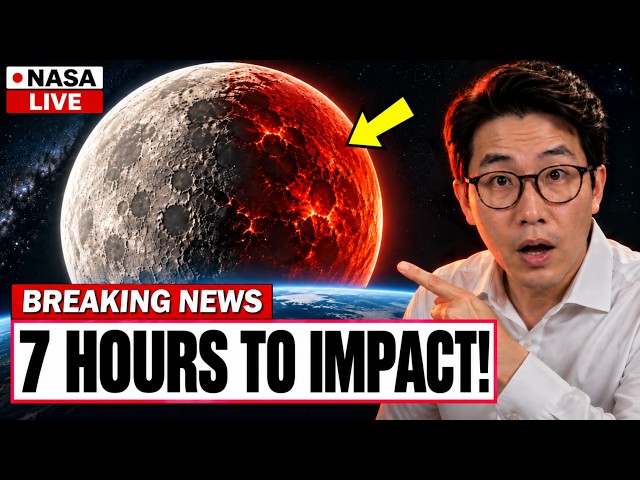
Viewers need no protective glasses to observe the Moon or Saturn; those are required only when looking directly at the Sun. Binoculars may reveal lunar maria and bright crater rays, while a modest telescope can show Saturn’s rings despite interference from the Moon’s glare. The accompanying artwork of a cracked, burning lunar surface and an imminent impact should be treated as fictional.
The Moon will not split open, ignite or threaten Earth. The genuine spectacle is quieter but still impressive: a warm-colored Harvest Moon climbing above the horizon with Saturn shining beside it, transforming an ordinary evening into one of the month’s most memorable skywatching events.