James Webb Just Detected a Planet With a 100% Chance of Life—and It’s Not Earth
The James Webb Space Telescope has intensified the search for life beyond Earth after examining the atmosphere of K2-18 b, a distant planet whose chemical signals have generated both excitement and sharp scientific debate. Located approximately 124 light-years away in the constellation Leo, K2-18 b orbits within the habitable zone of a cool red-dwarf star, where temperatures could theoretically allow liquid water under suitable atmospheric conditions.
The planet is about 2.6 times Earth’s radius and roughly nine times its mass, placing it in a category known as sub-Neptunes—worlds unlike any planet in our solar system. Webb’s observations have provided strong evidence of methane in its hydrogen-rich atmosphere, while some analyses have also reported carbon dioxide. Researchers have proposed that K2-18 b could be a “Hycean” world, potentially possessing a deep global ocean beneath a hydrogen atmosphere. The most sensational claims followed tentative signs of dimethyl sulfide, or DMS, and dimethyl disulfide, known as DMDS.
On Earth, DMS is produced mainly by biological activity, particularly marine microorganisms, making it an intriguing potential biosignature. A subsequent analysis of mid-infrared observations reported evidence consistent with DMS or DMDS at approximately three-sigma significance, meaning random noise could imitate the result roughly once in several hundred comparable experiments.
That is interesting, but it falls far below the level normally required for an extraordinary discovery. Other research teams reprocessed the same Webb data using different analytical pipelines and found insufficient statistical evidence for either molecule. They demonstrated that ethane and other compounds with overlapping infrared features could fit the observations equally well, while variations in data reduction and atmospheric models significantly affected the result. Some studies have even shown that K2-18 b’s spectrum could be explained by an oxygen-poor mini-Neptune with no accessible ocean and no biological activity. Scientists also do not yet know every non-biological pathway capable of producing sulfur-bearing gases under unfamiliar planetary conditions.
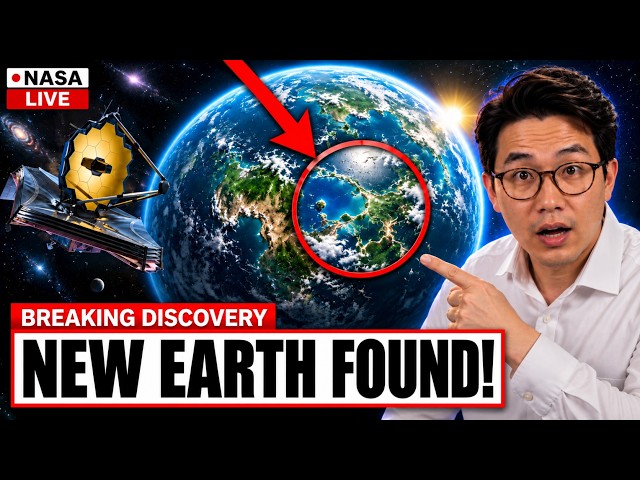
The accompanying thumbnail showing a blue, cloud-covered Earth twin is an artistic reconstruction, not a photograph of K2-18 b. Webb cannot resolve continents, oceans, vegetation or cities on the planet; instead, it measures tiny changes in starlight passing through the atmosphere as K2-18 b crosses in front of its star. No telescope has determined that the planet has a “100% chance of life,” and NASA has made no such confirmation. Habitability is not equivalent to habitation, while a potential biosignature is not proof of biology. Additional Webb observations, laboratory measurements and improved atmospheric models will be needed to determine whether the disputed sulfur signal is genuine and, if so, what produces it.
The responsible conclusion is therefore both more cautious and more compelling than the headline: K2-18 b is not a confirmed living world, but it is one of the most scientifically valuable laboratories yet found for testing whether life-related chemistry can be recognized across interstellar distances. Humanity may not have discovered a second Earth, but Webb has brought astronomers closer than ever to learning how such a discovery could eventually be made.