James Webb Just Saw Titan for the First Time — And Something Is Off
NASA’s James Webb Space Telescope has delivered an extraordinary new look at Titan, Saturn’s largest moon, revealing a world that may look surprisingly familiar while remaining completely alien. Although dramatic images circulating online suggest that Webb may have discovered life on Titan, NASA’s actual findings are more subtle—and scientifically fascinating.
Webb has observed Titan before, with its first observations dating back to November 2022, when its infrared instruments detected clouds and surface features hidden beneath the moon’s thick orange haze. (NASA Science) What makes Titan so unusual is that it is the only moon in the Solar System known to have a dense atmosphere and the only world besides Earth known to currently have rivers, lakes and seas on its surface. But there is a major difference: Titan’s rivers and lakes are not filled with water.
Instead, they contain liquid hydrocarbons such as methane and ethane, which remain liquid because temperatures on Titan can fall to around minus 180 degrees Celsius. (NASA Science) Webb’s infrared vision has allowed scientists to look through Titan’s atmospheric haze and study its weather in unprecedented detail. Observations made in 2022 and 2023, together with follow-up observations from the Keck Observatory, provided evidence of cloud convection in Titan’s northern hemisphere, near the region containing its vast methane lakes and seas.
Scientists observed clouds at different altitudes, helping confirm predictions that Titan experiences a seasonal methane weather cycle remarkably similar in structure to Earth’s water cycle. (NASA Science) Even more intriguing, Webb’s mid-infrared observations detected methyl radicals, a short-lived carbon-containing molecule that plays an important role in the chemical pathway leading from methane to more complex hydrocarbons such as ethane.
According to NASA, sunlight and energetic particles break methane apart in Titan’s upper atmosphere, producing these radicals, which can then recombine into heavier molecules before eventually returning to the surface through condensation and methane-ethane precipitation. (NASA Science) This chemistry is one reason Titan has become such an important target in the search for environments that could potentially support interesting prebiotic chemistry.
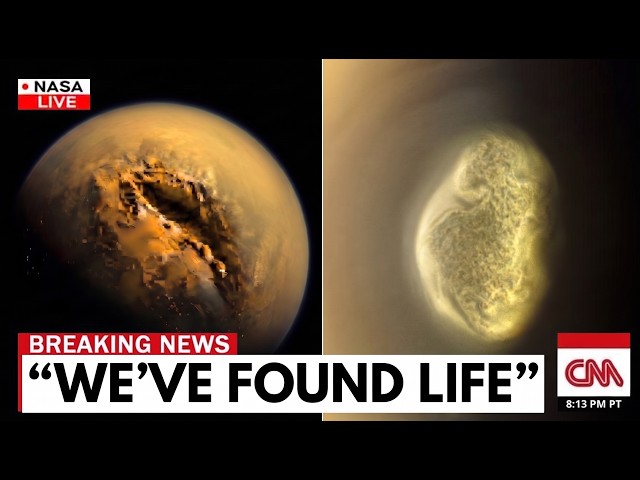
However, there is currently no confirmed evidence that Webb has discovered life on Titan. The spectacular “WE’VE FOUND LIFE” wording in the image should therefore be treated as sensationalized rather than an established NASA announcement.
What Webb has actually revealed may be even more valuable: a dynamic moon with an active atmosphere, complex organic chemistry, clouds, rainfall and vast hydrocarbon seas—all operating under conditions radically different from Earth. Scientists are now trying to understand how Titan’s atmosphere evolved, how its methane cycle works, and whether its chemistry could provide clues about the processes that preceded life.
Future missions could take this investigation much further. NASA’s Dragonfly mission, for example, is designed to explore Titan directly, examining its surface and atmosphere and investigating the moon’s habitability and prebiotic chemistry. For now, Webb’s observations do not show that life has been found—but they do show that Titan is far from the quiet, frozen world it once appeared to be.
Beneath its orange haze lies an active and chemically complex environment, and every new observation seems to raise another question: could this strange moon hold the ingredients needed for life—or is Titan simply showing us another way that a world can evolve?