We Finally Know How Big the Universe Really Is — And It’s Terrifying

Astronomers have produced their most precise picture yet of the observable universe, revealing a cosmic expanse so enormous that familiar distances on Earth become almost meaningless—but scientists caution that humanity still does not know the true size of everything that exists. Current measurements indicate that the universe is approximately 13.8 billion years old, yet the observable region surrounding Earth is about 93 billion light-years across. This apparent contradiction is explained by cosmic expansion.
While light from the most distant regions traveled toward us for billions of years, the space separating those regions from Earth continued to stretch, meaning the objects that emitted the oldest detectable light are now much farther away than 13.8 billion light-years. The observable universe is defined by a horizon: the greatest distance from which information has had enough time to reach us since the early universe became transparent. Beyond that horizon, there may be vastly more galaxies and matter, but their light has not reached Earth and, because expansion is accelerating, some regions may remain permanently inaccessible.
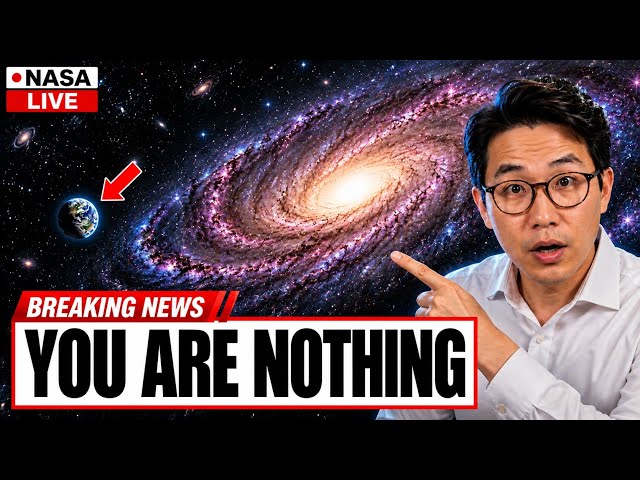
Estimates based on deep-space surveys suggest that the observable universe contains hundreds of billions—and potentially trillions—of galaxies, each holding millions or billions of stars. The Milky Way alone spans roughly 100,000 light-years, yet it is only one galaxy among an almost unimaginable population spread through a web of enormous clusters, filaments and nearly empty voids. The thumbnail’s dramatic “Breaking News” presentation reinforces the message that human beings are vanishingly small compared with the cosmos.
However, its giant galaxy and nearby Earth are an artistic montage rather than a scientifically scaled image; if Earth were shown at its correct size beside the Milky Way, it would be far too small to see. Scientists have not proved that the entire universe is exactly 93 billion light-years wide. That figure describes only the observable portion. Measurements of the cosmic microwave background indicate that space is extremely close to geometrically flat, which means the complete universe could be far larger than the region we can observe, perhaps hundreds of times larger, or even infinite.
An infinite universe would have no physical outer wall, central point or location where space simply ends. Another possibility is that space is finite but unbounded, resembling in three dimensions how Earth’s two-dimensional surface can be traveled without encountering an edge. Researchers continue testing these possibilities through the distribution of galaxies, ancient radiation and the effects of dark energy. What many find “terrifying” is not a newly discovered threat but the scale of our isolation: most galaxies are receding, and sufficiently distant ones will eventually disappear beyond the cosmic horizon.
Yet the same measurements carry an extraordinary achievement. From a single small planet, human beings have reconstructed the history and structure of a universe extending tens of billions of light-years—while recognizing that everything visible may still represent only a tiny window onto a reality whose full extent remains unknown.