Real UFO Sightings 2026 | Clearest UFO & UAP Footage Caught on Camera!
Imagine looking across a remote desert and suddenly noticing a strange silver object hovering above the mountains. Now picture another mysterious craft, this time shaped like a giant flying saucer, apparently engulfed in flames above a tropical forest. These are the dramatic scenes presented in a collection of alleged UFO sightings circulating online in 2026. The images have attracted attention because they seem to capture two extraordinary moments: an unidentified aircraft operating without visible engines and another experiencing what looks like a catastrophic accident. But before concluding that extraterrestrial visitors have arrived, there’s an important question worth exploring: how much can these images actually tell us?
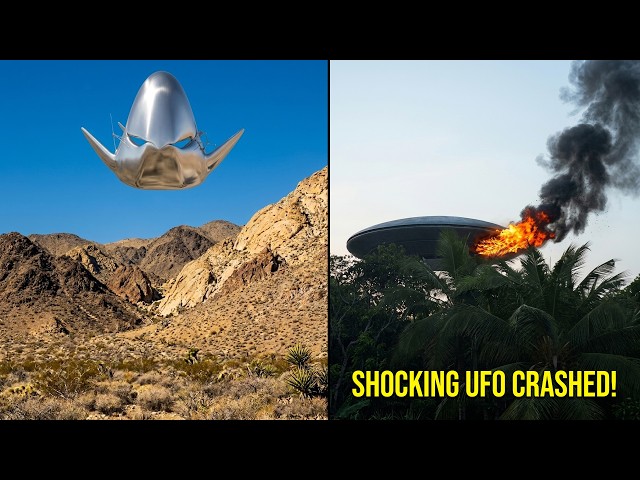
The first scene shows a polished metallic object suspended above a rugged desert landscape. Its unusual structure immediately stands out. Rather than resembling a traditional circular flying saucer, the craft has a tall, rounded central body and several pointed extensions projecting outward from its lower section.
Sunlight reflects across its smooth silver surface, making the object appear almost like an experimental aircraft from the distant future.
You might wonder how something with such an unusual design could remain airborne without visible propellers, wings, or conventional jet engines.
That’s precisely the kind of question investigators would need to examine if the object were documented in an authentic recording.
The second image tells a much more dramatic story.
Behind a line of tropical palm trees, a large disc-shaped object appears to hover dangerously close to the ground. Bright orange flames erupt from one side of the structure, while thick black smoke rises into the sky.
At first glance, the scene resembles an unidentified spacecraft suffering a serious mechanical failure.
The combination of fire, smoke, and an enormous metallic object creates a striking visual impression. It’s easy to understand why such imagery would generate speculation about a mysterious UFO crash.
However, there’s no independently verified evidence that these images show genuine extraterrestrial spacecraft or an actual UFO crash in 2026.
The thumbnail doesn’t establish where either event supposedly occurred, who recorded it, or whether an original, unedited video exists.
The scenes could also have been created or altered using digital effects or artificial intelligence.
That distinction matters because unidentified aerial phenomena, commonly called UAP, are subjects of genuine scientific investigation.
NASA has encouraged researchers to study unusual aerial observations using reliable measurements, transparent analysis, and independently verifiable evidence.
The United States Department of Defense has also investigated UAP reports through the All-domain Anomaly Resolution Office, or AARO.
These investigations don’t begin with the assumption that every unusual object comes from another planet.
Instead, researchers examine possible explanations involving conventional aircraft, drones, atmospheric conditions, optical effects, and limitations in recording equipment.
Consider the silver object hovering above the desert.
Its unconventional appearance might suggest an unfamiliar propulsion system, but a photograph cannot establish how an object moves, how far away it is, or even whether it’s physically present.
Camera angles and perspective can make relatively ordinary objects appear much larger or stranger than they really are.
Modern aerospace engineering also continues to produce aircraft and spacecraft designs that would have seemed impossible just a few decades ago.
Reusable rockets, autonomous flying vehicles, and experimental propulsion technologies demonstrate how rapidly aviation and space exploration can evolve.
Yet an unfamiliar shape isn’t evidence of extraterrestrial engineering.
The burning object in the second image raises a different question: what would happen if a large aircraft or spacecraft suffered a catastrophic failure?
Real aerospace accidents can involve intense flames, structural damage, and falling debris.
Rocket components and satellites can also produce spectacular fireballs as they encounter extreme heating during atmospheric reentry.
If the scene represented a genuine incident, investigators would look for radar observations, independent recordings, eyewitness accounts, emergency communications, and physical debris.
Recoverable materials could reveal important information about the object’s construction and possible origin.
Without that supporting evidence, the appearance of flames and smoke tells us very little about what actually happened.
There’s another complication that’s becoming increasingly important in 2026: artificial intelligence.
Modern image-generation technology can create remarkably convincing metallic spacecraft, desert landscapes, tropical environments, explosions, and smoke effects.
A fictional scene can now resemble a dramatic eyewitness photograph, particularly when presented alongside a sensational headline.
That’s why authenticating the original recording, checking metadata, and comparing independent observations are essential steps in investigating extraordinary claims.
Meanwhile, the broader scientific search for extraterrestrial life continues.
Astronomers have identified thousands of planets beyond our solar system, including rocky worlds that may have conditions suitable for liquid water.
NASA’s James Webb Space Telescope is helping scientists examine the atmospheres of selected exoplanets, while planetary exploration missions investigate environments that might support life closer to home.
These discoveries make the question of extraterrestrial life scientifically meaningful, even though researchers have not confirmed the existence of an alien civilization.
Ultimately, the two images don’t prove that alien spacecraft are hovering above Earth’s deserts or crashing into tropical forests.
They do, however, illustrate why mysterious aerial phenomena continue to attract attention.
As artificial intelligence becomes more sophisticated, separating authentic observations from fictional creations will be increasingly important.
A genuine breakthrough in UFO research would require something stronger than an extraordinary-looking picture: independent observations, measurable evidence, and findings that scientists can examine.
Until then, these mysterious scenes remain intriguing images rather than confirmed extraterrestrial encounters.
What do you think? Could the strange silver object represent an advanced experimental aircraft, or is it a futuristic digital creation? And if you saw a massive flying saucer apparently catching fire above a forest, would your first thought be an extraterrestrial spacecraft, a secret aerospace experiment, or something else entirely? Share your theory in the comments.