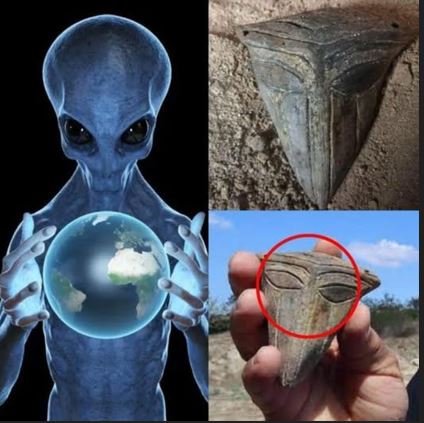
Mysterious Triangular Artifact Sparks New Debate Over Ancient Civilizations and Possible Extraterrestrial Connections
A recently resurfaced image showing a small triangular artifact engraved with what appear to be large almond-shaped eyes has ignited widespread debate across social media, with many users claiming the object could represent one of history’s most mysterious archaeological discoveries. Accompanied by artistic depictions of a classic “Grey alien,” the image has fueled renewed speculation that ancient civilizations may have encountered beings from beyond Earth—or at the very least recorded symbols that continue to puzzle researchers today.
The artifact, reportedly discovered during an archaeological survey in a remote desert region according to online claims, has become the latest subject of viral discussion among UFO enthusiasts, independent researchers, and amateur historians. Supporters argue that the carved object bears an uncanny resemblance to modern depictions of extraterrestrials, while skeptics insist the similarities are coincidental and reflect humanity’s tendency to interpret ancient artwork through the lens of contemporary popular culture.
Within hours of the image appearing online, thousands of users began comparing the carving to alleged alien encounters reported throughout the past century. Some claimed the object represents evidence that contact between humans and non-human intelligences occurred thousands of years ago, while others suggested it could simply be an example of symbolic religious art whose original meaning has long been forgotten.
Although the origins of the artifact remain uncertain, the debate highlights a broader fascination that has existed for decades: the possibility that ancient cultures may have recorded encounters with mysterious beings using the artistic styles available to them at the time.
Throughout history, numerous archaeological discoveries have inspired similar theories. Ancient carvings, unusual statues, cave paintings, and enigmatic symbols found across different continents have frequently been interpreted in dramatically different ways. Traditional archaeologists generally explain these objects within the cultural and religious contexts of the civilizations that created them, whereas proponents of the “ancient astronaut” hypothesis argue that some ancient artworks may depict visitors possessing advanced technology.
Despite these competing interpretations, no universally accepted archaeological evidence has confirmed that extraterrestrial civilizations visited Earth in antiquity.
Researchers emphasize that artistic symbolism often evolves independently across different cultures. Large eyes, elongated heads, and geometric facial features appear repeatedly throughout human history because they carry spiritual, ceremonial, or stylistic significance rather than necessarily representing real biological beings.
Nevertheless, the viral image has reopened discussion surrounding several unexplained discoveries that continue to attract public curiosity. Some internet users point to mysterious stone carvings discovered in South America, unusual figurines recovered from Mexico, enigmatic petroglyphs found in Australia, and ancient rock art from Africa as possible examples of civilizations attempting to depict unfamiliar visitors.
Professional archaeologists, however, urge caution when interpreting isolated artifacts without proper excavation records or scientific analysis. They note that the age, location, material composition, and cultural context of an object are all essential for understanding its purpose. Without verified documentation, assigning extraordinary meanings to an artifact can easily lead to misleading conclusions.
The latest image has also become a focal point in ongoing discussions about whether governments possess undisclosed information concerning extraterrestrial life. Recent congressional hearings on unidentified aerial phenomena (UAP), military pilot testimonies, and whistleblower allegations have renewed public interest in subjects once considered fringe topics. Although officials have acknowledged investigating unexplained aerial incidents, no government has confirmed the existence of alien civilizations or verified archaeological evidence linking ancient humanity to extraterrestrial visitors.
Even so, the possibility of intelligent life elsewhere in the universe remains an active area of legitimate scientific research. Astronomers have identified thousands of planets orbiting distant stars, and powerful telescopes continue searching for atmospheric signatures that could indicate biological activity. Meanwhile, projects dedicated to the Search for Extraterrestrial Intelligence (SETI) monitor space for unusual radio signals that might reveal technologically advanced civilizations.
Scientists stress that the discovery of extraterrestrial life would require extraordinary evidence supported by independently verifiable data. Photographs circulating online, particularly those lacking documented provenance, cannot by themselves establish historical facts.
Experts in digital imaging also warn that advances in artificial intelligence and image-editing software have made it increasingly difficult to determine whether widely shared images accurately represent real objects. Enhanced photographs, manipulated backgrounds, and AI-generated artwork frequently circulate alongside sensational headlines, encouraging speculation while providing little reliable information about an object’s true origin.
Still, the fascination surrounding mysterious artifacts continues to capture the imagination of millions. Whether viewed as forgotten religious symbols, remarkable examples of ancient craftsmanship, or clues to unanswered historical questions, such discoveries remind us how much of humanity’s past remains unexplored.
For many researchers, the greatest mystery is not whether the triangular carving depicts an extraterrestrial being, but rather understanding the people who created it. Every authentic archaeological artifact offers valuable insight into the beliefs, artistic traditions, and worldview of ancient civilizations. Scientific investigation, careful excavation, and rigorous analysis remain the most reliable tools for uncovering those stories.
As debate surrounding the viral image continues, experts encourage the public to distinguish between intriguing possibilities and established evidence. While the triangular artifact may inspire imaginative theories about humanity’s place in the cosmos, its true significance will ultimately depend on careful archaeological research rather than speculation alone. Until new evidence emerges, the object remains another captivating mystery at the crossroads of history, mythology, and the enduring human search for answers beyond our world.