Spielberg’s New Trailer Reignites UFO Debate as Viral Image Fuels Speculation About Alien Disclosure
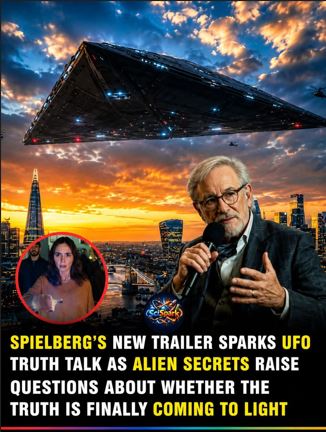
LOS ANGELES — July 2026 — A dramatic promotional image circulating across social media has reignited worldwide discussions about unidentified aerial phenomena (UAPs), government transparency, and the enduring fascination with extraterrestrial life. The viral graphic, featuring acclaimed filmmaker Steven Spielberg beneath an enormous triangular object hovering over a modern city skyline, claims that a new movie trailer has sparked renewed conversation about whether humanity is approaching a new era of UFO disclosure. While the image has generated millions of views and countless online discussions, there is no verified evidence that any upcoming Spielberg project confirms or reveals classified information about extraterrestrial life.

The image depicts what appears to be a colossal triangular craft dominating the evening sky above a metropolitan skyline, while Spielberg is shown speaking during what resembles an interview or promotional event. A smaller inset image features another individual, suggesting that recent public comments and new cinematic material have inspired speculation about long-rumored government secrets concerning unidentified aerial phenomena.
Within hours of the image appearing online, hashtags related to UFO disclosure, alien technology, and Spielberg began trending across several social media platforms. Fans of science fiction praised the legendary director for once again inspiring public curiosity about one of humanity’s greatest mysteries, while others questioned whether the promotional artwork was intended purely as entertainment or as commentary on the growing public interest in unidentified aerial phenomena.
For decades, Steven Spielberg has been closely associated with stories exploring humanity’s relationship with the unknown. His films have shaped public perceptions of extraterrestrial life through memorable portrayals that range from hopeful first contact to mysterious encounters with advanced civilizations. Because of this legacy, many viewers naturally associate his work with ongoing discussions surrounding UFO sightings and government investigations.
The timing of the viral image has further amplified public interest. In recent years, military agencies and governments have acknowledged investigating a number of unidentified aerial phenomena reported by trained personnel. Although several incidents remain officially unresolved, authorities have repeatedly emphasized that an unidentified object should not automatically be interpreted as evidence of extraterrestrial technology. In many cases, limited sensor data, environmental conditions, or insufficient information prevent investigators from reaching definitive conclusions.
The enormous triangular craft featured in the viral image closely resembles one of the most frequently reported shapes described in UFO literature. Over several decades, witnesses around the world have reported sightings of large triangular objects displaying unusual lighting patterns and silent flight characteristics. Some researchers believe these reports deserve careful investigation, while skeptics argue that many sightings can be explained by conventional aircraft, optical illusions, atmospheric effects, or misidentified astronomical objects.
Digital media specialists have also cautioned viewers that the viral graphic itself appears to be a composite illustration rather than a documentary photograph. Modern artificial intelligence image-generation systems and advanced digital editing software make it increasingly possible to create photorealistic scenes that blend recognizable public figures with fictional spacecraft. Without original production materials or verified context, experts recommend treating such images as promotional artwork rather than factual documentation.
Film historians note that science fiction has often reflected society’s evolving hopes and anxieties regarding technological progress and humanity’s place in the universe. During different eras, cinematic depictions of alien visitors have mirrored Cold War tensions, rapid scientific advancement, concerns about artificial intelligence, and questions surrounding first contact with extraterrestrial civilizations. As interest in unexplained aerial phenomena has grown, filmmakers have increasingly incorporated these themes into modern storytelling.
Scientists involved in the search for extraterrestrial intelligence continue emphasizing that the question of whether intelligent life exists elsewhere remains open. Astronomers have confirmed the existence of thousands of planets orbiting distant stars, many of which reside within regions where liquid water could potentially exist. Space telescopes continue searching for atmospheric signatures that might indicate biological activity, while radio observatories scan the cosmos for possible technological signals. Despite these ongoing efforts, no verified evidence has yet confirmed the existence of extraterrestrial civilizations or demonstrated that alien spacecraft have visited Earth.
Media analysts suggest that the viral success of the image reflects a broader cultural shift. Public interest in UFO-related topics has expanded significantly following congressional hearings, military reports, and increasing government transparency regarding unexplained aerial observations. Combined with the influence of iconic filmmakers such as Spielberg, these developments have created renewed enthusiasm for stories exploring the boundaries between science, mystery, and imagination.
Psychologists studying viral media note that images combining famous personalities, mysterious objects, and provocative headlines often spread rapidly because they appeal to curiosity and encourage speculation. Social media algorithms amplify visually striking content, allowing fictional concepts, artistic interpretations, and authentic news to circulate side by side, making it increasingly important for audiences to distinguish verified reporting from creative storytelling.
Entertainment industry observers also point out that science fiction frequently serves as a platform for discussing profound philosophical questions rather than making factual claims. Themes involving first contact, advanced civilizations, and humanity’s future continue to inspire filmmakers because they encourage audiences to reflect on scientific discovery, ethics, exploration, and our place in the cosmos.
For now, the viral image remains a compelling piece of promotional-style artwork rather than evidence of imminent alien disclosure. Although it has successfully reignited conversations surrounding unidentified aerial phenomena and the possibility of intelligent life beyond Earth, there is no verified evidence that Steven Spielberg possesses classified information about extraterrestrials or that any new trailer reveals hidden government secrets.
As scientific investigations into unidentified aerial phenomena continue and astronomers expand the search for life elsewhere in the universe, public fascination with these questions is unlikely to fade. Whether inspired by groundbreaking research, official investigations, or imaginative cinema, humanity’s enduring curiosity about what may exist beyond our world continues to drive both scientific exploration and creative storytelling. Until verifiable evidence emerges, however, the mystery remains one of the greatest unanswered questions of the modern age.