George H.W. Bush, UFO Secrecy, and the Claims That Refuse to Disappear
By Staff Reporter | Special Report
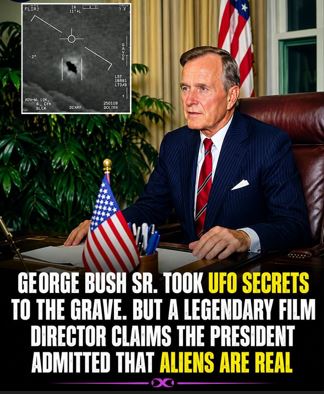
For decades, speculation surrounding unidentified flying objects (UFOs)—now officially referred to by many government agencies as Unidentified Anomalous Phenomena (UAP)—has generated countless theories about what world leaders may have known behind closed doors. A new image circulating widely across social media has once again fueled that debate, claiming that former U.S. President George H.W. Bush “took UFO secrets to the grave” and that a well-known film director alleged the president privately admitted aliens were real.
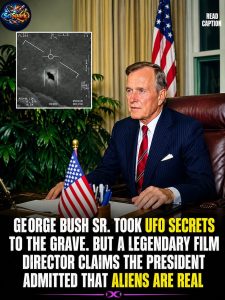
The dramatic graphic, featuring Bush seated in the Oval Office alongside an image resembling a military-recorded unidentified object, has accumulated thousands of shares across multiple online platforms. While the image has reignited public curiosity, experts caution that the claims presented remain unverified and should not be interpreted as established fact.
A Long History of UFO Speculation
George H.W. Bush’s background has made him a recurring figure in UFO discussions. Before becoming the 41st President of the United States, Bush served as Director of the Central Intelligence Agency (CIA) in 1976 and later held numerous national security positions.
Because of his intelligence background, some UFO researchers have speculated that Bush may have had access to classified information concerning unusual aerial phenomena.
However, despite decades of speculation, no publicly released government document has demonstrated that Bush possessed or acknowledged evidence confirming extraterrestrial visitors.
Instead, most claims rely on anonymous sources, secondhand stories, or interpretations of comments made by individuals outside government.
The Hollywood Connection
The viral image also references statements allegedly made by a legendary Hollywood filmmaker.
Over the years, several filmmakers, actors, journalists, and entertainment figures have discussed conversations they claim to have had with military officials, intelligence personnel, or political leaders regarding UFOs.
Some have suggested that influential government figures privately acknowledged unexplained aerial incidents while refusing to publicly discuss the subject.
Yet none of these stories have been independently verified with documentary evidence.
Historians note that personal recollections—especially those reported many years after the events allegedly occurred—should be treated carefully unless supported by official records.
Government Transparency Has Increased
Although extraordinary claims remain controversial, it is true that the U.S. government has become more transparent regarding unidentified aerial incidents in recent years.
Since 2017, several Navy videos showing unusual airborne objects have been officially acknowledged by the Pentagon.
Congress has also held multiple public hearings examining military reports involving UAPs.
Officials have repeatedly stated that many incidents remain unexplained because of insufficient data—not because they have concluded the objects are extraterrestrial.
Current investigations focus on determining whether such sightings involve advanced drones, foreign surveillance technologies, atmospheric phenomena, sensor errors, or other explanations.
Why Bush Remains Part of the Conversation
Researchers who believe governments possess hidden UFO information often point to Bush’s intelligence career as a reason he might have been aware of classified programs.
Supporters of this theory argue that highly sensitive aerospace projects are compartmentalized, meaning only a small number of officials receive access.
Skeptics counter that there has never been credible evidence showing Bush participated in any secret extraterrestrial program.
Political historians likewise emphasize that numerous presidential libraries, declassified intelligence records, and memoirs have been examined over the years without revealing proof of alien contact.
Public Interest Continues to Grow
The debate surrounding UFOs has evolved dramatically over the last decade.
Rather than dismissing every report outright, scientists increasingly encourage careful investigation using high-quality sensor data, radar information, satellite imagery, and multiple eyewitness accounts.
Astronomers also note that the universe contains billions of potentially habitable planets, making the search for extraterrestrial life an active field of scientific research.
However, discovering microbial life elsewhere—or even intelligent civilizations somewhere in the galaxy—is entirely different from demonstrating that extraterrestrial spacecraft have visited Earth.
That distinction remains central to the ongoing discussion.
Experts Urge Critical Thinking
Digital media analysts say images like the one currently circulating are designed to attract attention by combining recognizable public figures with dramatic headlines.
Without accompanying evidence such as official documents, authenticated recordings, or independently verified testimony, experts recommend treating sensational claims with caution.
Several organizations dedicated to investigating aerial phenomena stress that every case should be evaluated on its own merits using verifiable evidence rather than assumptions.
Extraordinary claims require equally extraordinary supporting data.
The Bottom Line
The viral image has once again placed George H.W. Bush at the center of one of the longest-running mysteries in modern history.
It reflects growing public fascination with government secrecy, classified aerospace programs, and the possibility of intelligent life beyond Earth.
However, despite decades of rumors, no publicly available evidence has confirmed that Bush admitted aliens were real or possessed definitive knowledge of extraterrestrial visitors.
As official UAP investigations continue and additional government records are reviewed, interest in the mystery is unlikely to fade.
For now, the discussion remains suspended between documented facts, unanswered questions, and speculation—reminding observers that curiosity about what may exist beyond our world continues to capture imaginations across generations.