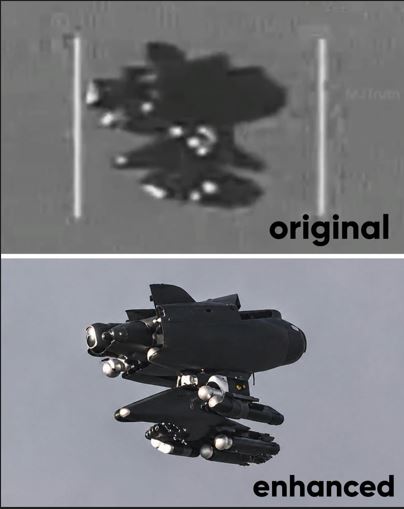
Pentagon Drops Fourth UFO File Dump: “Clearest Footage Yet” Shows Bizarre Two-Tiered Object Over Atlantic
WASHINGTON, D.C. — July 2026 — A newly released military video allegedly showing an unidentified aerial phenomenon (UAP) over the Atlantic Ocean has ignited a fresh wave of debate among defense analysts, scientists, and UFO researchers worldwide. The footage, described online as the Pentagon’s “clearest release yet,” appears to capture a strange two-tiered object unlike any conventional aircraft currently known to the public. While the unusual shape has fueled speculation about advanced technology and possible non-human origins, officials caution that the object’s identity remains unconfirmed and that no evidence has established an extraterrestrial explanation.
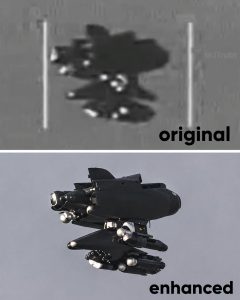
The grayscale infrared footage, reportedly recorded by a U.S. military aircraft during a routine patrol, quickly spread across social media after defense commentators claimed it was part of a fourth batch of declassified UAP material. Alongside the original thermal image, digital artists produced enhanced visualizations intended to highlight structural details that are difficult to distinguish in the low-resolution recording. The enhanced version appears to show a layered, asymmetrical craft featuring a large upper body connected to a smaller lower platform by a narrow central section, creating what many online observers have described as a “two-tiered” design.
Within hours of the video’s release, analysts from across the aerospace community began examining every visible frame. Image-processing enthusiasts attempted to sharpen the footage, stabilize camera movement, and reconstruct the object’s geometry using artificial intelligence. While these enhanced images generated considerable excitement, experts emphasized that enhancement techniques cannot recover details absent from the original recording. Instead, such methods often interpolate missing information, meaning the enhanced images should be viewed as visual interpretations rather than exact representations of the recorded object.
According to individuals familiar with the alleged incident, the object was detected during a surveillance mission over international waters in the Atlantic. Operators reportedly observed the target maintaining steady flight while displaying no obvious wings, tail surfaces, or conventional propulsion signatures visible through infrared sensors. Witnesses have claimed the object executed subtle directional adjustments without producing the exhaust plumes typically associated with jet-powered aircraft, although these accounts have not been independently verified.
The release has inevitably drawn comparisons to previous military UAP videos that sparked international headlines in recent years. Those earlier recordings—including the well-known “Tic Tac,” “Gimbal,” and “GoFast” incidents—prompted renewed government interest in unidentified aerial phenomena and led to expanded reporting procedures within the U.S. Department of Defense. While several cases remain officially unresolved, defense officials have repeatedly stressed that “unidentified” does not necessarily imply extraterrestrial origin. Instead, it simply indicates that available information has been insufficient to determine a definitive explanation.
Aerospace engineers reviewing the latest footage have proposed several possibilities. Some suggest the object could represent an experimental military platform viewed from an unusual angle, while others note that atmospheric distortion, infrared sensor limitations, and camera tracking systems can produce visual effects that make familiar objects appear extraordinary. Aircraft photographed through long-range infrared systems often lose recognizable features, particularly when viewed at great distances or under challenging environmental conditions.
Computer vision specialists have also warned against relying too heavily on AI-enhanced imagery. Modern enhancement algorithms are designed to predict fine details based on learned visual patterns rather than recovering hidden information directly from the source image. As a result, structures visible in enhanced versions may not accurately reflect the object’s true appearance. Researchers therefore continue to emphasize that any technical analysis should prioritize the original sensor data rather than digitally reconstructed images circulating online.
Despite these cautions, the video’s unusual appearance has reignited speculation about advanced aerospace technologies. Some UFO researchers argue that the layered configuration differs significantly from conventional aircraft designs and could indicate propulsion concepts not currently understood in public aerospace engineering. Others suggest the object might represent an advanced drone, classified reconnaissance platform, or another form of experimental technology operating under restricted military programs.
Scientists, however, continue urging restraint. Extraordinary claims require multiple independent sources of evidence, including radar tracking, high-resolution imagery, telemetry, eyewitness testimony, and reproducible observational data. A single infrared recording—even one released through official channels—cannot by itself establish the nature or origin of an unidentified object.
The renewed public attention reflects a broader shift in how unidentified aerial phenomena are discussed. Rather than dismissing unexplained observations outright, defense agencies and scientific organizations increasingly encourage systematic investigation using standardized reporting procedures and rigorous analytical methods. This approach aims to distinguish between sensor anomalies, natural atmospheric events, classified technology, and genuinely unexplained observations without prematurely reaching extraordinary conclusions.
Public fascination with UAPs has also expanded as governments around the world acknowledge that a small number of military encounters remain unresolved after initial investigation. At the same time, officials continue emphasizing that unresolved cases do not automatically constitute evidence of extraterrestrial visitors. Many incidents ultimately receive conventional explanations once additional information becomes available.
Whether the newly released Atlantic footage ultimately proves to depict advanced military technology, a misunderstood sensor artifact, or another unexplained phenomenon remains unknown. Investigators are expected to continue reviewing available flight data, radar information, environmental conditions, and sensor recordings in an effort to better understand what military personnel observed during the encounter.
For now, the latest release serves as another reminder of the enduring mystery surrounding unidentified aerial phenomena. The video has reignited public curiosity, inspired renewed technical analysis, and intensified discussions about the limits of current aerospace knowledge. Yet despite widespread online speculation and increasingly sophisticated image enhancements, there is currently no publicly verified evidence demonstrating that the object shown in the footage is extraterrestrial in origin. Until additional corroborating evidence becomes available, the two-tiered object remains exactly what investigators officially describe it as: an unidentified aerial phenomenon awaiting further scientific and technical analysis.