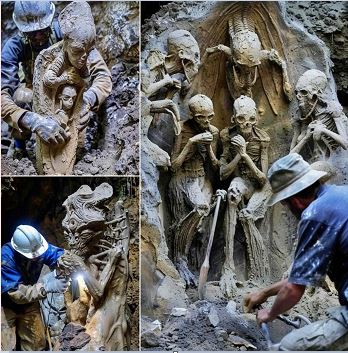
In the vast expanses of the Egyptian desert, where the scorching sun and imperceptible areas have kept ancient secrets, a recent discovery has shaken the foundations of traditional archaeology: the discovery of what some call “the extraterrestrial Egyptologist.” During an excavation in a remote region near the Giza Plateau, a team of researchers unearthed an artifact that defies conventional explanation, leading to speculation about the possible involvement of otherworldly beings in the ancient Egyptian civilization. This article explores the details of this riddle and the theories that have arisen around it.
The discovery took place in a previously unknown underground tomb, discovered by chance when a group of archaeologists was searching for remains of a forgotten diastia. Among the everyday objects—vessels, hieroglyphics, and sarcophagus fragments—something completely out of place appeared: a figure carved from an unknown material, with characteristics that do not fit with traditional Egyptian art. The statue, which is 30 centimeters tall, depicts a humanoid figure with an elongated skull, large, almond-shaped eyes, and disproportionately thin limbs. Experts have described its appearance as “extraterrestrial,” which has generated a storm of controversy and fascination.
The material of the figure is another mystery. Preliminary analysis suggests that it is not stone, metal, or ceramic known in ancient Egypt, but an alloy or composite that does not match the technology of the time, dated to 2,500 BC. Some researchers have suggested that it could be of meteoritic origin, while others, more daring, suggest that it was brought to Earth by visitors from the stars. The most intriguing thing is its location: the figure was placed in a sealed chamber, surrounded by hieroglyphics that have not yet been fully deciphered, but which seem to refer to “messengers from heaven.”
Theories about this “extraterrestrial Egyptologist” — so nicknamed for his position, which resembles a scribe or scholar — have not been long in coming. Proponents of the ancient astropath hypothesis argue that this find is proof that extraterrestrial beings interacted with the Egyptians, perhaps guiding them in the construction of the pyramids or imparting advanced knowledge. He points to the mathematical precision of the structures at Giza and other unsolved mysteries as circumstantial evidence. The figure, he says, could be a representation of these visitors or a tribute to them by Egyptian priests.
However, the mainstream academic community remains skeptical. Some experts suggest that the statue could be a modern forgery brought to the site, although initial dating evidence contradicts this idea. Others propose that it is an artistic anomaly, perhaps a stylized deformation of a god or pharaoh, created by an eccentric craftsman. The encircled hieroglyphs, once fully translated, might offer clarity, but so far have only added more questions than answers.
The impact of this discovery transcends archaeology. Already obsessed with the possibility of extraterrestrial life, the “extraterrestrial Egyptologist” has captured the public’s imagination, inspiring social media debates, documentary films, and speculation. For Egypt, it represents an opportunity to revitalize interest in its heritage, while also raising the risk of science being overshadowed by signaling.
The discovery of this enigmatic figure in the Egyptian desert forces us to rethink what we think we know about the past. Is it a relic of a forgotten cosmic contact or simply an earthly mystery yet to be deciphered? While scientists continue their research, the “extraterrestrial Egyptologist” remains a symbol of the unknown, challenging other societies of history and humanity beneath Egypt’s eternal realms.