“Near Collision With Commercial Airliner”: Viral UFO Video Makes an Alarming Claim, but Nothing Is Confirmed
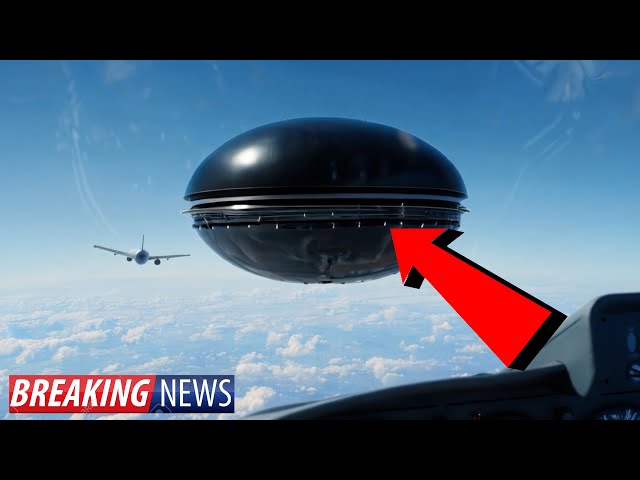
A video titled “BREAKING UFO NEWS! NEAR COLLISION WITH COMMERICAL AIRLINER!” is circulating online, led by a thumbnail that appears to show a glossy black, disc-shaped object hovering in the sky as seen from a cockpit, with a passenger jet visible in the distance. A bold red arrow points at the object, and a “Breaking News” banner sits in the corner. The title claims that an unidentified craft came dangerously close to a commercial airliner. It names no airline, flight, date, or location, and no aviation authority, airline, or established news organization has been identified as confirming any such incident.
What the thumbnail shows
The image presents a view over the nose of an aircraft, with part of a cockpit panel visible in the lower right corner. Ahead, a smooth, glossy, black object shaped like a flattened egg or lens floats above a sea of white clouds. A thin ring of metallic structure runs around its middle, and a bright highlight gleams on its upper surface. At the left of the frame, a small passenger jet appears at a considerable distance, its wings and tail faintly visible against the blue sky.
What the image does not show is just as telling. There is no flight number, no airline livery, no instrument reading, no altitude or speed display, and no timestamp. Nothing identifies where the scene took place. The airliner in the frame looks far away, so the picture does not actually depict anything resembling a near collision. In aviation, a “near miss” has a specific meaning, usually involving two aircraft passing within a short distance, and such events are formally reported and investigated. The thumbnail provides no basis for judging distance at all.
Signs the imagery may not be real
Several features suggest the picture was created digitally rather than photographed. The object’s surface is unusually clean and uniformly glossy, its reflections look idealized, and the lighting does not quite match the soft glare of high-altitude sunlight. The composition is also very polished: the object sits dead center, the airliner is placed neatly at the side, and the cockpit edge frames the corner like a film poster. Real photographs taken through cockpit windows usually show reflections, scratches, glare, and haze, and they are rarely this clean. Some faint streaks on the sky resemble window marks, but they may have been added to make the image look authentic.
None of this proves what the video itself contains, since thumbnails are often made separately from the footage. But it does mean the image should not be treated as evidence of a real encounter.
How real aviation incidents are handled
If a commercial airliner truly had a close encounter with an unknown object, the paper trail would be extensive. Pilots are required to report serious near-miss events, and air traffic controllers log radio communications and radar tracks. Aviation safety agencies in many countries investigate reported close calls and publish findings. Airlines may issue statements, and passengers who witnessed the event would likely post accounts. Flight-tracking services would show the route and altitude of the aircraft involved.
The title promises breaking news, yet no independent record of this kind has been identified. A video that omits the flight, the date, and the location also omits everything that would allow anyone to check it.
Official attention to UAP and aviation safety
Unidentified aerial phenomena (UAP) have received more serious attention in recent years, and aviation safety has been part of the discussion. Government bodies in several countries have invited pilots to report unexplained sightings, partly out of concern for flight safety. That shift helps explain why a video claiming a close call with an airliner attracts attention.
But official interest in the subject is not the same as official confirmation of any particular viral claim. Investigators publish findings in reports and data releases, not in thumbnails. So far, there is no sign that any agency has confirmed the event this video suggests.
The anatomy of a clickbait package
The thumbnail relies on a familiar formula:
- A news-style banner that suggests a real broadcast, though anyone can add one
- A giant red arrow that implies something important is hidden in the image
- Alarming keywords such as “near collision” and “commercial airliner,” built to trigger concern about safety
- A cockpit viewpoint that gives the impression of a first-hand pilot recording
- Capital letters and exclamation marks that signal urgency, even in a title with a spelling error
These elements are effective because they trigger fast emotional reactions. They are also easy to reproduce, and AI image tools now make it possible to produce a convincing scene in minutes. A viewer cannot tell from a thumbnail alone whether the underlying video shows a genuine event, a staged clip, a flight-simulator capture, a fictional production, or recycled footage from elsewhere.
Ordinary explanations worth considering
Even real footage of strange objects near aircraft is often misunderstood. Weather balloons, drones, other aircraft, birds, and high-altitude research balloons can all appear near flight paths. Lens flare and reflections on cockpit glass can create dark, glowing, or disc-like shapes. Judging distance and size in the sky is notoriously difficult, since a small object close to a camera can look like a large object far away, and the reverse. Cloud formations, contrails, and space debris re-entering the atmosphere may also add to the confusion. None of these explanations applies to every case, and some reports remain unresolved, but they show why careful analysis is needed before reaching extraordinary conclusions.
How to check a claim like this
Media-literacy specialists suggest a straightforward process:
- Look for specifics. Does the video name an airline, a flight, a date, and a location?
- Search for independent coverage. Check established news outlets, airline statements, and aviation authority announcements.
- Reverse-search the image. Tools that trace image origins can reveal whether a picture comes from an AI gallery, a simulator, or a film.
- Compare the thumbnail with the footage. Does the video actually show the encounter, or only a teaser image?
- Check the channel. Does it have a record of verified reporting, or mainly sensational titles?
Why this content spreads
Fear for safety is a powerful motivator, and the idea of a mysterious object endangering a planeload of passengers makes an almost perfect click magnet. Platforms reward strong reactions, so each comment, share, and debate helps the video travel, regardless of accuracy. There is also a cost. Exaggerated or fabricated incident videos can spread unnecessary alarm, particularly among people who fly regularly, and make it harder for audiences to take well-documented cases seriously.
The bottom line
As it stands, there is no verified evidence that a UFO nearly collided with a commercial airliner. The thumbnail appears to be a digitally created image, it does not actually show a close encounter, the title offers no checkable details, and no credible source has backed up the claim.
Unidentified aerial phenomena remain a legitimate subject of study, and unexplained reports, especially those involving aviation safety, deserve careful, evidence-based investigation. But that work depends on data, not dramatic artwork. Until reliable reporting, official statements, or verifiable original footage emerge, this story is best treated as a viral curiosity: striking to look at, impossible to confirm, and a reminder to ask who made an image, and why, before believing it.