“Best UFO Videos of November 2024! What Just Happened Over Our World?” Compilation Video Resurfaces, but Its Claims Remain Unverified
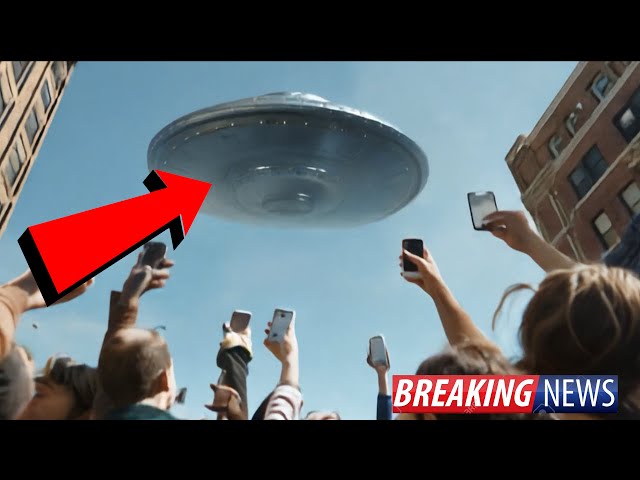
A video titled “BEST UFO Videos Of November 2024! What Just Happened Over Our WORLD?” is circulating online, led by a thumbnail of a large, silver, saucer-shaped object hovering above a city street while a crowd points phones at the sky. A bold red arrow points at the object and a “Breaking News” banner sits in the corner. The title presents the video as a roundup of the month’s most striking sightings and asks, in dramatic terms, what happened “over our world.” It names no specific event, location, or witness, and no official agency or established news organization has been identified as confirming anything extraordinary.

What the thumbnail shows
The image presents a daytime scene on an urban street. A smooth, gray-silver disc with a domed center and a ringed underside floats against a clear blue sky. Below it, a cluster of hands holds up smartphones, some raised high, others angled upward, while the heads and shoulders of several people are visible at the bottom of the frame. Older brick buildings line the left and right edges, forming a natural frame around the craft.
What the image does not show is just as telling. There are no signs, street names, or landmarks that identify the city. No one’s face is clearly visible, and no emergency vehicles, aircraft, or officials appear. Nothing in the image indicates when it was made, and it offers no link to the month named in the title.
Signs the imagery may not be real
Several features suggest the picture was created digitally rather than photographed. The disc has an unusually clean, uniform surface and lighting that does not quite match the bright daylight around it. The crowd is arranged almost perfectly, with each phone held at a distinct, easy-to-read angle, as if staged for a film poster. Real crowd photographs tend to be messier, with overlapping figures, motion blur, and distracting background detail. Some of the hands and phones also look slightly simplified, a common trait of AI-generated imagery.
None of this proves what the video itself contains, since thumbnails are often made separately from the footage. A compilation might include real clips from many sources, but the cover image should not be treated as evidence of any of them.
The compilation format
“Best of” roundups are a staple of online UFO content. Creators gather clips from social media, news broadcasts, and viewer submissions, add dramatic music and commentary, and package them under an urgent title. The format has real appeal: it saves viewers the effort of searching and suggests a pattern across many sightings.
It also has well-known weaknesses. Clips in compilations often arrive without their original context, such as the date, place, camera type, or the identity of the person who recorded them. Footage is frequently re-uploaded, cropped, sped up, or color-adjusted, which can make ordinary objects look strange. Old videos may be recycled under new titles, and some clips are staged, edited, or generated by software. When many unverified clips are placed together, their number can create an impression of strength that none of them has on its own.
A title from 2024, still circulating
The reference to November 2024 is worth noting. Late 2024 was a period of heightened public attention to unexplained aerial reports, particularly drone sightings in the northeastern United States, which drew heavy media coverage and public concern. Officials said at the time that many of the reported objects turned out to be ordinary aircraft, hobby and commercial drones, and other known objects, although the episode raised real questions about airspace monitoring and public communication.
Videos tied to that period continue to circulate, sometimes with new “breaking news” framing. Viewers who see an older compilation promoted as if it were current should treat the “Breaking News” label with caution. A title naming a past month is not reporting on something that happened today, and the thumbnail’s banner can mislead people into thinking it is.
“What just happened over our world?”
The closing question is a familiar device. It implies that something significant occurred, that it affected the entire planet, and that viewers must watch to learn what it was. Yet the title provides no answer, and a question mark lets the creator suggest drama without making a claim that can be checked. The phrase “over our world” widens the scope without naming a single country, city, or witness.
If a truly global event had taken place in November 2024, it would be well documented. Governments, aviation authorities, scientists, and news organizations on every continent would have issued statements and analyses, and the story would be easy to find through independent sources. The title does not point to any such record.
What strong evidence looks like
Researchers who study unidentified aerial phenomena generally look for more than a single clip. Strong cases usually include:
- The original, unedited video, ideally with metadata showing the time, date, and device
- Multiple independent recordings from different angles, which allow the object’s size, distance, and motion to be estimated
- Corroborating data, such as radar records, flight-tracking information, or weather balloon launch schedules
- Named witnesses who can be interviewed
- Expert analysis that rules out ordinary explanations
A thumbnail and a dramatic title offer none of these. A compilation may contain footage that meets some of these standards, but viewers cannot tell which clips, if any, do without tracing each one to its source.
Ordinary explanations worth considering
Even real footage of unusual sights in the sky is often misunderstood. Aircraft lights, drones, balloons, satellites, and the growing number of satellite constellations can produce strange visuals, especially when filmed through a phone camera. Lens flare, reflections on windows, insects close to the lens, and compression artifacts can create shapes and movements that seem inexplicable. A group of people looking up is also not proof of anything unusual: crowds gather for balloons, advertising blimps, skywriting, and rocket launches. None of these explanations applies to every case, and some reports remain unresolved, but they show why careful analysis is needed before reaching extraordinary conclusions.
How to check a claim like this
Media-literacy specialists suggest a straightforward process:
- Look for specifics. Does the video name a place, a date, and a source for each clip?
- Search for independent coverage. Check established news outlets and official agency websites for the events described.
- Reverse-search the image and clips. Tools that trace origins can reveal whether a picture comes from an AI gallery, a film, or an older source.
- Compare the thumbnail with the footage. Does the video actually show what the cover image suggests?
- Check the channel. Does it have a record of verified reporting, or mainly sensational titles?
Why this content spreads
Curiosity about the unknown is powerful, and a glowing disc, a crowd of witnesses, and an urgent headline make an almost perfect click magnet. Platforms reward strong reactions, so each comment, share, and debate helps the video travel, regardless of accuracy. There is also a cost. Exaggerated or fabricated videos can spread unnecessary alarm and make it harder for audiences to take well-documented cases seriously.
The bottom line
As it stands, there is no verified evidence that anything extraordinary “just happened over our world,” and the video’s title does not identify a specific event that can be checked. The thumbnail appears to be a digitally created image, the footage inside the compilation cannot be assessed from the cover alone, and no credible source has backed up the implied claim.
Unidentified aerial phenomena remain a legitimate subject of study, and unexplained reports deserve careful, evidence-based investigation. But that work depends on data, not dramatic artwork. Until reliable reporting, official statements, or verifiable original footage emerge, this video is best treated as a viral curiosity: striking to look at, impossible to confirm, and a reminder to ask who made an image, and why, before believing it.