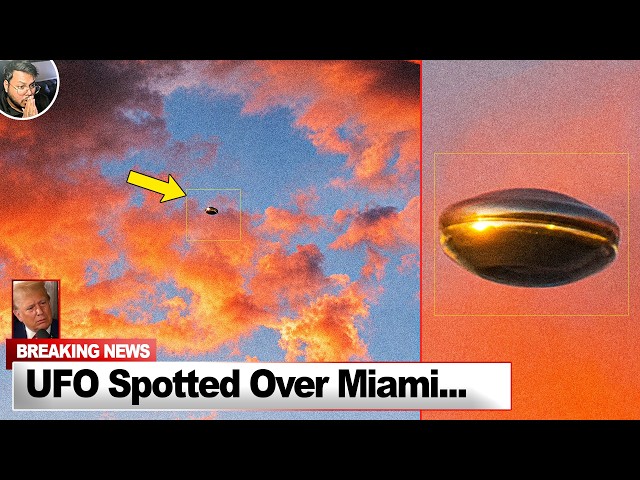
A mysterious metallic object allegedly spotted hovering above Miami during the growing excitement surrounding Grand Theft Auto VI has sparked a fascinating debate about unidentified flying objects, viral marketing, and the possibility of extraterrestrial visitors. The dramatic image shows a small, disc-shaped object suspended against a spectacular orange sunset, while an enlarged view reveals what appears to be a smooth metallic spacecraft reflecting golden sunlight. The unusual sight has inspired an extraordinary question: could a mysterious UFO really have appeared over Miami during a major gaming promotional campaign, or is this part of an elaborate publicity stunt designed to capture worldwide attention?
Miami has become a particularly interesting location for this type of speculation because of its connection to Grand Theft Auto VI, the highly anticipated video game developed by Rockstar Games. The game features Vice City, a fictional destination inspired by Miami, complete with tropical scenery, vibrant nightlife, beaches, and the distinctive atmosphere of South Florida.
The connection between Miami and the Grand Theft Auto franchise has encouraged fans to search for possible promotional clues, hidden references, and unusual events that might be associated with the game’s marketing.
However, there is no verified evidence that Rockstar Games organized a UFO appearance above Miami as part of its GTA VI promotional campaign.
The alleged sighting has also attracted attention because of Miami’s history of unusual aerial reports.
In January 2024, a viral conspiracy theory claimed that enormous extraterrestrial creatures had appeared near Bayside Marketplace in downtown Miami after a significant police response.
Social media users circulated dramatic stories suggesting that mysterious figures had been witnessed walking through the area.
Authorities explained that the police response involved a disturbance among teenagers, and no credible evidence emerged supporting claims of extraterrestrial creatures.
The incident demonstrated how quickly unusual footage and incomplete information can develop into extraordinary online narratives.
The latest UFO-themed image follows a similar pattern.
Its central object resembles the classic flying saucer design that has dominated popular culture since the middle of the twentieth century.
The enlarged section shows a smooth, circular metallic body with a glowing band of reflected light, creating the impression of an advanced craft without visible wings or conventional engines.
But the image alone cannot establish whether the object is a genuine aircraft, a drone, a digital creation, or an edited photograph.
Without access to an authenticated original recording, precise location information, reliable witness accounts, and independent observations, its true origin cannot be determined.
Scientists studying unidentified anomalous phenomena emphasize that unusual appearances do not automatically indicate extraterrestrial technology.
Small objects photographed against the sky can appear enormous when their distance is unknown. Reflections, camera effects, unusual lighting, and perspective can also make familiar objects look extraordinary.
Even a seemingly perfect flying saucer silhouette may result from a digitally manipulated image or an object whose actual shape is difficult to determine.
The broader UFO debate has nevertheless gained serious scientific attention.
NASA has encouraged researchers to investigate unidentified phenomena using reliable data, while the Pentagon’s All-domain Anomaly Resolution Office continues examining reports involving unusual aerial observations.
Some cases remain unresolved because investigators lack sufficient information, but no publicly verified evidence has established that extraterrestrial spacecraft are regularly visiting Earth.
Meanwhile, the entertainment industry has a long history of using mysterious imagery, fictional conspiracies, and spectacular visual effects to generate excitement.
The Grand Theft Auto franchise itself has included UFO-related Easter eggs and science-fiction references, making the connection especially appealing to fans.
That creative history, however, does not prove that a real-world UFO sighting is part of an official marketing campaign.
If a genuine unidentified object appeared over Miami, investigators would need multiple independent videos, radar information, verified timestamps, and careful analysis of its movement before drawing conclusions.
The most fascinating mystery is not that aliens have been confirmed flying over Miami during GTA VI marketing—they haven’t—but how a single dramatic image can bring together gaming culture, UFO mythology, and humanity’s enduring curiosity about life beyond Earth. Whether the object is an artistic creation, a publicity-inspired rumor, or an ordinary sighting awaiting explanation, the story demonstrates that the fascination with mysterious visitors in our skies is far from over.