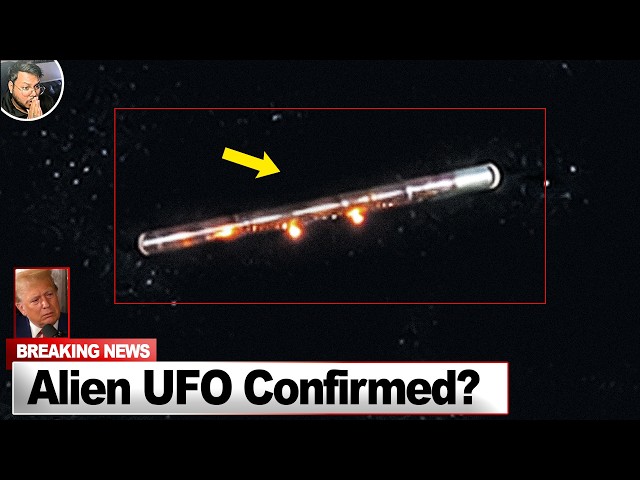
A mysterious unidentified object appearing to travel through the darkness of space has sparked extraordinary speculation about a possible extraterrestrial spacecraft approaching Earth.

The dramatic image shows a long, cylindrical structure illuminated by several bright orange lights, seemingly moving against a background of distant stars. With its unusual shape and glowing features, the object has raised an unsettling question: could an enormous alien spacecraft be heading toward our planet without humanity knowing its true purpose? Although sensational headlines suggest that an unidentified flying object has been confirmed on a collision course with Earth, there is currently no verified scientific evidence supporting such a claim.
The mystery surrounding unidentified objects has fascinated scientists, military investigators, and the public for decades. Reports of unusual aerial phenomena have included glowing spheres, triangular formations, elongated objects, and structures apparently moving without conventional propulsion.
Some witnesses have described objects accelerating unexpectedly, changing direction abruptly, or appearing to disappear from view. However, determining the true nature of these observations requires reliable measurements rather than visual impressions alone.
One of the most famous examples remains the 2004 USS Nimitz UFO encounter, when U.S. Navy pilots reported observing an unusual white object during military exercises near Southern California. The encounter attracted international attention after military infrared footage became publicly available.
Although the Pentagon confirmed the authenticity of several Navy recordings, those videos did not establish that the objects were extraterrestrial spacecraft.
The possibility of unusual objects approaching Earth also connects to a different field of scientific investigation: the detection of asteroids, comets, and interstellar visitors.
Astronomers routinely monitor the sky for celestial bodies whose trajectories bring them near our planet. NASA’s planetary defense programs use ground-based telescopes and orbital calculations to identify potentially hazardous asteroids and evaluate possible impact risks.
One especially fascinating discovery was 1I/’Oumuamua, the first confirmed interstellar object detected passing through our Solar System in 2017.
Its unusual brightness variations suggested an elongated or flattened shape, while its motion and apparent non-gravitational acceleration generated scientific debate about its physical properties.
Some researchers proposed unconventional explanations, including the possibility of artificial technology. However, no evidence established that ‘Oumuamua was an extraterrestrial spacecraft, and natural explanations remain under investigation.
More recently, the discovery of 3I/ATLAS in 2025 provided astronomers with another opportunity to examine material originating beyond our Solar System.
Unlike ordinary comets bound to the Sun, interstellar objects follow trajectories indicating that they arrived from the space between stars.
Their unusual appearances and chemical compositions can generate extraordinary headlines, but their interstellar origins do not imply intelligent control.
The accompanying thumbnail depicts a remarkably long, metallic-looking object with glowing orange features. Its appearance resembles a fictional spacecraft or a stylized interpretation of an unusual celestial object.
However, the image does not provide authenticated evidence that a giant alien vessel has been detected approaching Earth. Without a verified observation date, telescope identification, precise coordinates, and independent measurements, its origin and authenticity cannot be established.
If astronomers genuinely detected an enormous unidentified object heading toward Earth, researchers would immediately attempt to determine its distance, velocity, composition, and predicted trajectory.
Multiple observatories could independently track its position, allowing scientists to distinguish between a natural celestial body, an artificial satellite, an imaging artifact, or something genuinely unexplained.
An approaching object would not automatically represent a threat. Scientists would need accurate orbital calculations before determining whether it could pass safely, enter Earth’s atmosphere, or pose a collision risk.
Meanwhile, the search for extraterrestrial intelligence continues through radio astronomy, exoplanet observations, and investigations of possible technological signatures.
The most astonishing possibility is not that an alien invasion has been confirmed—it hasn’t—but that humanity is becoming increasingly capable of detecting mysterious objects traveling through our cosmic neighborhood. If an extraordinary visitor ever approaches Earth, the evidence will come from precise scientific observations, not sensational images. Until then, the universe remains full of unanswered questions, and the next discovery could be more surprising than anyone expects.