NASA Just Found Something Strange on Saturn’s Moon Titan
NASA’s ongoing investigation of Saturn’s largest moon, Titan, has revealed one of the most mysterious environments in our Solar System, raising extraordinary questions about what might be hidden beneath its thick orange atmosphere.

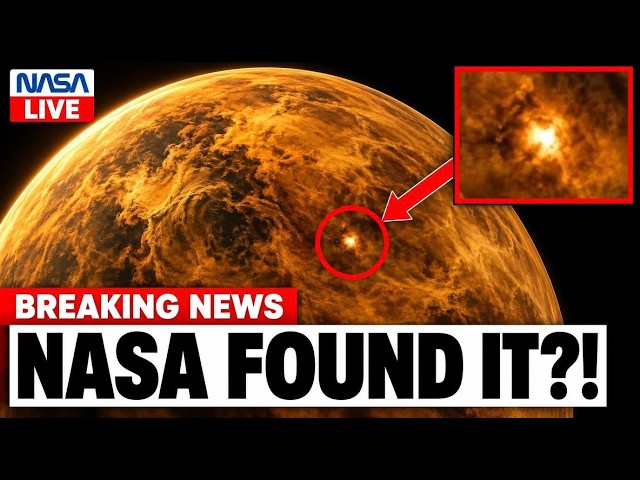
Scientists have discovered enormous lakes of liquid hydrocarbons, complex organic molecules, unusual weather patterns, and compelling evidence suggesting that a vast ocean of liquid water may exist beneath Titan’s frozen surface. But a sensational image circulating online has taken the mystery even further, highlighting a strange glowing object apparently emerging from the moon’s surface. Could NASA have discovered something extraordinary on Titan—or is the real scientific explanation even more fascinating?
Titan is unlike any other moon scientists have explored. Larger than the planet Mercury, it possesses a dense atmosphere composed primarily of nitrogen, with methane playing a major role in its climate. Temperatures at the surface hover around minus 179 degrees Celsius, cold enough for methane and ethane to exist as liquids.
NASA’s Cassini spacecraft and the European Space Agency’s Huygens probe transformed our understanding of this distant world. In January 2005, Huygens descended through Titan’s thick atmosphere and successfully landed on its surface, revealing a landscape shaped by flowing liquids, rounded icy pebbles, and geological processes resembling those found on Earth.
Cassini later discovered enormous methane-rich lakes and seas, including Kraken Mare, one of Titan’s largest known liquid bodies. Radar observations also revealed dunes, river channels, and complex surface formations.
These discoveries demonstrated that Titan possesses an active weather cycle involving evaporation, cloud formation, precipitation, and surface runoff. However, unlike Earth’s water cycle, Titan’s surface weather is driven primarily by liquid methane.
One of the most intriguing mysteries involves Titan’s complex organic chemistry. Sunlight and energetic particles interact with atmospheric methane and nitrogen, producing increasingly complicated carbon-containing molecules.
These compounds eventually descend toward the surface, potentially creating environments where unusual chemical reactions can occur over immense periods.
Scientists are particularly interested in whether Titan could support unfamiliar forms of chemistry associated with life. Although there is currently no confirmed evidence of living organisms on Titan, its combination of organic materials, liquid hydrocarbons, and possible subsurface water makes it an important destination for astrobiological research.
Another remarkable discovery concerns Titan’s internal structure. Measurements from Cassini provided evidence consistent with a global liquid-water ocean beneath the icy crust, although scientists continue investigating its exact properties and potential habitability.
The possibility of liquid water hidden beneath such an extremely cold surface raises fascinating questions about how common potentially habitable environments might be throughout the outer Solar System.
NASA’s upcoming Dragonfly mission is designed to investigate these mysteries directly. The nuclear-powered rotorcraft will travel between locations on Titan, studying surface materials, atmospheric conditions, and complex organic chemistry.
Unlike conventional planetary landers, Dragonfly will be capable of flying through Titan’s dense atmosphere, allowing researchers to explore multiple geological environments during a single mission.
But what about the mysterious glowing feature shown in the accompanying thumbnail?
The dramatic orange world and bright circular anomaly should not be interpreted as an authenticated NASA photograph of an artificial object on Titan. Titan’s dense atmospheric haze prevents ordinary cameras from obtaining the kind of unobstructed, highly detailed global surface view depicted in the image. Scientists rely on radar, infrared observations, and spacecraft measurements to investigate its hidden terrain.
There is no verified evidence that NASA has discovered an alien spacecraft, mysterious energy source, or artificial structure beneath Titan’s atmosphere.
Nevertheless, the moon’s authentic discoveries are extraordinary enough to challenge our understanding of planetary science.
Titan may not contain the glowing alien mystery suggested by sensational images, but beneath its orange skies lies a world of methane seas, complex organic chemistry, and possibly a hidden ocean—making it one of the most compelling places in the Solar System to investigate whether life could exist beyond Earth.