James Webb and Vera Rubin JUST CONFIRMED THE SAME TERRIFYING Object! And It’s AMAZING!
A mysterious object traveling through the darkness of space has sparked extraordinary excitement among astronomy enthusiasts, raising a fascinating question: what would happen if two of the world’s most powerful observatories detected the same unusual visitor from beyond our Solar System? NASA’s James Webb Space Telescope and the Vera C. Rubin Observatory represent two revolutionary approaches to exploring the universe, and their combined capabilities could transform how scientists investigate rare celestial objects. While sensational headlines suggest both observatories have confirmed a terrifying, previously unknown object, there is currently no verified announcement establishing that they have jointly discovered the strange, glowing structure depicted in the accompanying image.
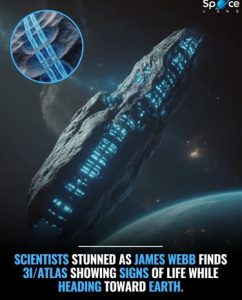
One particularly fascinating target for modern astronomy is 3I/ATLAS, the third confirmed interstellar object discovered passing through our Solar System. First identified in July 2025 by the ATLAS survey, the comet immediately attracted worldwide attention because its unusual trajectory revealed that it originated beyond the gravitational influence of the Sun.
Unlike ordinary comets that remain bound to our star, 3I/ATLAS is traveling along a hyperbolic path, meaning it entered our planetary neighborhood from interstellar space and will eventually depart permanently.
Scientists are especially interested in the object’s chemical composition. Observations with the James Webb Space Telescope have revealed a coma containing an unusually high proportion of carbon dioxide relative to water, suggesting that the comet may have formed under conditions different from those experienced by many familiar Solar System comets.
These measurements provide valuable clues about the distant planetary system where the object originated.
The Vera C. Rubin Observatory, meanwhile, is designed to survey enormous regions of the sky repeatedly, detecting moving objects, variable stars, exploding supernovae, and other changing astronomical phenomena.
Its powerful camera and wide field of view make it particularly valuable for discovering previously unknown asteroids and comets. By repeatedly photographing the sky, Rubin can identify faint objects whose positions change over time.
The two observatories are scientifically complementary. Rubin can discover and track unusual objects across large areas of the sky, while Webb can investigate selected targets in extraordinary infrared detail.
Together, observations from facilities with these different capabilities could help astronomers determine an interstellar object’s trajectory, brightness, chemical composition, and physical characteristics.
However, identifying the same astronomical target with two observatories would not automatically mean scientists had discovered something dangerous or artificial.
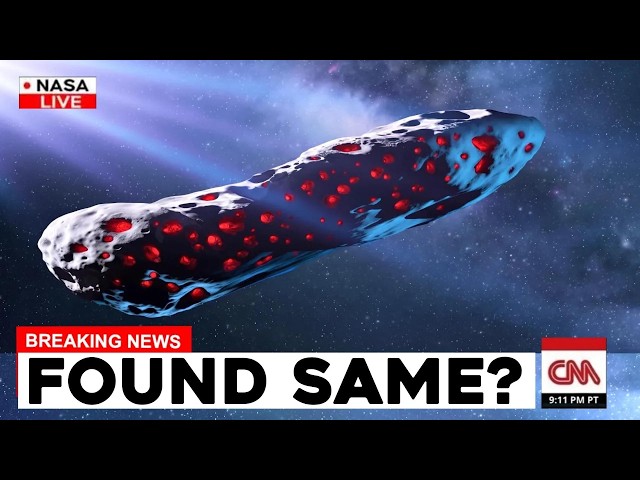
The spectacular object shown in the thumbnail resembles an enormous elongated body covered with glowing red cavities. Although visually striking, there is no authenticated Webb or Rubin observation demonstrating that such a structure exists. The image should be understood as an artistic visualization rather than an actual scientific photograph.
Natural asteroids and comets can possess irregular shapes, fractured surfaces, unusual colors, and complex structures created by collisions, radiation, and billions of years of exposure to space.
Some can also appear unexpectedly bright when sunlight heats volatile materials, releasing clouds of gas and dust.
The real scientific opportunity lies in comparing observations from different instruments. When astronomers combine optical measurements, infrared spectroscopy, and precise orbital calculations, they can build a much more complete understanding of an object than any single telescope could provide.
Future discoveries could be even more remarkable. Rubin’s repeated sky surveys may identify additional interstellar visitors, potentially giving scientists enough advance warning to coordinate detailed observations with Webb and other spacecraft.
Such discoveries could reveal whether material from distant planetary systems resembles the comets and asteroids found around our own Sun—or whether the galaxy contains entirely different populations of small celestial bodies.
James Webb and Vera Rubin have not confirmed the terrifying object portrayed in the image. But their ability to investigate the universe in complementary ways points toward something genuinely extraordinary: humanity is entering an era when mysterious visitors from other star systems may no longer pass through our Solar System unnoticed.