James Webb Telescope Finally Captured a Real Image of Another World — And It’s Stunning
NASA’s James Webb Space Telescope has opened an extraordinary new chapter in humanity’s search for worlds beyond our Solar System, capturing remarkable images of distant planets that were once almost impossible to observe directly. For decades, astronomers could detect exoplanets mainly through indirect clues, such as the tiny dimming of a star when a planet passed in front of it or the subtle gravitational wobble caused by an orbiting world.

But Webb’s advanced infrared instruments are now allowing scientists to observe some planets themselves, revealing details about their temperatures, atmospheres, and formation histories. The achievement has generated enormous excitement, particularly as researchers continue investigating whether distant planetary systems might contain environments suitable for life. However, despite sensational headlines suggesting scientists have finally photographed an inhabited alien world, no James Webb image has confirmed the existence of extraterrestrial life or revealed cities, oceans, or civilizations on a distant planet.
One of Webb’s most significant achievements came when it captured direct images of HIP 65426 b, a massive gas giant located approximately 385 light-years from Earth. The planet is several times more massive than Jupiter and orbits far from its host star. Webb used specialized instruments called coronagraphs to suppress the overwhelming brightness of the star, allowing the much fainter infrared light from the planet to become visible. This technique represents a major breakthrough because stars can be millions or even billions of times brighter than the planets surrounding them.
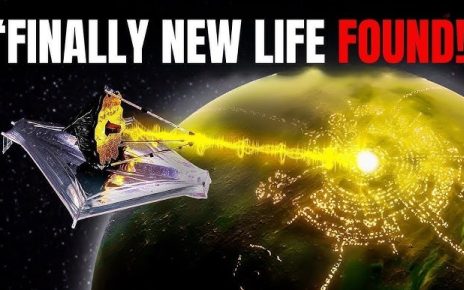
Unlike the spectacular Earth-like world shown in the accompanying thumbnail, actual direct images of exoplanets generally appear as small points of light rather than detailed planetary surfaces. Nevertheless, those tiny points contain valuable scientific information. By examining infrared radiation, astronomers can estimate a planet’s temperature, investigate its atmosphere, and study how its properties compare with theoretical models.
Webb has also directly imaged Epsilon Indi Ab, a cold gas giant orbiting a nearby star approximately 12 light-years away. Its observations demonstrated the telescope’s ability to investigate relatively cool giant planets, helping scientists understand planetary systems that may resemble aspects of our own.
Perhaps even more exciting is Webb’s work examining the atmospheres of exoplanets. By analyzing starlight passing through planetary atmospheres during transits, scientists can identify chemical signatures associated with molecules such as water vapor, methane, and carbon dioxide.
One particularly fascinating target is K2-18 b, a planet roughly 120 light-years from Earth. Webb observations have detected methane and carbon dioxide in its atmosphere, prompting investigations into whether the planet could possess conditions compatible with liquid water. Researchers have also examined tentative claims involving potentially biologically relevant sulfur-containing molecules, although those interpretations remain disputed and do not establish the presence of life.
The distinction between detecting interesting chemistry and discovering living organisms is crucial. Molecules associated with biological activity on Earth can sometimes form through non-biological processes elsewhere, meaning extraordinary conclusions require multiple independent lines of evidence.
The accompanying image depicts a brilliantly illuminated planet with glowing continents and what appear to be extensive networks of city lights. While visually stunning, this is not an authenticated Webb photograph of an inhabited exoplanet. Current telescopes cannot resolve individual cities or surface landscapes on planets hundreds of light-years away.
Still, Webb’s genuine achievements may be even more important than the dramatic imagery suggests. Humanity has moved from merely discovering that distant planets exist to directly examining some of their physical and chemical characteristics.
Future observatories may eventually become capable of studying smaller, rocky worlds in far greater detail, searching for atmospheric combinations that could provide convincing evidence of biological activity.
James Webb has not photographed an alien civilization, but it has accomplished something that once seemed almost unimaginable: humanity can now capture light from planets orbiting other stars and use it to investigate worlds we may never physically reach. The next great discovery may not be a photograph of alien cities—but a chemical signature revealing that Earth is not the only place where life has emerged.