NASA’s Lucy Discovery “Stopped the World”
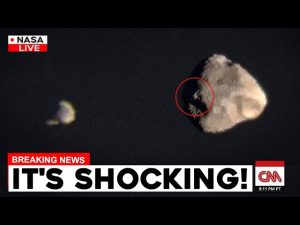
NASA’s Lucy spacecraft has delivered a remarkable new look at Donaldjohanson, an ancient asteroid whose unusual shape is helping scientists reconstruct the violent history of our solar system. Despite the dramatic claims circulating online, the discovery was not made “two minutes ago,” nor did Lucy photograph an alien structure or an approaching threat. The genuine finding is nevertheless extraordinary: images captured during Lucy’s April 20, 2025, flyby revealed Donaldjohanson to be an elongated contact binary—an object apparently formed when two separate bodies came together and remained joined.
Lucy passed approximately 600 miles, or 960 kilometers, from the asteroid, allowing its powerful L’LORRI camera to photograph the surface in unprecedented detail. NASA’s initial analysis indicated that Donaldjohanson is roughly five miles, or eight kilometers, long and about two miles, or 3.5 kilometers, across at its widest point, making it larger and more structurally complex than researchers had expected. The close-up observations show two irregular lobes connected by a narrower region, giving the asteroid a distorted, peanut-like appearance.
Scientists believe Donaldjohanson is a fragment left behind after a larger parent asteroid broke apart about 150 million years ago. Its strange shape, impact craters, boulders and fractured terrain preserve evidence of collisions and gravitational processes that have transformed small objects throughout the solar system. The circled feature highlighted in sensational thumbnail images should not be interpreted as a spacecraft, building or artificial opening. Such thumbnails commonly use digital enhancement, added shadows and exaggerated colors, while Lucy’s scientific photographs are primarily monochrome images requiring careful calibration and comparison. Donaldjohanson lies in the main asteroid belt between Mars and Jupiter and presents no known danger to Earth. The encounter was also an important operational rehearsal for Lucy’s main mission: exploring the Trojan asteroids that travel around the Sun in Jupiter’s orbit. These distant bodies are thought to contain material left over from the era when the planets formed, meaning they could reveal how the giant planets moved and how the solar system acquired its present architecture. Beginning with Eurybates and its small satellite Queta in August 2027, Lucy is scheduled to examine multiple Trojan targets using its cameras, spectrometers and thermal instruments. Donaldjohanson’s surprising form therefore represents more than a visually striking discovery; it demonstrates that even comparatively small asteroids can preserve complicated geological histories.
Lucy did not literally stop the world, but its observations have forced planetary scientists to look again at how rubble, collisions and gravity can assemble entirely new worlds from the remains of older ones—and the mission’s most important discoveries may still be ahead.