CIA Physicist Issues Shocking Warning — “They Are Secretly Living Among Us”

A sensational claim suggesting that non-human beings may already be “living among us” has reignited one of the most controversial debates surrounding UFOs, unidentified anomalous phenomena, and alleged government secrecy.
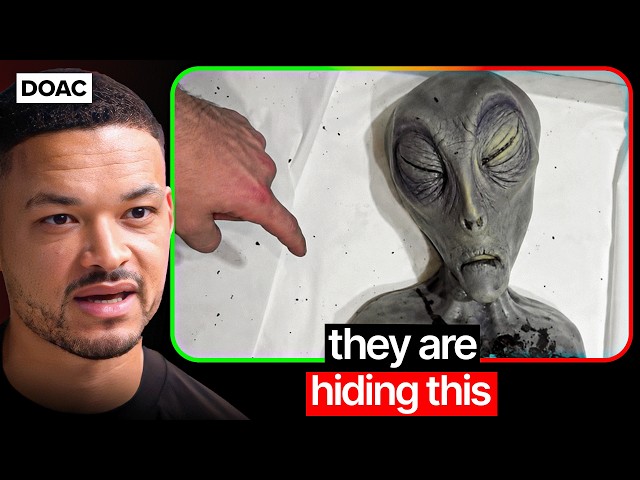
The headline, paired with an unsettling image of an apparently alien body, implies that a physicist connected to the CIA has issued an extraordinary warning about a hidden extraterrestrial presence on Earth.
However, there is currently no publicly verified scientific evidence establishing that extraterrestrial or non-human beings are secretly living among the human population, and the alien figure shown in the accompanying image should not be treated as authenticated evidence. The broader controversy does have roots in real government investigations.
In recent years, U.S. military personnel, intelligence officials, scientists and congressional witnesses have publicly discussed unexplained objects detected by pilots, radar systems and other sensors.
The U.S. government now generally uses the term Unidentified Anomalous Phenomena (UAP) rather than UFO when investigating reports that cannot initially be identified.
Some former officials and contractors have gone significantly further, alleging that secret programs have recovered unusual craft or even biological material of unknown origin. These claims have attracted enormous attention, particularly following congressional hearings, but extraordinary testimony is not equivalent to independently verifiable physical evidence.
NASA has similarly investigated how scientific methods could improve the study of UAP while emphasizing that it has found no conclusive evidence that reported phenomena are extraterrestrial in origin.
NASA’s UAP research The Pentagon’s All-domain Anomaly Resolution Office, or AARO, has also reviewed historical allegations involving secret UFO programs and reported that it found no verifiable evidence that the U.S. government or private companies possessed extraterrestrial technology.
AARO That has not ended the controversy. Critics argue that classified programs make complete public verification difficult, while skeptics counter that decades of extraordinary allegations have still failed to produce publicly available material that independent laboratories can conclusively demonstrate was manufactured by a non-human intelligence.
Scientists also point out that “unidentified” does not automatically mean “alien.” Reports can remain unresolved because observations are incomplete, sensor data are ambiguous, or investigators lack sufficient information to determine whether an object was a balloon, aircraft, satellite, atmospheric phenomenon or something else.
The even more dramatic idea that non-human entities could disguise themselves and live unnoticed among humans would require an entirely different level of evidence. Such a discovery would transform biology, astronomy, history and virtually every field concerned with humanity’s place in nature.
Yet no peer-reviewed biological analysis, independently authenticated specimen or reproducible genetic evidence has demonstrated that this is happening. Images of supposed alien bodies circulating online must therefore be evaluated carefully because photographs alone cannot establish an object’s origin, authenticity or biological nature.
The mystery surrounding UAP remains scientifically interesting precisely because some observations have not yet received definitive explanations. Governments are collecting more standardized data, astronomers continue searching for signs of life beyond Earth, and increasingly powerful instruments are examining potentially habitable worlds around other stars.
But there is an enormous difference between acknowledging unexplained phenomena and concluding that extraterrestrials are secretly walking among us.
For now, the latter remains an extraordinary allegation—not an established scientific fact—and any genuine proof would require transparent evidence capable of surviving independent examination by researchers around the world.