Aliens Didn’t Scare Me Until I Learned This… Joe Rogan
The possibility of extraterrestrial intelligence has fascinated humanity for generations, but a far more unsettling question is increasingly appearing in conversations about UFOs and unidentified anomalous phenomena: what if discovering alien life would be stranger—and potentially more disturbing—than simply finding a spacecraft?
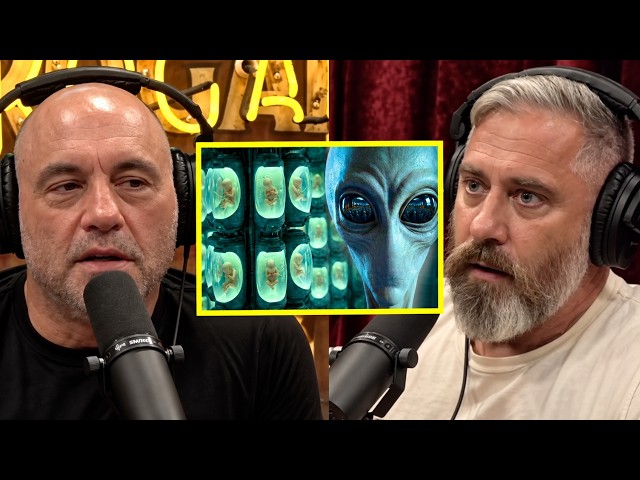
Discussions on major podcasts have helped push once-fringe theories about recovered objects, mysterious biological material and secret government programs into mainstream public debate. The accompanying image, showing an alien-like figure beside rows of apparent biological specimens, captures the most extreme version of those fears.
However, there is currently no independently verified scientific evidence that governments possess extraterrestrial beings, alien embryos, or laboratories containing non-human creatures like those depicted in the thumbnail.
The real story is complicated enough without such imagery. In recent years, military personnel, intelligence officials and former government employees have publicly discussed unexplained objects observed by pilots and sophisticated sensor systems.
Some witnesses have gone much further, alleging that secret programs recovered unusual vehicles and even biological material described as “non-human.” These allegations received enormous attention after being raised in congressional testimony, but publicly available evidence has not established that the alleged material originated from another planet.
The Pentagon’s All-domain Anomaly Resolution Office has investigated historical claims involving hidden UFO programs and says it has found no verifiable evidence that the U.S. government or private companies secretly possessed extraterrestrial technology.
AARO official information NASA has also encouraged serious scientific investigation of UAP while stressing that there is no conclusive evidence demonstrating an extraterrestrial origin.
NASA UAP research Yet the subject becomes particularly fascinating when biology enters the discussion. If scientists ever recovered an organism genuinely originating outside Earth, proving it would require far more than photographs, testimony or classified video.
Researchers would need access to physical samples and would examine their cellular structure, chemistry, isotopic composition and any genetic or genetic-like information.
If the organism used DNA remarkably similar to terrestrial life, scientists would immediately confront profound questions about whether life can naturally spread between worlds. If its biology operated according to an entirely unfamiliar molecular system, the discovery could represent a true second origin of life—one of the most important scientific findings in human history.
There is also a reason scientists remain cautious about frightening interpretations of unexplained phenomena. Human perception is imperfect, military sensors can produce ambiguous data, and images can be manipulated or presented without their original context.
Artificial intelligence has made realistic fabricated imagery even easier to create, meaning disturbing photographs of alleged extraterrestrial specimens cannot be authenticated simply because they look convincing.
The same principle applies to dramatic stories: an unidentified object is not automatically an alien spacecraft, and an unexplained biological sample is not automatically extraterrestrial.
Meanwhile, the scientific search for life continues through far more measurable methods. Astronomers are studying potentially habitable exoplanets, examining planetary atmospheres for unusual chemical signatures and searching the sky for possible technological signals.
Perhaps the most unsettling realization is not that aliens have secretly been proven to exist, but that the universe contains hundreds of billions of stars in our galaxy alone and an enormous number of planets.
We still have no confirmed evidence that another technological civilization has visited Earth—but science has reached a point where discovering life elsewhere is a question researchers can increasingly investigate rather than merely imagine.