NASA Just Revealed a New Image of TON 618—And Something Is Off

A newly circulated image said to depict TON 618, one of the most extreme quasars known to science, has renewed public fascination with a cosmic object so powerful that it challenges our understanding of how supermassive black holes formed in the early universe.
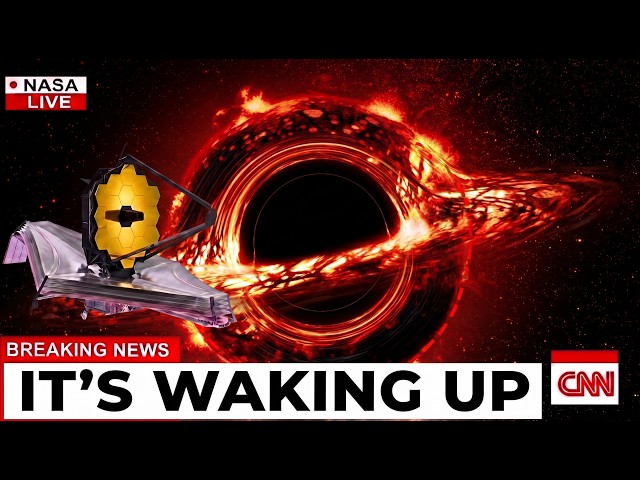
The dramatic picture shows a blazing ring of material surrounding a perfectly dark center, with streams of glowing gas appearing warped by immense gravity.
Yet something is immediately “off” about the image: it is not a conventional photograph of TON 618’s black hole or event horizon.
Located billions of light-years from Earth, TON 618 is far too distant for any current telescope to resolve in such detail.
Astronomers observe it primarily as an extraordinarily bright point of light, while close-up views of its accretion disk are scientific visualizations based on mathematical models and available measurements.
TON 618 is classified as a quasar, an intensely luminous galactic nucleus powered by matter falling toward a supermassive black hole.
As gas and dust spiral inward, friction and magnetic forces heat the material to enormous temperatures, producing radiation bright enough to outshine the quasar’s entire host galaxy.
Estimates suggest that the central black hole contains tens of billions of times the mass of the Sun, although its exact mass depends on how researchers interpret the motion and emission of gas around it.
What continues to trouble scientists is not evidence that the black hole is “waking up,” as the accompanying graphic implies, but how such a massive object could have grown so early in cosmic history.
Black holes require time and a vast supply of material to reach gigantic sizes, yet astronomers see remarkably massive quasars when the universe was only a fraction of its current age.
Possible explanations include unusually heavy black-hole seeds, periods of feeding faster than traditional limits predict, or repeated mergers between young galaxies and their central black holes.
Researchers are also examining changes in quasar brightness and spectral features, which can reveal shifts in the accretion disk or powerful winds moving outward at extraordinary speeds.
Such variations are expected in active galactic nuclei and do not mean that TON 618 has suddenly moved closer, expanded dramatically, or become a threat to Earth.
Because its light has traveled across the universe for billions of years, every observation shows the quasar as it existed in the distant past, not as it is today.
Scientists hope that advanced observatories, including the James Webb Space Telescope and future high-resolution instruments, will help identify the galaxy surrounding TON 618 and clarify how its central black hole accumulated mass so rapidly.
The real mystery, therefore, is more profound than the sensational image suggests: TON 618 may preserve evidence of an early growth process that modern theories have not yet fully captured, offering astronomers a rare opportunity to investigate how the universe created its largest black holes long before such giants should seemingly have had time to exist.