NASA Just Revealed a New Theory About Planet Nine—and It’s Not a Planet
The mysterious gravitational influence attributed to “Planet Nine” may not come from a planet at all, according to a provocative alternative theory that proposes an invisible primordial black hole could be hiding in the outer solar system. Planet Nine was originally suggested to explain why several extremely distant objects beyond Neptune appear to follow unusually clustered and elongated orbits.
The standard model predicts a cold world five to ten times more massive than Earth, traveling along a vast path that may require between 10,000 and 20,000 years to complete. NASA emphasizes that this object remains hypothetical: astronomers have observed possible gravitational footprints, but no telescope has directly detected the proposed planet.
The black-hole alternative begins with the idea that tiny black holes may have formed from exceptionally dense regions of matter shortly after the Big Bang. Unlike stellar black holes created by collapsing stars, a primordial black hole could possess several Earth masses while having an event horizon only about the size of a grapefruit. Such an object would emit no visible light and would be extraordinarily difficult to photograph, yet its gravity could rearrange the orbits of icy bodies in much the same way as a distant planet.
NASA notes that primordial black holes remain theoretical and that no definitive proof of their existence has been found. Some models also suggest they could account for a portion of the universe’s unexplained dark matter. If one wandered through the Sun’s birth environment billions of years ago, it might theoretically have been captured into a remote orbit. Researchers would then search for it indirectly through gravitational microlensing—the temporary brightening or distortion of a background star when an invisible massive object passes in front of it—or through flashes produced as surrounding comets and asteroids fall toward it.
NASA’s upcoming Nancy Grace Roman Space Telescope is expected to use microlensing to investigate compact dark objects, including possible primordial black holes elsewhere in the galaxy.
However, scientists caution that the black-hole explanation is not a NASA confirmation and currently has no stronger direct evidence than Planet Nine itself. The orbital clustering may weaken as additional trans-Neptunian objects are discovered, and some researchers argue that observational bias could create an artificial pattern because surveys do not examine every part of the sky equally. Other possibilities include the collective gravity of many smaller bodies or an undiscovered rogue planet captured by the Sun.
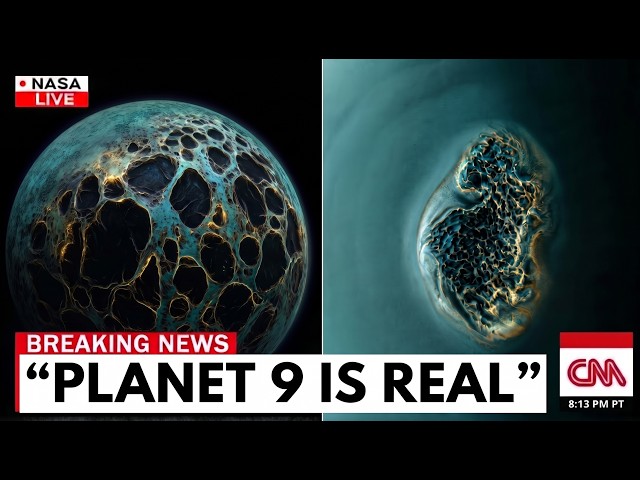
A dark, glowing or mechanically detailed object shown in accompanying thumbnails is therefore an illustration, not a verified image. Whatever causes the unusual orbits poses no known threat to Earth; if a distant massive object exists, it would remain hundreds of astronomical units away. The real importance of the theory is that it broadens the search beyond reflected sunlight.
Planet Nine could be an extraordinarily faint planet, a more exotic compact object or simply a pattern produced by incomplete data. Until astronomers detect the source directly, the outer solar system will continue to conceal one of modern astronomy’s most intriguing mysteries.