NASA’s New Telescope Could Change Everything We Know About the Universe
NASA’s newly launched Nancy Grace Roman Space Telescope is beginning a mission that could transform humanity’s understanding of dark energy, dark matter, distant galaxies, and planets beyond the solar system. Launched on August 30, 2026, Roman combines the sharp infrared vision associated with the Hubble Space Telescope with a field of view at least 100 times larger, allowing it to survey enormous regions of the sky without sacrificing detail.
In a single observation, Roman can capture an area that would require hundreds of individual Hubble images to cover, and during its operational lifetime it could measure light from as many as a billion galaxies. This extraordinary reach will allow researchers to construct a three-dimensional map of the universe across cosmic time and investigate one of modern physics’ greatest mysteries: why the expansion of the universe is accelerating. Scientists use the term “dark energy” for the unknown phenomenon thought to drive that acceleration, but its true nature remains uncertain.
By measuring the distances and distribution of galaxies, observing supernovae, and studying the way matter bends light through gravitational lensing, Roman will test whether dark energy is constant, changes over time, or indicates that the theory of gravity needs to be revised on cosmic scales. The telescope will also map dark matter, an invisible substance detected through its gravitational influence on stars and galaxies.
Although dark matter does not emit or reflect light, Roman can trace its location by measuring the subtle distortion it produces in images of more distant galaxies. Beyond cosmology, Roman is expected to conduct an unprecedented census of planetary systems in the Milky Way. Using gravitational microlensing—the temporary brightening caused when a foreground star or planet passes in front of a more distant star—it could discover thousands of exoplanets, including worlds orbiting far from their stars and planets wandering through the galaxy without any host star at all.
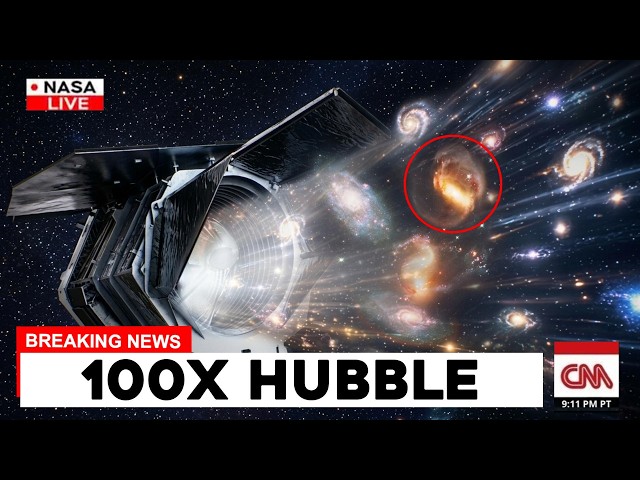
Roman also carries a technology-demonstration coronagraph designed to suppress starlight and reveal faint planets and planet-forming disks nearby. This instrument will test technologies needed for future missions that may one day directly image Earth-like worlds. Despite the dramatic “100X HUBBLE” wording in the accompanying thumbnail, Roman is not simply 100 times more powerful than Hubble in every respect.
The comparison refers primarily to its much wider field of view; Hubble, Webb, and Roman have different instruments and complementary scientific roles. The illustrated galaxies streaming toward the telescope are also a promotional visualization rather than a real photograph taken by Roman.
Engineers must first complete an extensive commissioning process, activating instruments, aligning systems, and confirming that the observatory can deliver precise measurements before full science operations begin. If those checks proceed as planned, Roman will repeatedly survey broad areas of the sky, making its data available to scientists around the world. Its greatest discoveries may be objects nobody designed the mission to find: unusual stellar explosions, hidden galaxies, rogue planets, or evidence that current cosmological models are incomplete.
Roman may not replace Hubble or Webb, but its combination of depth, clarity, and enormous coverage could reveal the universe as a connected, changing system—and potentially force scientists to rewrite some of their most fundamental ideas. NASA’s Roman mission page provides the observatory’s current status and scientific objectives.