NASA Found Something Strange on Saturn’s Moon Titan
Scientists investigating Saturn’s largest moon, Titan, are taking a closer look at one of the strangest phenomena ever observed beyond Earth: mysterious bright features that appear and disappear across the surfaces of its hydrocarbon seas. Nicknamed “magic islands,” these objects were first noticed in radar images captured by NASA’s Cassini spacecraft, which repeatedly flew past Titan before its mission ended in 2017. In some observations, bright patches suddenly emerged within dark bodies of liquid, only to change shape or vanish during later flybys.
Titan is the only known world besides Earth with stable seas, lakes, rivers, clouds, and rainfall at its surface, but its weather cycle is driven by liquid methane and ethane rather than water. At approximately minus 179 degrees Celsius, water ice on Titan behaves like solid rock, while hydrocarbons flow through channels and collect in vast polar basins.
Researchers have proposed several explanations for the temporary radar features, including waves, bubbles of nitrogen gas, floating ice, and clusters of lightweight organic material falling from the atmosphere. One recent model suggests that porous chunks of frozen organic compounds could float for a time if methane becomes trapped inside their cavities, creating bright radar reflections before the material absorbs enough liquid to sink.
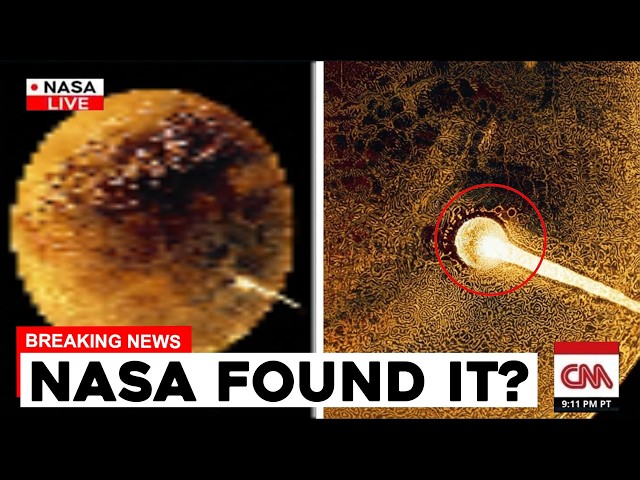
That process would make the “islands” appear unexpectedly and then disappear without leaving a permanent trace. Although dramatic images online may suggest that NASA has discovered a glowing object, spacecraft, or biological entity on Titan, no such claim has been confirmed. The accompanying thumbnail is an artistic and heavily edited presentation, and its question—“NASA FOUND IT?”—is not evidence of an official announcement.
The actual discovery is compelling because Titan’s surface and atmosphere operate as a complex chemical laboratory. Sunlight and energetic particles break apart nitrogen and methane high in the atmosphere, allowing them to recombine into increasingly complicated carbon-based molecules. These substances form Titan’s orange haze and eventually settle onto its dunes, plains, and seas. Beneath the moon’s frozen exterior, gravity measurements and interior models also indicate the possible presence of a global ocean of salty liquid water. Scientists have not found life on Titan, and its extreme cold makes Earth-like surface biology unlikely, but the combination of organic chemistry, liquid reservoirs, and a possible subsurface ocean makes it one of the solar system’s most important destinations in the search for habitable environments.
NASA’s Dragonfly mission is designed to explore that potential by sending a nuclear-powered rotorcraft to Titan, where it will travel between locations and analyze surface materials. Rather than landing in the northern seas, Dragonfly is expected to investigate equatorial dunes and the impact region around Selk crater, searching for clues about how far Titan’s prebiotic chemistry has progressed.
The mission could help determine whether ingredients associated with life have mixed with liquid water during past impact events. Titan’s mystery, therefore, is not a hidden monster or artificial signal—it is a natural world where weather, geology, and organic chemistry interact in ways found nowhere else we have explored. More details are available in NASA’s overview of Titan.