The World’s Most Powerful Telescope Just Turned On — And It Already Found Something Nobody Expected

One of the most powerful astronomical survey instruments ever constructed has opened its enormous eye on the southern sky, and its earliest observations have already demonstrated a discovery rate that surprised even the scientists who designed it. The Vera C. Rubin Observatory, positioned on Cerro Pachón in Chile, uses the 8.4-meter Simonyi Survey Telescope and the world’s largest digital camera built for astronomy—a 3.2-gigapixel instrument capable of photographing an area approximately 45 times larger than the full Moon in a single exposure. During just over ten hours of early observations, Rubin detected 2,104 previously unknown asteroids, including several near-Earth objects, although researchers reported that none presented a known impact threat.
Under ordinary circumstances, discovering that many objects could have required months or years of observations; Rubin accomplished it before beginning its full ten-year Legacy Survey of Space and Time. Another early image, nicknamed the “Cosmic Treasure Chest,” revealed around 10 million galaxies in a relatively small section of the sky. That staggering number still represents only a tiny fraction of the approximately 20 billion galaxies the observatory is expected to catalog.
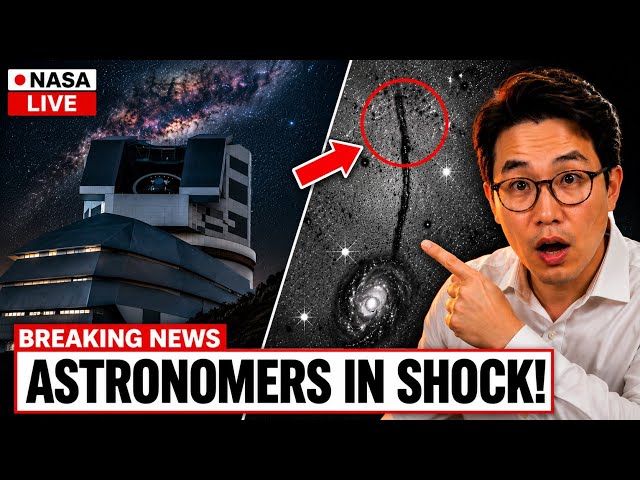
The accompanying thumbnail circles several dark streaks and declares that astronomers are “in shock,” language clearly visible in the promotional image. Such streaks are not evidence of alien spacecraft or gigantic unidentified objects. Similar marks in astronomical images can be produced by satellites, detector artifacts, foreground dust, image-processing effects or moving objects recorded during an exposure; their origin cannot be established from a heavily edited thumbnail alone. The telescope is also not operated by NASA. Rubin is jointly funded by the U.S. National Science Foundation and the Department of Energy’s Office of Science, although NASA missions and astronomers worldwide can benefit from its discoveries.
What scientists did not fully anticipate was how quickly the observatory’s combination of sensitivity, wide field of view and rapid imaging would turn the night sky into a continuously updated motion picture. Rather than observing one narrow target for long periods, Rubin will repeatedly scan the visible southern sky, comparing new exposures with previous ones and issuing alerts whenever something appears, disappears, changes brightness or moves.
At full capacity, the system is expected to generate millions of alerts per night, flagging supernovae, variable stars, active galaxies, distant icy bodies and potentially hazardous asteroids for immediate follow-up. Its enormous galaxy maps will also help researchers trace the distribution of dark matter through gravitational lensing and investigate dark energy by measuring how cosmic structures and stellar explosions have changed over time.
The most important discovery may therefore not be one mysterious feature in a photograph, but an entire population of brief and unpredictable events that older telescopes were never fast or wide-ranging enough to catch. Rubin has not uncovered an alien structure, and no official announcement supports that interpretation. Yet its early performance has confirmed something arguably more profound: the supposedly familiar sky is filled with hidden movement, and humanity has only just switched on an instrument capable of watching it unfold.